Henry V: Act 2, Scene 1 – Analysis
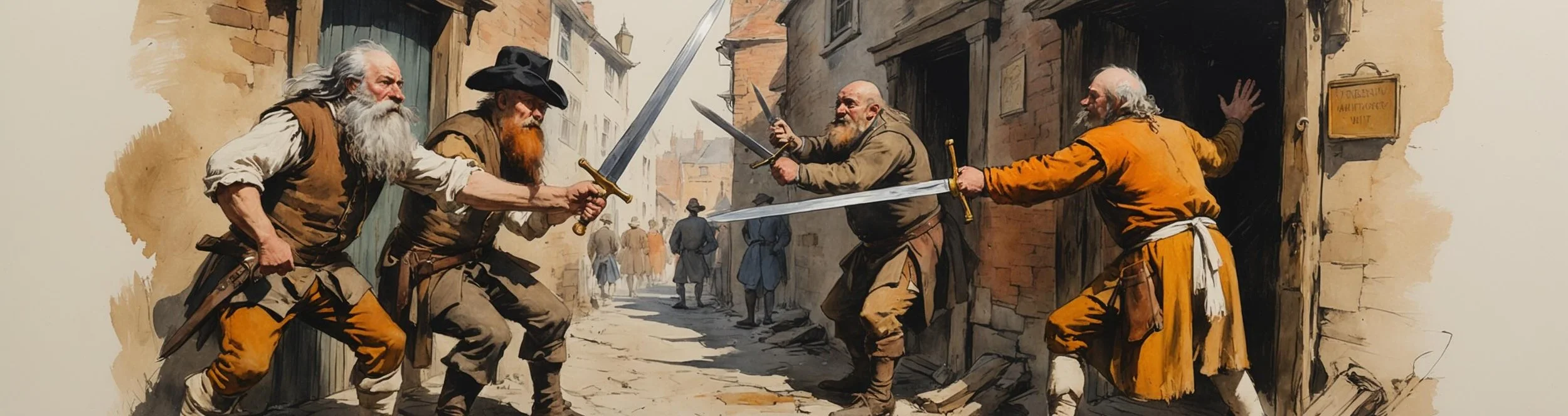
Scene Profile – At a Glance
- Location: A London street, near the Boar’s Head in Eastcheap.
- What Happens: Nym and Pistol square up over Nell Quickly – who was engaged to Nym and married Pistol – in a duel of drawn swords and undrawn courage. Bardolph brokers peace, the Boy brings word that Falstaff is gravely ill, and the Hostess delivers the play’s quietest bombshell: “The king has killed his heart.”
- Key Characters: Pistol, Nym, Bardolph, the Hostess (Nell Quickly) and the Boy.
- Dramatic Function: Eastcheap’s first appearance in the play – the low-plot answer to the Chorus’s blazing patriotism, and the scene that files the charge against the King which the whole play must answer.
- Famous Quote:
"By my troth, he'll yield the crow a pudding one of these days. The king has killed his heart. Good husband, come home presently."
(the Hostess, Act 2, Scene 1) - Why It Matters: Between the Chorus’s “youth of England on fire” and the reality – two cowards duelling over a widow’s hand and eight shillings – the play measures its own myth. And the Hostess’s verdict on Falstaff’s illness hangs over Henry to the last scene.
Scene Summary
Bardolph meets Nym and probes the sore point: is he friends yet with Pistol? Nym’s answers are all iceberg – he says little, but “when time shall serve, there shall be smiles”; he dare not fight, “but I will wink and hold out mine iron”. The grievance: Nym was “troth-plight” – engaged – to Nell Quickly, and she has married Pistol.
Pistol and his new wife arrive, and the war begins at the word “host”: Pistol scorns the term, Nym invites him to “shog off” and be “solus”, and Pistol detonates – the “solus” in thy most mervailous face, thy teeth, thy throat, thy lungs, “and, which is worse, within thy nasty mouth!” Swords are drawn twice and used never; Bardolph’s own drawn sword – he will run the first striker “up to the hilts” – enforces the peace both duellists were privately praying for. The quarrel settles into its true currency: the eight shillings Nym won of Pistol at betting, compounded at “a noble” (six and eightpence) plus liquor – and a business plan: Pistol will be sutler to the camp, “and profits will accrue”. Friendship, brotherhood, and a discount: Eastcheap’s treaty of Southampton.
Twice the Boy and the Hostess interrupt with the real news: Sir John Falstaff is very sick – shaking with “a burning quotidian tertian” – and the Hostess names the disease: “The king has killed his heart.” Nym’s epitaph for the reign is Eastcheap’s political philosophy entire: “The king is a good king: but it must be as it may; he passes some humours and careers.” They go in to condole the knight – “for, lambkins, we will live.”
The Duel of Words
The play’s first Eastcheap quarrel is fought entirely in vocabulary – which is the joke, and the point.
Original
'Solus,' egregious dog? O viper vile!
The 'solus' in thy most mervailous face;
The 'solus' in thy teeth, and in thy throat,
And in thy hateful lungs, yea, in thy maw, perdy...
(Pistol, Act 2, Scene 1)
Shakespeare Retold (Modern Verse)
‘Solo’, disgusting dog? Oh, vulgar snake!
I’ll shove your ‘solo’ in your fancy face;
The ‘solo’ in your teeth, and in your throat,
And in your hate-filled lungs and stomach, damn you...
Nym’s plain English word “solus” – alone – becomes, in Pistol’s mouth, an exotic missile to be retorted into face, teeth, throat, lungs and bowels: rage performed as anatomy lesson. The comedy is that neither man wants the fight their language promises – Nym “dare not fight” and says so; Pistol’s sword, as the Boy will later testify, is the quietest thing about him – so the duel happens at the level of style: Pistol’s rented theatrical thunder against Nym’s laconic menace, “and that’s the humour of it”. Placed directly after the Chorus’s Mercuries with winged heels, the scene is the play’s first structural joke: this, too, is the youth of England on fire – over a widow, a word, and eight shillings.
The Treaty of Eastcheap
The quarrel’s resolution is a settlement – cash, liquor and commerce – and a small parody of everything the great plot is about to do.
Original
A noble shalt thou have, and present pay;
And liquor likewise will I give to thee,
And friendship shall combine, and brotherhood:
I'll live by Nym, and Nym shall live by me;
Is not this just? For I shall sutler be
Unto the camp, and profits will accrue.
(Pistol, Act 2, Scene 1)
Shakespeare Retold (Modern Verse)
Right now I’ll give a gold coin worth just less;
Then I’ll buy you a drink to pay the difference,
And we’ll be friends again and stand as brothers.
I’ll live for Nym, and Nym will live for me;
Is that not fair? For I will be a trader
In camp and I will make a lot of profit.
The disputed woman stays with her possessor; the injured party is bought off – “a noble… and present pay”, drink thrown in; and the peace is sealed not by justice but by a business opportunity: Pistol will be a sutler – a camp victualler – “and profits will accrue”. Read against the main plot, the parallel is impudent and exact: a quarrel with a woman at its centre, settled by payment and partnership, because war makes the quarrellers more useful to each other as partners – France and England’s whole arc, rehearsed over eight shillings. The war, for Eastcheap, is neither cause nor crusade but a market – “sworn brothers to France”, as Bardolph says, in filching – and the play never pretends otherwise about them, which is precisely what makes their honesty a commentary on the scenes above.
The King Has Killed His Heart
Twice the scene’s farce is interrupted by news from upstairs – and the second interruption carries the play’s heaviest sentence.
Original
By my troth, he'll yield the crow a pudding one of these days. The king has killed his heart. Good husband, come home presently.
(the Hostess, Act 2, Scene 1)
Shakespeare Retold (Modern Verse)
I tell you, he’ll die and make food for crows one of these days. The king broke his heart. Dear husband, come home soon.
Falstaff is dying – shaking with fever, fit to “yield the crow a pudding” – and the Hostess’s diagnosis is delivered without rancour, as settled fact: “The king has killed his heart.” Five words, from the person nursing him, naming the rejection at the coronation as the mortal wound. What follows is just as remarkable: no one disputes it, and no one rebels over it. Nym’s response – the king “hath run bad humours on the knight”… but “the king is a good king” – holds both truths without strain: the wrong is real, the loyalty survives it, “it must be as it may”. That shrug is Eastcheap’s whole politics, and it frames the play’s hardest question about its hero before he has spoken a word in France: the perfect king’s first casualty predates the war.
Language and Technique
- Idiolect as character: Nym’s “that’s the humour of it”, Pistol’s blank-verse bombast, the Hostess’s malapropisms (“quotidian tertian”) – every Eastcheap voice is a verbal signature, comedy built from style itself.
- Mock-heroic register: Pistol conducts a tavern spat in the vocabulary of stage tragedy – “O hound of Crete”, Barbason, the powdering tub – epic dress on an eight-shilling quarrel.
- The undrawn duel: Swords out twice, blood never – the scene’s action is all threat-display, a physical running gag about the gap between word and deed.
- Bathos by interruption: The Boy’s sickroom bulletins puncture the duel at its most inflated moments – death entering a farce by the side door, twice.
- Five plain words: “The king has killed his heart” – the scene’s one unadorned sentence, and its most quoted: prose doing what all Pistol’s thunder cannot.
Key Quotes from Act 2, Scene 1
Quote 1
Original
For my part, I care not: I say little; but when time shall serve, there shall be smiles; but that shall be as it may.
(Nym, Act 2, Scene 1)
Shakespeare Retold (Modern Verse)
For my part, I don’t care; I do not say much. But when the time is right, we’ll smile at each other; but that will be as it will be.
Quote Analysis: Nym’s credo, and the birth of a comic style: he cares not, says little, and promises “smiles” when time shall serve – menace by ellipsis, every threat trailing off into “but that shall be as it may”. The manner parodies the strong silent soldier (he has “heard that men of few words are the best men”, the Boy explains later), and the play prices it precisely: Nym’s few bad words are matched with as few good deeds. Beside Pistol’s eruptions, he is the same cowardice in the opposite costume.
Original
O hound of Crete, think'st thou my spouse to get?
No; to the spital go,
And from the powdering tub of infamy
Fetch forth the lazar kite of Cressid's kind...
(Pistol, Act 2, Scene 1)
Shakespeare Retold (Modern Verse)
You Cretan dog, you think you’ll pinch my wife?
Oh no you won’t; go to the poor man’s sickhouse,
And where they treat venereal disease,
Bring out the leper whore, like Cressida...
Quote Analysis: Pistol defending his marriage in full theatrical armour: Nym is a “hound of Crete” hunting another man’s spouse, and may take himself to the spital – the hospital – and the “powdering tub of infamy” (the treatment-vat for venereal disease) to marry “the lazar kite of Cressid’s kind”, Doll Tearsheet. The abuse is magnificent and revealing: Pistol’s grand style is built from old plays – Cressida, Crete, tragedy’s furniture – rented eloquence for a man whose whole identity is quotation. The Boy’s “empty vessel” verdict is already audible.
Original
The king is a good king: but it must be as it may; he passes some humours and careers.
(Nym, Act 2, Scene 1)
Shakespeare Retold (Modern Verse)
The king is a good king, but we have to accept some things: he has his moods and certain ways about him.
Quote Analysis: Eastcheap’s constitutional settlement in two lines: the king is a good king – and he has wronged their dying friend – and “it must be as it may”. Nym’s catchphrase fatalism here rises almost to statesmanship: no rebellion, no forgiveness either, just the subject’s durable shrug at power’s “humours and careers”. It is the closest the play’s underclass comes to a political philosophy, and it will be tested to destruction – by a hanging, a cudgelling, and a war that kills nearly all of them.
Key Takeaways
- The fire is farce: One scene after “all the youth of England are on fire”, England’s actual youth duel bloodlessly over a widow and eight shillings – the Chorus audited immediately.
- The quarrel parodies the war: A woman, an injury, a cash settlement and a profitable partnership – the main plot’s whole arc, rehearsed in Eastcheap miniature.
- The charge is filed: “The king has killed his heart” – the play’s indictment of its hero, entered by a landlady before Henry ever embarks.
- Loyalty survives the wrong: Nym’s “good king” shrug – grievance and allegiance held together – is the common subject’s politics the night-scene at Agincourt will articulate in earnest.
Study Questions and Analysis
What is the quarrel between Nym and Pistol actually about?
A marriage – and the money that stands in for the wound. Bardolph states the case with lawyerly precision:
Original
It is certain, corporal, that he is married to Nell Quickly: and certainly she did you wrong; for you were troth-plight to her.
(Bardolph, Act 2, Scene 1)
Shakespeare Retold (Modern Verse)
It is a fact, corporal, that he is married to Nell Quickly; and she certainly did wrong by you, for you were engaged to her.
Nell Quickly, hostess of the Boar’s Head, was “troth-plight” – formally betrothed, a binding contract in the period – to Nym, and has married Pistol instead. The injury is real; the response is Eastcheap: swords drawn twice and sheathed twice, abuse traded at operatic volume, and settlement finally reached in the quarrel’s true currency – the eight shillings of an old bet, compounded at a noble with liquor attached. The displacement is the comedy and the insight: neither man will bleed for love, but money is worth a genuine standoff. For essays on the low plot’s function, note the shape: a disputed woman, an affronted claimant, a payment and a partnership – the play in Eastcheap miniature, one scene before the crown stakes England on its own disputed claim.
What is "the humour of it" – and why does Nym keep saying it?
A catchphrase caught from a craze. “Humour” in the period’s new comic fashion – Ben Jonson’s “comedy of humours” was the hit of 1598 – meant a person’s governing disposition, and the word instantly decayed into modish slang for almost anything: mood, whim, style, the way of things. Nym runs the fashion into the ground – the knocks are too hot “and that’s the humour of it”; he will cut a throat “in fair terms: that is the humour of it” – a man of few words who has effectively reduced himself to one.
The tic does three jobs. It is characterisation by economy: where Pistol rents the grand style, Nym rents the fashionable word, and both are disguises for the same empty scabbard. It is period satire the first audience caught at once – Shakespeare ribbing the Jonsonian vogue through its shallowest possible adopter. And it is the play’s running lesson in language as costume, taught at the bottom of the cast: the King wears registers – law, terror, brotherhood, plainness – as instruments; Nym wears one threadbare word as armour. When the Boy audits the swashers in Act 3, his verdict on Nym’s few words “matched with as few good deeds” simply completes what the catchphrase already confessed.
What does this scene tell us about Falstaff – and the King?
That the play’s greatest offstage character is dying, and who is to blame. The Boy’s bulletins bring the sickroom into the farce – Sir John “very sick”, calling for a warming-pan – and the Hostess’s second summons names the fever (“a burning quotidian tertian”, her muddle of two medical terms) and, without raising her voice, the cause: “The king has killed his heart.” Nym seconds the diagnosis in his own idiom:
Original
The king hath run bad humours on the knight; that's the even of it.
(Nym, Act 2, Scene 1)
Shakespeare Retold (Modern Verse)
The king has treated this knight badly; that’s the truth of the matter.
“Run bad humours on the knight” – the rejection at the coronation, “I know thee not, old man”, translated into Eastcheap’s one-word philosophy. A. C. Bradley, in his 1909 essay The Rejection of Falstaff, built the classic case that Shakespeare’s audience is never allowed to feel that rejection as simply right – “our hearts go with Falstaff to the Fleet” – and this scene is the charge-sheet’s first entry in Henry V itself: before the King has spoken a word of the play’s glorious war, a landlady has entered a manslaughter verdict against him, and nobody on stage files a defence. The deathbed scene two scenes later pays the account; every essay on the cost of Henry’s reformation starts from these five words.
How is the quarrel resolved – and what does the resolution parody?
By arbitration, cash and commerce – the full diplomatic toolkit. Bardolph imposes an armistice at swordpoint (the first striker dies “up to the hilts”); the belligerents accept mediation with visible relief; and the final settlement converts every grievance into terms: Nym’s eight shillings become “a noble… and present pay” plus liquor; the marriage stands; and the former rivals become business partners – Pistol as camp sutler, Nym attached to the profits, “friendship shall combine, and brotherhood”.
The parody is structural and, by the play’s end, prophetic. A quarrel rooted in a woman’s disputed hand, inflamed by honour-language, cooled by payment, and concluded in a profitable alliance: that is the France plot’s exact itinerary, down to the marriage that seals the treaty – Katharine, like Nell, going to the possessor while the settlement pays everyone into partnership. Harold C. Goddard, in The Meaning of Shakespeare (1951), read the play’s low scenes as precisely this kind of running commentary – the underplot performing the overplot’s logic with the dignity stripped off, so the audience can see the machinery. Whether the parallel dignifies Eastcheap or deflates the crown is the essay question; the scene, first in the field, supplies the evidence both ways.
Why does Act 2 open in Eastcheap instead of Southampton?
Because the Chorus has just made a promise the play means to test. The Act 2 Prologue blazed with mobilisation – all the youth of England on fire, dalliance in the wardrobe, honour’s thought reigning “in the breast of every man” – and then, in its last lines, awkwardly admitted the scene would go to Southampton only “till the king come forth”. What actually enters is Nym: a corporal who dare not fight, quarrelling over a widow, in a street where honour’s thought reigns nowhere and the only fire is Bardolph’s nose. The juxtaposition is the meaning – the play’s official voice audited by its first available facts.
The scene also does indispensable plot work ahead of the war: it assembles the crew whose France this will also be – thieves and survivors, not Mercuries – and it opens the Falstaff account that the deathbed scene will close, so that the King sails for his epic already carrying Eastcheap’s verdict. And it establishes the play’s double vision as method: for the rest of Henry V, nearly every great official scene will be shadowed by a low one – the breach speech by the swashers, the band of brothers by the casualty list – and this is the pattern’s first beat: the Chorus says England burns; England, inspected, is haggling over eight shillings. Both are true. The play is built from exactly that doubleness.