Macbeth: Act 5, Scene 8 – Analysis
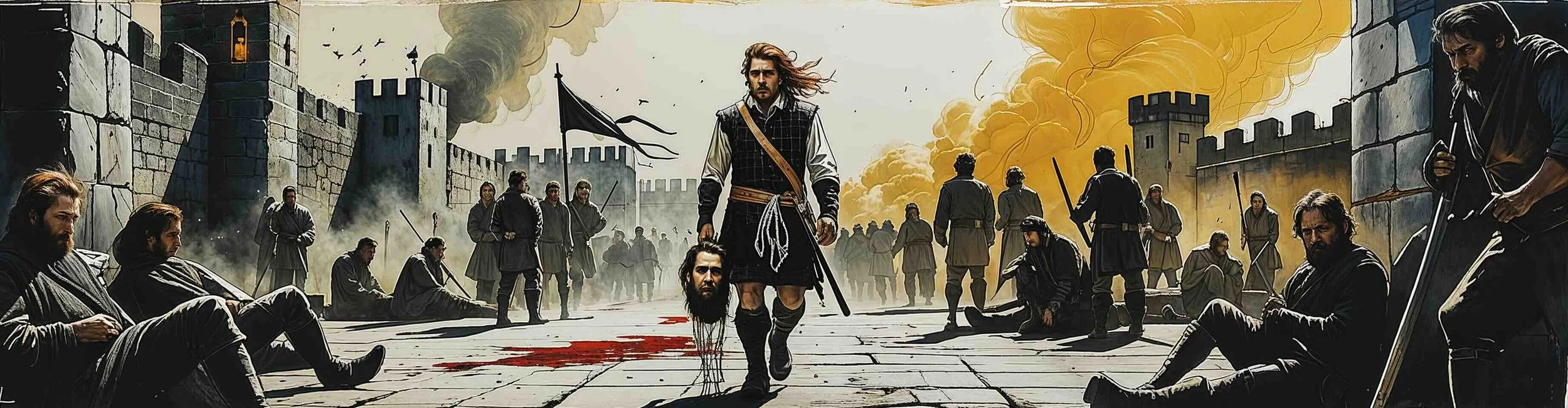
Scene Profile – At a Glance
- Location: Another part of the battlefield before Dunsinane – the play's final scene.
- What Happens: Macduff confronts Macbeth and reveals he was "from his mother's womb untimely ripped". Macbeth, his last prophecy broken, refuses to yield and dies fighting. Macduff brings in his head, and Malcolm is hailed King of Scotland.
- Key Characters: Macbeth, Macduff, Malcolm, Siward, and Ross.
- Dramatic Function: The resolution – the tyrant is killed, order is restored, and Scotland's rightful king is crowned.
- Famous Quote:
"Macduff was from his mother's womb
Untimely ripped."
(Macduff, Act 5, Scene 8) - Why It Matters: The final prophecy springs its trap. The promise Macbeth trusted most becomes the instrument of his death.
Scene Summary
Macbeth refuses to "play the Roman fool" and die on his own sword while enemies still live. Macduff finds him and calls him "hell-hound". Macbeth warns him off, saying his soul is already too burdened with the blood of Macduff's family, but Macduff answers only with his sword. As they fight, Macbeth boasts that he bears "a charmed life" that no man born of woman can take – whereupon Macduff reveals that he was "from his mother's womb untimely ripped".
The revelation breaks Macbeth's courage. He curses the prophecy and the "juggling fiends" who "palter with us in a double sense", keeping their promise to the ear but breaking it to the hope, and at first refuses to fight on. Macduff tells him to yield and be displayed as a captured monster. Rather than be paraded and mocked, Macbeth chooses to fight to the death, and they exit fighting.
Malcolm and Siward enter with the surviving thanes. Ross reports that Young Siward is dead, killed facing his foe; Siward, hearing the wounds were "on the front", grieves with stern pride and asks no fairer death for his son. Then Macduff enters carrying Macbeth's severed head, hails Malcolm as king, and all cry "Hail, King of Scotland!". Malcolm thanks his followers, makes his thanes the first earls Scotland has known, promises to call home the exiled and bring the tyrant's agents to justice, names Macbeth a "dead butcher" and his queen "fiend-like", and invites everyone to see him crowned at Scone.
The Charm Broken
The duel turns on a single revelation. Macbeth, still trusting his last prophecy, taunts Macduff that his life is charmed against any man born of woman – and Macduff answers with the words that undo him.
Original
Tell thee, Macduff was from his mother's womb
Untimely ripped.
(Macduff, Act 5, Scene 8)
Shakespeare Retold (Modern Verse)
Tell you, Macduff was, from his mother's womb,
Ripped prematurely.
Macduff was born by caesarean section – cut from his mother rather than delivered in the ordinary way – and so, in the prophecy's grim logic, he was not "of woman born". The promise Macbeth leaned on hardest is revealed as the cruellest trick of all. It was always true and always a trap, the perfect example of the witches' equivocation: a form of words that comforts the ear while it destroys the hope. The moment it lands, Macbeth understands he is going to die.
The Tyrant's Last Stand
For an instant the revelation unmans Macbeth, and he refuses to fight. But when Macduff offers him surrender – to be caged and displayed like a monster – the old soldier's pride flares one final time.
Original
Yet I will try the last. Before my body
I throw my warlike shield. Lay on, Macduff,
And damned be him that first cries, 'Hold, enough!'
(Macbeth, Act 5, Scene 8)
Shakespeare Retold (Modern Verse)
Yet I'll fight to the death. In front of me
I'll hold my battle shield. Come on, Macduff,
And damned be him who cries out, 'That's enough!'
This is the closest the play comes to redeeming Macbeth, and it is a deliberately ambiguous moment. He knows now that the prophecies were lies and that he cannot win, yet he refuses to be made a spectacle or to kneel at Malcolm's feet. There is courage in the choice – the warrior the play first showed us reasserts himself – but it is courage in the service of nothing, a man choosing to die on his feet because he has destroyed every other reason to live. "Lay on, Macduff" is a cry of defiance and of despair at once.
Order Restored
With the tyrant dead, the play closes on the careful restoration of order. Macduff enters with Macbeth's head and hails the new king, and Malcolm takes up the work of healing the country Macbeth had wrecked.
Original
Hail, king! For so thou art: behold, where stands
The usurper's cursed head: the time is free...
(Macduff, Act 5, Scene 8)
Shakespeare Retold (Modern Verse)
Hail, king! For king you are now. Look what's here,
The tyrant's bloody head. We all are free now...
"The time is free" announces the lifting of tyranny: the nightmare is over and Scotland can breathe again. Malcolm's closing speech is everything Macbeth's reign was not – generous, lawful, and looking outward. He rewards loyalty by creating Scotland's first earls, promises to bring home those the "watchful tyranny" drove into exile, and pledges justice done "by the grace of Grace". His curt epitaph for the dead pair, "this dead butcher and his fiend-like queen", delivers the official, public verdict on a tragedy the audience has watched far more intimately from the inside.
Language and Technique
- Equivocation revealed: "Juggling fiends... that palter with us in a double sense" names the trick of promises true to the ear but false to the hope.
- The opening frame closed: Macbeth, once "Bellona's bridegroom" praised for valour, ends as a "dead butcher", the heroic frame of Act 1 inverted.
- Cyclical structure: A noble Scottish general is again rewarded with new titles, echoing Macbeth's own promotion and suggesting history restarting cleanly.
- Public versus private judgement: Malcolm's "dead butcher and his fiend-like queen" is the world's verdict, set against the inner anguish the audience alone has seen.
- Restoration of order: The crowning at Scone and creation of earls signal the return of legitimate, ceremonious kingship.
Key Quotes from Act 5, Scene 8
Quote 1And be these juggling fiends no more believed,
That palter with us in a double sense...
(Macbeth, Act 5, Scene 8)
Shakespeare Retold (Modern Verse)
And I do not believe those witches now
As they prevaricate with double meanings...
Why then, God's soldier be he!
Had I as many sons as I have hairs,
I would not wish them to a fairer death...
(Siward, Act 5, Scene 8)
Shakespeare Retold (Modern Verse)
Then he is God's own soldier!
If I'd as many sons as I have hairs,
None could I wish more dignity in death.
Producing forth the cruel ministers
Of this dead butcher and his fiend-like queen...
(Malcolm, Act 5, Scene 8)
Shakespeare Retold (Modern Verse)
And seeking justice for the cruel agents
Of this dead butcher and his wretched queen...
So, thanks to all at once and to each one,
Whom we invite to see us crowned at Scone.
(Malcolm, Act 5, Scene 8)
Shakespeare Retold (Modern Verse)
So, thanks to everyone within our nation,
Please come to Scone to see my coronation.
Key Takeaways
- The last prophecy springs: Macduff was "untimely ripped" from his mother, so he is not "of woman born".
- Macbeth dies fighting: Refusing to be paraded or to yield, he chooses a soldier's death.
- Equivocation exposed: Macbeth names the witches "juggling fiends" who keep promises to the ear and break them to the hope.
- Honourable grief: Siward's stern pride in his son's brave death contrasts with Macbeth's numbness.
- Order restored: Malcolm is hailed king, creates Scotland's first earls, and is to be crowned at Scone.
Study Questions and Analysis
How does the prophecy about Macduff complete the witches' deception?
The apparitions in Act 4 told Macbeth that "none of woman born" could harm him, and he took it as a guarantee of safety – everyone, after all, is born of a woman. Here Macduff reveals the catch: he was delivered by caesarean section, "from his mother's womb untimely ripped", and so, by the prophecy's grim wordplay, he does not count as "of woman born".
This completes a pattern that runs through the play. Each prophecy is literally true but misleading: Birnam Wood does "come" to Dunsinane, and a man not "of woman born" does kill Macbeth. The witches deal in equivocation – statements crafted to be heard one way and to come true in another. Macbeth's tragedy is that he trusted the comforting surface of their words and never questioned the trap beneath. A. C. Bradley, in Shakespearean Tragedy (1904), stressed that the witches never compel Macbeth; they tempt and mislead, leaving the fatal choices his own.
Does Macbeth regain any dignity at the end?
The question divides readers, and the scene is written to keep it open. When the last prophecy fails, Macbeth could surrender, but he refuses to be displayed as a caged monster or to kneel before Malcolm. Instead he throws down his shield and chooses to die fighting, with "Lay on, Macduff" as his final challenge.
There is undeniable courage in this. The brave general of Act 1 reappears, and Macbeth meets his end on his feet rather than on his knees. Yet it is courage emptied of meaning – he fights for a cause that is monstrous and already lost, knowing he cannot win. Marjorie Garber, in Shakespeare After All (2004), notes how the play keeps our response to Macbeth painfully double: he is both a butcher who deserves his fall and a human being whose ruin we have felt from within. The ending lets us admire his nerve without forgiving his crimes, and that discomfort is exactly the point.
Why does Malcolm call Macbeth a "dead butcher" and Lady Macbeth a "fiend-like queen"?
Malcolm's closing verdict is the official, public summing-up of the tragedy. To Scotland, Macbeth and his wife were exactly that – a "butcher" who murdered his king and slaughtered the innocent, and a "fiend-like queen" who drove him to it. As a statement of their crimes, it is accurate and just.
But its bluntness is deliberately unsatisfying. The audience has spent the whole play inside these characters, sharing Macbeth's imagination and terror and watching Lady Macbeth disintegrate under guilt. We know them as far more than monsters. By ending on this stark public judgement, Shakespeare reminds us that the world will remember the couple only as villains, while we alone have seen the human cost from the inside. The gap between the verdict and our experience is one of the play's most haunting effects.
How does the ending restore order to Scotland?
The final movement of the play is a careful reversal of everything Macbeth's reign represented. The tyrant's head is displayed, "the time is free", and Malcolm – Duncan's rightful heir – is hailed as king by acclamation rather than seizing power by murder.
His closing speech models good kingship. He rewards loyalty by making his thanes Scotland's first earls, promises to bring home those exiled by "watchful tyranny", pledges justice against the tyrant's agents, and invites everyone to a lawful coronation at Scone. Where Macbeth ruled by fear and isolation, Malcolm rules by gratitude, law, and consent. The structure even comes full circle – a Scottish soldier is again rewarded with new honours, as Macbeth once was – suggesting that the natural order Macbeth violated has been healed and history can begin again cleanly.