Richard III: Act 1, Scene 1 – Analysis
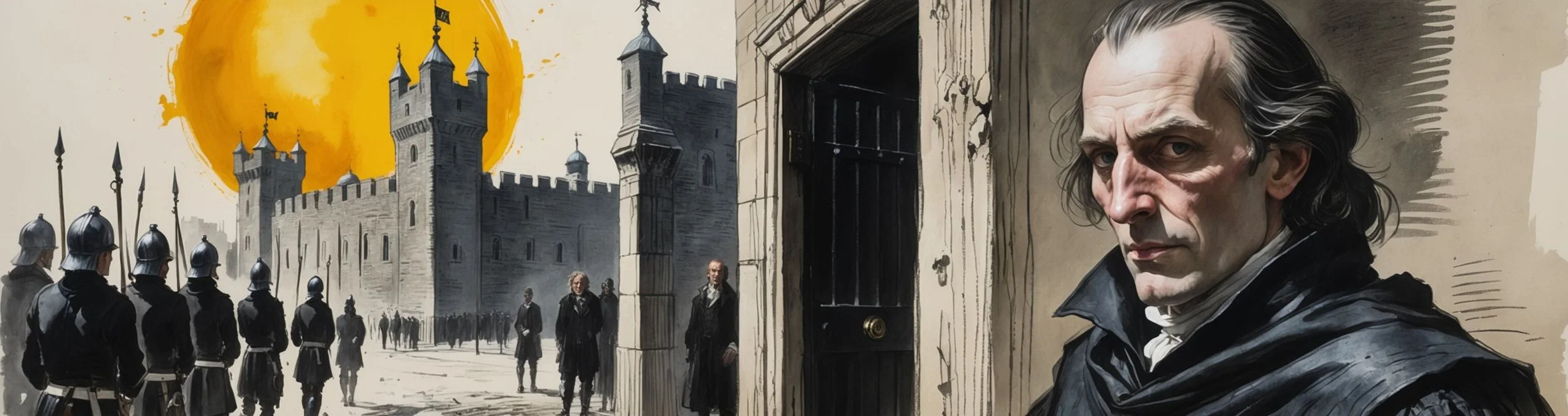
Scene Profile – At a Glance
- Location: London. A street.
- What Happens: Richard, alone, describes the Yorkist peace, his own deformity, and his decision to be a villain. His brother Clarence passes under guard to the Tower, victim of a prophecy about the letter G that Richard has planted; Richard blames the Queen’s family, promises to free him, and, once alone, promises to kill him. Hastings reports that the King is dying. Richard lays out the rest of his plan.
- Key Characters: Richard, Duke of Gloucester, George, Duke of Clarence, Sir Robert Brakenbury, Lord Hastings, guards.
- Dramatic Function: The opening soliloquy makes the audience Richard’s confidant before it has met anyone else; the scene then shows his method twice, on Clarence and on Hastings, with the audience in on both.
- Famous Quote:
"Now is the winter of our discontent
Made glorious summer by this son of York;
And all the clouds that lowered upon our house
In the deep bosom of the ocean buried."
(Richard, Act 1, Scene 1) - Why It Matters: Nobody in the play ever knows as much as the audience does after these 41 lines, and everything Richard does for four acts is measured against the plan he announces here.
Scene Summary
Richard, alone on stage, announces that the winter of the house of York’s discontent has been turned to glorious summer by this son of York, King Edward. The wars are over: bruised arms hang up as monuments, marches have become dances, and War himself, instead of riding armoured horses, capers in a lady’s chamber to a lute. But Richard is not shaped for such sport. He was cheated of feature by dissembling nature, deformed, unfinished, sent before his time into the world scarce half made up, so lamely that dogs bark at him as he limps by. In this weak piping time of peace he has nothing to do but watch his shadow in the sun and describe his own deformity. Since he cannot prove a lover, he is determined to prove a villain. He has laid plots – drunken prophecies, libels and dreams – to set his brother Clarence and the King in deadly hate, and if Edward is as true as Richard is treacherous, Clarence will be locked up today over a prophecy that G shall murder Edward’s heirs.
Clarence enters under armed guard, bound for the Tower. Why? Because his name is George. Richard jokes that the fault is his godfathers’, and that the King must mean to have him christened again in the Tower. Clarence explains: the King listens to prophecies and dreams, a wizard has told him that G will disinherit his issue, and since George begins with G, the King has decided that Clarence is the man. Richard says this is what happens when men are ruled by women – it is not the King but his wife, Lady Grey, and her brother Anthony Woodville who send men to the Tower, as they sent Hastings, released only today. Clarence agrees that no one is safe except the Queen’s kindred and the messengers who run between the King and Mistress Shore; Hastings had to beg Shore for his freedom. Richard suggests they had best wear the Queen’s livery; she and Shore, since the King made them gentlewomen, are mighty gossips in the monarchy.
Brakenbury interrupts: the King has ordered that no man speak privately with Clarence. Richard invites him to listen – they speak no treason; they say the King is wise, the Queen fair and not jealous, Shore’s wife has a pretty foot and a cherry lip, and the Queen’s kindred are made gentlefolk – and then turns Brakenbury’s disclaimer into a joke about who may do naught with Mistress Shore. Clarence and Richard submit; they are the Queen’s abjects. Richard promises to go to the King and do anything to free his brother, even call the Queen sister; this disgrace touches him deeper than Clarence can imagine, and Clarence’s imprisonment will not be long, for Richard will deliver him or lie for him. Clarence goes. Alone, Richard tells him to tread the path he will never return by: simple plain Clarence, whom he loves so much that he will shortly send his soul to heaven.
Hastings enters, newly freed. He means to live to thank those who imprisoned him, and Richard says Clarence will do the same, since their enemies are the same. Hastings laments that eagles are caged while kites and buzzards fly free. The news at home is the worst: the King is sickly, weak and melancholy, and his physicians fear for him. Richard says he has kept an evil diet long. Hastings goes ahead to the King. Alone again, Richard hopes Edward cannot live, but must not die until George has been packed with post-horse to heaven; he will go in and sharpen the King’s hatred of Clarence with well-steeled lies, and if he does not fail, Clarence has not another day to live. Then God may take Edward, and leave the world for Richard to bustle in. He will marry Warwick’s youngest daughter, Anne – what though he killed her husband and her father? The readiest way to make amends is to become her husband and father – not for love, but for a secret intent he must reach by marrying her. But he runs before his horse to market: Clarence still breathes, Edward still reigns, and only when they are gone can he count his gains.
Now Is the Winter of Our Discontent
The play opens with a man alone, telling the audience what the world looks like, and the first thirteen lines are a picture of peace so complete it sounds like a complaint. The house of York has won; the clouds are buried in the ocean; War has smoothed his wrinkled front.
Original
Grim-visaged War hath smoothed his wrinkled front;
And now, in stead of mounting barbed steeds
To fright the souls of fearful adversaries,
He capers nimbly in a lady’s chamber
To the lascivious pleasing of a lute.
(Richard, Act 1, Scene 1)
Shakespeare Retold (Modern Verse)
The ugly face of war has stopped its scowling;
And now, instead of mounting armoured horses
To terrify our enemies to death,
Our troops canoodle in a lady’s bedroom
And fornicate as gentle lute tunes play.
The verse is balanced and ceremonial – stern alarums against merry meetings, dreadful marches against delightful measures – and the balance is a trap, because the speaker is about to say that he has no place in any of it. Two things are worth noticing before the turn comes. The pun on son and sun in the second line – the son of York is Edward, whose badge was the sun in splendour – is the play’s first sign that Richard hears every word twice. And the word Now, repeated at the head of each sentence, presses the audience into the present tense of a peace that the speaker plans to end. For the argument about language in the play, the opening matters because it is the only time Richard speaks the public style without irony, and he does it so that the audience will hear the irony when it arrives: But I.
Determined to Prove a Villain
The turn is a catalogue of what Richard is not. Not shaped for sportive tricks, not made to court a looking-glass, rudely stamped, curtailed of fair proportion, cheated of feature by dissembling nature, deformed, unfinished, sent before his time. Then the conclusion, offered as if it followed.
Original
And therefore, since I cannot prove a lover
To entertain these fair well-spoken days,
I am determined to prove a villain
And hate the idle pleasures of these days.
(Richard, Act 1, Scene 1)
Shakespeare Retold (Modern Verse)
And therefore, since I cannot be a lover
To keep me occupied within our peacetime,
I am determined that I’ll be a villain,
Destroying this frivolity of peace.
The logic is false and the speech knows it. Deformity does not make a villain, and Richard’s and therefore is the first of the play’s many pieces of reasoning that persuade because they are said with confidence. Determined carries two senses – resolved, and predetermined – and the play never settles which one is true of him. What is true is the delight. He descants on his own deformity as a musician plays variations on a theme, and the image of a man watching his shadow in the sun is both pathetic and a joke he is telling against himself for the audience’s benefit; in the next scene, having won Anne, he will ask the sun to shine so he can admire the shadow. The plots he announces – drunken prophecies, libels and dreams – are the machinery, and the prophecy about G is the first of them. The audience is told the answer before the riddle is set: G is for George, as Edward believes, and G is for Gloucester, as Richard knows. For an essay on appearance and reality, this is the moment the play establishes its contract: the audience will always know, and no one on stage ever will.
Because My Name Is George
Clarence enters under guard, and the audience watches a man walk into the trap it has just been shown. Richard’s greeting is brotherly concern, his jokes about godfathers and christening are affectionate, and every word is spoken by the man who arranged the arrest.
Original
Why, this it is, when men are ruled by women:
’Tis not the King that sends you to the Tower;
My Lady Grey his wife, Clarence, ’tis she
That tempers him to this extremity.
(Richard, Act 1, Scene 1)
Shakespeare Retold (Modern Verse)
This happens when we men are ruled by women:
It’s not the King that’s sent you to the Tower;
It is his wife, Lady Elizabeth Grey,
Who’s wound him up to take such drastic action.
The blame goes at once to the Queen and her family, and the tactic is the one Richard will use for three acts: not to deny the wrong but to find someone else to have done it. Lady Grey, Anthony Woodville and Mistress Shore are the whole explanation, and Clarence, who wants an explanation, accepts it. The exchange with Brakenbury is the scene’s comic set-piece – Richard inviting the Lieutenant to hear treason and giving him gossip, then trapping him in a joke about Shore’s husband – and it shows Richard enjoying himself in front of a man who cannot answer back. The farewell to Clarence is the play’s first use of a line with two meanings that the audience hears both ways: I will deliver you, or else lie for you, where lie is take your place and tell lies. Then Clarence goes, and Richard says what he meant: simple plain Clarence, whom he loves so much that he will send his soul to heaven. The audience laughs, and the laugh is the play’s first act of manipulation – Richard has made the theatre his accomplice before Act 1 is a quarter done.
The World for Me to Bustle In
Hastings brings the news the plot needs – the King is dying – and Richard receives it with pious regret and a remark about the King’s diet. Then the stage clears and the plan is laid out in full.
Original
For then I’ll marry Warwick’s youngest daughter.
What though I killed her husband and her father?
The readiest way to make the wench amends
Is to become her husband and her father...
(Richard, Act 1, Scene 1)
Shakespeare Retold (Modern Verse)
I’ll wed the Earl of Warwick’s youngest daughter.
So what if I killed both her spouse and father?
The quickest way to rectify what she’s lost
Is to become her new husband and father...
The order is exact: Clarence first, then Edward, then the world to bustle in, then a marriage. The line about Anne is the scene’s coldest – what though he killed her husband and her father, the readiest way to make the wench amends is to become both – and the audience has not yet met her, so the plan for the wooing arrives as pure appetite. He is honest about the motive: not so much for love as for another secret close intent, which the play never spells out and which history supplies as the Warwick inheritance. The final couplet checks him. He runs before his horse to market; Clarence still breathes, Edward still reigns; when they are gone he will count his gains. The speech is a table of contents for Acts 1 to 3, and it is also a confession of the thing Richard wants, which is not the crown – he does not mention it – but the bustle. For a question on power and ambition, the scene’s evidence is that Richard’s ambition is first of all a way of filling the weak piping time of peace, and that the crown becomes the object only as the bodies pile up.
Language and Technique
- Soliloquy: Richard speaks to the audience for 41 lines before anyone else enters, so the theatre knows his plan before his brother does. Every scene after this is watched from inside his confidence.
- The pun: “This son of York”: the sun was Edward’s badge, and the son is Edward himself. Richard’s first joke is a word that means two things, which is how he will speak for the rest of the play.
- Anaphora: “Now is”, “Now are”, “I, that am”, “I, that am”: the repeated openings build the peace and then the deformity in matching columns, and the shape of the speech is the argument.
- Personification: War is a face with a wrinkled front that has smoothed itself and gone dancing. Making war a person lets Richard treat peace as a rival’s holiday.
- The double-edged line: “I will deliver you, or else lie for you”: deliver means free and kill, lie means take your place and tell lies. Clarence hears comfort; the audience hears the sentence.
- The false therefore: “And therefore, since I cannot prove a lover”: the speech connects deformity to villainy with a word that claims logic where there is only choice, and dares the audience to notice.
Key Quotes from Act 1, Scene 1
Quote 1
I, that am curtailed of this fair proportion,
Cheated of feature by dissembling nature,
Deformed, unfinished, sent before my time
Into this breathing world, scarce half made up,
And that so lamely and unfashionable
That dogs bark at me as I halt by them...
(Richard, Act 1, Scene 1)
Shakespeare Retold (Modern Verse)
Me, robbed of beauty in my face and body,
Me, cheated out of features and proportions,
Deformed because I was born prematurely,
Arriving incomplete in this cruel world,
Appearing crippled, ugly and infirm
So dogs bark at me when I limp on by.
Quote Analysis: The centre of the opening soliloquy: Richard’s account of his own body as nature’s cheat. Every phrase is a diminishment – curtailed, cheated, deformed, unfinished, half made up – and the dogs barking at him as he limps by is the one concrete image in the list, the sound of a world that reads him at a glance.
Plots have I laid, inductions dangerous,
By drunken prophecies, libels, and dreams,
To set my brother Clarence and the King
In deadly hate the one against the other...
(Richard, Act 1, Scene 1)
Shakespeare Retold (Modern Verse)
I’ve laid down devious and dangerous plots,
Through drunken prophecies, slander and dreams,
To pitch my brother Clarence and the King
Against each other through a deadly hatred...
Quote Analysis: The plan in miniature. Inductions are the opening scenes of a play, and the word tells the audience how Richard thinks of what he does; prophecies, libels and dreams are the props. The first target is his brother, and the audience learns this before it has seen Clarence’s face.
Well, your imprisonment shall not be long,
I will deliver you, or else lie for you.
(Richard, Act 1, Scene 1)
Shakespeare Retold (Modern Verse)
Well, you won’t be in prison very long;
I’ll get you freed, or else I’ll swap with you.
Quote Analysis: Richard’s promise to Clarence, and the play’s model of his speech: a sentence that is true in a sense the listener cannot hear. Deliver means release and it means hand over; lie for you means take your place and it means tell lies on your behalf. Clarence thanks him for it.
Go tread the path that thou shalt ne’er return:
Simple plain Clarence, I do love thee so
That I will shortly send thy soul to heaven,
If heaven will take the present at our hands.
(Richard, Act 1, Scene 1)
Shakespeare Retold (Modern Verse)
Walk down that path that you’ll never return to:
Foolish and boring Clarence, I do love you
So much that I will send your soul to heaven,
Assuming heaven takes what I will offer.
Quote Analysis: The first of Richard’s farewells to a victim, spoken the moment the victim has gone. The joke is the tenderness – simple plain Clarence, I do love thee so – and the audience, which laughed at the christening joke a minute earlier, is now laughing at a murder. The if in the last line is Richard’s usual note of doubt about heaven’s cooperation.
But yet I run before my horse to market:
Clarence still breathes, Edward still lives and reigns;
When they are gone, then must I count my gains.
(Richard, Act 1, Scene 1)
Shakespeare Retold (Modern Verse)
But I am getting far too far ahead:
Clarence still lives, and Edward holds his innings;
But when they’re dead, I’m free to count my winnings.
Quote Analysis: The scene’s closing couplet, and the only moment of restraint in it. Richard has planned three deaths and a marriage in twenty lines, and stops himself with a proverb about getting ahead of the horse. The rhyme on reigns and gains is the play’s first statement of what a crown is to him: a sum to be counted once the arithmetic is done.
Key Takeaways
- The audience knows first: The soliloquy makes the theatre Richard’s confidant; no character will ever catch up.
- Deformity as excuse, not cause: Richard’s and therefore links his body to his villainy, and the play leaves open whether he believes it.
- The method, shown twice: Blame the Queen’s family, promise help, speak in double meanings: Clarence and Hastings both get the treatment in one scene.
- The plan is a table of contents: Clarence, Edward, Anne: the closing soliloquy names the business of Acts 1 to 3 in order.
Study Questions and Analysis
What does “Now is the winter of our discontent” mean?
That the bad times are over. The house of York’s long winter of discontent – the civil war against Lancaster – has been turned into glorious summer by this son of York, King Edward IV, and the clouds that lowered on the family are buried in the sea. The line is often quoted as if it meant that the winter is happening now, and the sentence says the opposite: now the winter has been made summer. Richard goes on for a dozen lines in the same vein, describing a peace of wreaths, monuments, dances and lutes, before the But I that turns the speech into his own.
Now are our brows bound with victorious wreaths,
Our bruised arms hung up for monuments,
Our stern alarums changed to merry meetings,
Our dreadful marches to delightful measures.
(Richard, Act 1, Scene 1)
Shakespeare Retold (Modern Verse)
Now we wear victory wreaths around our foreheads,
Our damaged armour hung like monuments,
Our frightful battle trumpets used for parties,
Our awful battle marches turned to dances.
The pun on son and sun is the line’s engine. Edward’s badge was the sun in splendour, adopted after three suns were seen in the sky before his victory at Mortimer’s Cross, so the son of York is also the sun that has ended the winter; Richard’s first words to the audience are a joke that works two ways, which is how he will talk for five acts. The opening also establishes the peace that he will describe, a moment later, as a weak piping time with nothing in it for him. For a question on power and ambition, the speech is the play’s starting point: a settled kingdom, a victorious king, and a brother who finds the settlement unbearable.
Why does Richard say he is “determined to prove a villain”?
He gives a reason and the play lets the audience doubt it. The reason is his body: rudely stamped, cheated of feature by dissembling nature, deformed, unfinished, sent before his time into the world scarce half made up. Since he cannot prove a lover in this time of peace, he will prove a villain and hate its idle pleasures. The reasoning is a therefore that does not follow, and it is spoken with such relish – he descants on his own deformity as if it were a tune – that the deformity reads less as a wound than as a licence.
Unless to see my shadow in the sun
And descant on mine own deformity.
(Richard, Act 1, Scene 1)
Shakespeare Retold (Modern Verse)
Except observing my distorted shadow,
Articulating how I am deformed.
Sigmund Freud, in his 1916 essay on character-types, took the speech as the model of a man who claims exemption from ordinary conscience on the ground that nature has already wronged him – the exception, who feels entitled to compensation. Samuel Taylor Coleridge, in his lectures of 1811-12, found the source elsewhere, in a pride of intellect that enjoys power over others for its own sake and treats the body as an occasion rather than a cause. The word determined holds both readings: resolved, which is Coleridge’s Richard choosing, and predetermined, which is a Richard made villainous before he was born, the reading Margaret will give when she calls him the slave of nature. A student writing on fate and free will can use the single word as the whole question.
What is the prophecy about the letter G?
A prophecy, which Richard says he has planted by drunken prophecies, libels and dreams, that G shall be the murderer of Edward’s heirs. The King has taken it to mean his brother George, Duke of Clarence, and has sent him to the Tower on the strength of it; Clarence himself reports that the King plucks the letter G from the cross-row and that a wizard told him G would disinherit his issue. The audience, who have just heard Richard announce the plot, know that the G is Gloucester.
These (as I learn) and such-like toys as these
Hath moved his Highness to commit me now.
(Clarence, Act 1, Scene 1)
Shakespeare Retold (Modern Verse)
I’ve learnt that trivialities like these
Have now convinced his Highness to arrest me.
The prophecy is in the chronicles Shakespeare used, which report that Edward was troubled by a saying that one whose name began with G would reign after him, and that the saying was afterwards understood of Gloucester; the play’s change is to make Richard its author. The device sets the pattern for the play’s prophecies: a prediction the audience can read correctly and the characters cannot, and a true prophecy that has been invented by a liar. Clarence’s line – because my name is George – is the play’s first joke about the gap, and Richard’s reply, that the King should commit his godfathers, is the second. Both men are laughing, and one of them is going to die.
Who are Mistress Shore and the Queen’s kindred, and why does Richard blame them?
Mistress Shore is Edward IV’s mistress, known to history as Jane Shore, the wife of a London merchant; the Queen’s kindred are Elizabeth’s family, the Woodvilles, whom the King raised to titles and offices after his marriage, including her brother Anthony Woodville, Earl Rivers, whom Richard names here. Richard tells Clarence that these are the real powers in England: the King is ruled by women, the Queen and Shore are mighty gossips in the monarchy, and Hastings had to beg Shore for his liberty. To keep the King’s favour, he says, they had best wear the Queen’s livery.
Humbly complaining to her deity
Got my Lord Chamberlain his liberty.
I’ll tell you what, I think it is our way,
If we will keep in favour with the King,
To be her men and wear her livery.
(Richard, Act 1, Scene 1)
Shakespeare Retold (Modern Verse)
Begging and pleading to that so-called goddess
Got Hastings, our Lord Chamberlain, his freedom.
I reckon that the only way for us
To stay within the good-books of the King
Is to be dressed up as that woman’s servants.
The blame is strategy, and it is the strategy the play will follow. Richard never denies that Clarence is wronged; he names a culprit, and the culprit is always the Queen’s family, who are unpopular with the old nobility and can be attacked as upstarts. The contempt for women is part of the method too: a king ruled by his wife and his mistress is a king who can be pitied and replaced. Everything Richard says here to Clarence he will say to Hastings in a moment, to the court in 1.3, and to the citizens of London through Buckingham in Act 3. For an essay on manipulation and deceit, the scene shows the story being told for the first time, to a man who has every reason to believe it.
What does the audience know about Clarence that Clarence does not?
Everything that matters. Clarence knows that he is going to the Tower over a prophecy, and believes his brother’s account that the Queen is behind it; the audience knows that Richard invented the prophecy, planted it, and is about to go to the King to urge his hatred with well-steeled lies. Every line of Richard’s sympathy is heard twice: the joke about godfathers, the promise to call the Queen sister, the deep disgrace in brotherhood that touches him deeper than Clarence can imagine – which is true, since he is the cause of it – and the promise to deliver Clarence or lie for him.
Alack, my lord, that fault is none of yours;
He should for that commit your godfathers.
O, belike his Majesty hath some intent
That you should be new christened in the Tower.
(Richard, Act 1, Scene 1)
Shakespeare Retold (Modern Verse)
Oh dear, my lord, your name is not your fault;
For that, he should lock up your godfathers.
Perhaps his Majesty is now intending
For you to be rechristened in the Tower.
The dramatic irony is the scene’s main instrument, and its cruelty is in the affection. Richard is funny with Clarence, and the audience laughs with him, so that by the time he says, alone, that he loves simple plain Clarence enough to send his soul to heaven, the theatre has already been made complicit. Clarence will die in 1.4 still believing that Richard loves him, and his belief will be the play’s measure of how good the performance in this scene was. For a question on appearance and reality, the Clarence exchange is the first demonstration of the gap, and the audience’s laughter is the proof that Richard has closed it from the inside.
Why does Richard speak directly to the audience?
Because the play wants the audience on his side before it has a chance to refuse. The soliloquy gives Richard the theatre’s first forty-one lines, and it gives them as confidence: here is the situation, here is what I am, here is what I mean to do. The device comes from the Vice of the old morality plays, the comic tempter who explained his tricks to the crowd and was liked for it, and Richard uses it in the same spirit, with a wit that makes his plans sound like entertainments and his victims like fools. Dive, thoughts, down to my soul, he says as Clarence enters, and the audience is left holding the thoughts.
Dive, thoughts, down to my soul, here Clarence comes!
(Richard, Act 1, Scene 1)
Shakespeare Retold (Modern Verse)
But I must hide my thoughts, for here comes Clarence!
E. M. W. Tillyard, in Shakespeare’s History Plays (1944), read the opening as the moment the play announces both its villain and its scourge, the man through whom the civil-war guilt of England will be punished and who will then be punished himself; Jan Kott, in Shakespeare Our Contemporary (1964), read the same speech as an actor stepping forward to tell the audience that he knows the play is a machine and intends to run it. Both readings depend on the intimacy the soliloquy creates. The audience’s complicity is the play’s most unsettling effect, and it is set up here, in the first minute, with a joke about the sun.
What does Richard plan in the closing soliloquy, and does it happen?
Three deaths and a marriage, in order. Clarence must die first, packed with post-horse up to heaven, which Richard will arrange by sharpening the King’s hatred with lies; then God may take King Edward, who is already sickly; then the world is Richard’s to bustle in. He will marry Warwick’s youngest daughter, Anne, whose husband and father he killed, and he will do it not for love but for another secret close intent that he must reach by marrying her. Then he stops himself: he runs before his horse to market, since Clarence still breathes and Edward still reigns.
The which will I, not all so much for love
As for another secret close intent
By marrying her which I must reach unto.
(Richard, Act 1, Scene 1)
Shakespeare Retold (Modern Verse)
Which I will do, but won’t do out of love
But for another undisclosed intention
Which I’ll achieve when I am married to her.
All of it happens, and faster than he says. Clarence is murdered in 1.4, Edward dies in 2.2, and Anne is wooed in the very next scene, over the coffin of the man Richard calls her father, Henry VI. The secret intent is never explained in the play; historically, Anne was co-heiress to the Warwick estates, and the marriage was a dispute with Clarence over money as much as anything. What the speech does not mention is the crown. Richard plans deaths, a marriage and a world to bustle in, and the throne enters his speech only in Act 3, when Buckingham has made it possible; for the play’s argument about ambition, the omission is worth noticing, because it suggests that what Richard wants at the start is not the crown but the game.