Richard III: Act 1, Scene 2 – Analysis
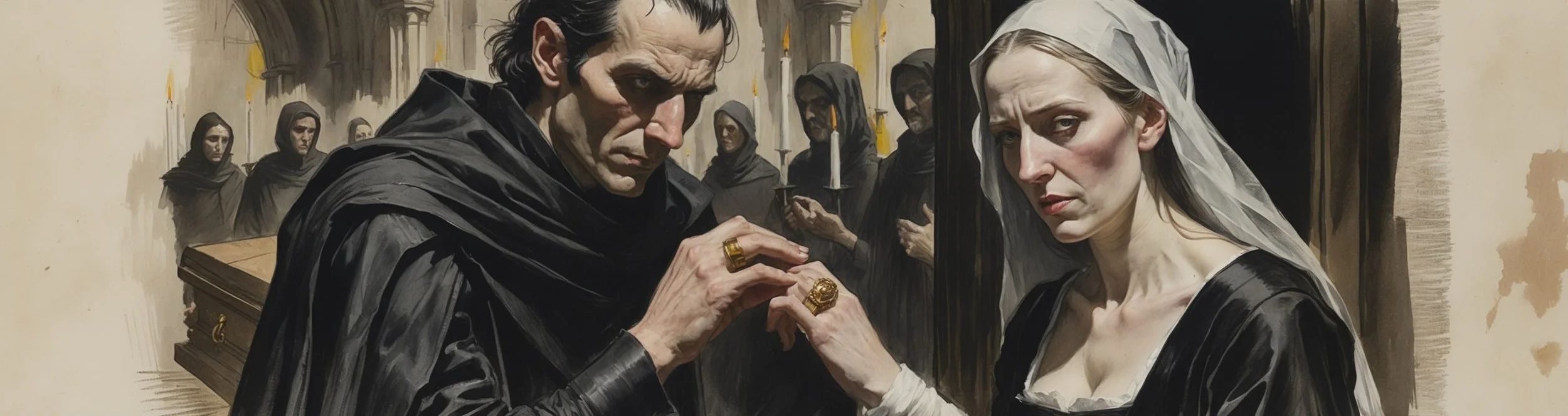
Scene Profile – At a Glance
- Location: London. A street, on the way to Chertsey.
- What Happens: Lady Anne follows the coffin of Henry VI, cursing his killer. Richard, who killed him and her husband, stops the procession, endures her curses, argues that her beauty drove him to it, offers her his sword, and wins her. Alone, he marvels at what he has done.
- Key Characters: Lady Anne, Richard, Duke of Gloucester, Gentlemen and Halberdiers bearing the corpse of Henry VI, Tressel and Berkeley.
- Dramatic Function: The first test of Richard’s boast that he can act the villain and win: the play stakes his credibility on the least likely seduction in Shakespeare, and he carries it.
- Famous Quote:
"Was ever woman in this humour wooed?
Was ever woman in this humour won?
I’ll have her, but I will not keep her long."
(Richard, Act 1, Scene 2) - Why It Matters: Anne’s surrender, achieved over the body of the man Richard murdered, tells the audience what his words can do, and her own curse on his future wife falls on herself.
Scene Summary
Lady Anne, widow of Henry VI’s son Edward, follows the dead King’s coffin from St Paul’s towards its burial at Chertsey. She halts the bearers to lament over the key-cold figure of a holy king and to curse the hand, the heart and the blood of the man who killed him and stabbed her husband. May a worse fate befall him than she could wish to wolves, spiders or toads; if he has a child, may it be born misshapen and frighten its mother; if he has a wife, may she be made more miserable by his life than Anne is by the deaths of her young lord and the King.
Richard enters and orders the bearers to set the corpse down, threatening to make a corpse of any man who disobeys and to strike down the gentleman who bars his way. Anne calls him a fiend conjured by a black magician, a dreadful minister of hell who had power only over Henry’s body, and bids him be gone. When he calls her a sweet saint she answers that his presence has made the earth his hell, and points to the King’s wounds, which have opened and bleed afresh at the murderer’s approach; she calls on God and earth to revenge the death. Richard says she knows no rules of charity; she says he knows no law of God or man, since no beast is so fierce it lacks some touch of pity. He knows none, he replies, and is therefore no beast.
The exchange quickens into single lines. He asks leave to acquit himself of these supposed crimes; she gives him leave to accuse himself. He did not kill her husband, he says; then her husband is alive; no, he is dead, and killed by Edward; she calls him a liar, for Queen Margaret saw his sword smoking in the blood. He grants that he killed the King, and says Henry was fitter for heaven than earth. She says he is fit for no place but hell; he names one other – her bedchamber. She wishes ill rest on any chamber where he lies, and he says so it will be, until he lies with her. Then he slows the pace: was the cause of these deaths as blameful as the executioner? Her beauty was the cause, which haunted his sleep and made him undertake the death of all the world for one hour in her bosom. She would tear that beauty from her cheeks with her nails. He tells her that her eyes have drawn tears from him that his father’s death and Rutland’s could not, and that he never sued to friend or enemy or learned a smoothing word until her beauty was proposed his fee.
He kneels, gives her his sword, bares his breast and bids her kill him: he did kill King Henry, but her beauty provoked him; he did stab young Edward, but her face set him on. Take up the sword again, or take up him. She lets the sword fall – she will not be his executioner – and when he offers to kill himself at her word, she says she has already bidden him, and he answers that was in her rage. She would like to know his heart; it is figured in his tongue; she fears both are false; then never was man true. She tells him to put up his sword, will not yet say his peace is made, but agrees that all men live in hope, and accepts his ring, remarking that to take is not to give. He asks one favour: that she leave the funeral to him, who has most cause to mourn, and go to Crosby House, where he will come to her after he has buried the King at Chertsey and wet the grave with repentant tears. She agrees with all her heart, glad to see him so penitent, and says a farewell he has taught her how to flatter. He sends the corpse not to Chertsey but to Whitefriars, and, alone, asks whether any woman was ever wooed or won in this humour. He will have her, but not keep her long. He killed her husband and his father, met her in the extremity of her hate, with curses in her mouth, tears in her eyes and the bleeding corpse beside her, with God, her conscience and every obstacle against him and nothing on his side but the plain devil and dissembling looks – and yet won her. Has she forgotten the sweet prince he stabbed three months ago at Tewkesbury? Will she stoop to a man who halts and is misshapen? He must have mistaken his own person: she finds him a marvellous proper man. He will buy a looking-glass and hire tailors, and first turn yon fellow into his grave.
Poor Key-Cold Figure
The scene opens as a funeral and turns into a wedding, and Anne’s lament over the coffin is the play’s second great formal speech after Richard’s own. She curses in threes – the hand, the heart, the blood – and then curses the murderer’s future, his child and his wife.
Original
If ever he have wife, let her be made
More miserable by the life of him
Than I am made by my young lord and thee!
(Lady Anne, Act 1, Scene 2)
Shakespeare Retold (Modern Verse)
And if he has a wife, let her become
More miserable by spending life with him
Than I am losing my husband and you!
The audience hears the trap before Anne does. The wife she curses will be herself, within two hundred lines, and the play will keep the curse to the letter: Richard says at the end of the scene that he will not keep her long, and in Act 4 she is dead. The curse on the child – abortive, prodigious, untimely brought to light, an ugly and unnatural aspect – is Margaret’s language for Richard himself in the next scene, so that Anne, without knowing it, is describing her husband’s own birth as the punishment she wishes on him. The speech also fixes what the corpse is: the body of a holy king, whose wounds will open when the murderer comes near, and the play lets the old belief stand as fact, since the gentlemen see the blood too. For the design of prophecy and curses in the play, Anne’s lament is the first curse the plot fulfils, and the first to fall on its speaker.
Keen Encounter of Our Wits
Richard stops the coffin by threatening to make corpses of the bearers, and then, to the widow who calls him a minister of hell, says sweet saint, for charity. The scene’s middle is a duel in single lines, and Anne’s mistake is to fight it.
Original
RICHARD: Vouchsafe, divine perfection of a woman,
Of these supposed crimes, to give me leave
By circumstance but to acquit myself.
ANNE: Vouchsafe, defused infection of a man,
Of these known evils, but to give me leave
By circumstance t’ accuse thy cursed self.
(Act 1, Scene 2)
Shakespeare Retold (Modern Verse)
RICHARD: Graciously, perfect woman, if you may,
Let me respond to these crimes I’m accused of,
And let me show, with proof, I’m innocent.
ANNE: Please let me, plague-sore of a man, explain
The evil acts you’ve done, and then allow me
To charge your evil self by facts against you.
Every line she throws, he catches and turns. She says no beast lacks pity; he knows none, and is therefore no beast. Devils tell the truth; angels are angry. He did not kill her husband; then her husband is alive. He is fit for no place but hell; there is one other place, her bedchamber. The exchange is comic in shape and appalling in substance, and its effect is to bring Anne down from the register of lament to the register of quarrel, where Richard cannot lose because he has no position to defend. He even admits the killing of Henry – I grant ye – and makes the admission a compliment to the dead man, who was fitter for heaven. The moment he chooses to leave this keen encounter of our wits and fall into a slower method, he has already won the pace. The scene is the play’s first full display of Richard’s language as a weapon, and its lesson is that the person who answers him is already losing.
Take Up the Sword Again, or Take Up Me
The slower method is an argument about cause. Was the man who ordered the deaths as guilty as the executioner? Anne says Richard was both; he says the cause was her beauty, which haunted his sleep. The claim is absurd and he states it as devotion, and then he proves it with tears.
Original
Lo here I lend thee this sharp-pointed sword,
Which if thou please to hide in this true breast,
And let the soul forth that adoreth thee,
I lay it naked to the deadly stroke,
And humbly beg the death upon my knee.
(Richard, Act 1, Scene 2)
Shakespeare Retold (Modern Verse)
Then I will lend you my sharp-pointed sword,
Which I ask that you stab right through my heart
So that my soul that loves you can be free;
Here is my naked chest that you can stab through,
And humbly, on one knee, I ask you kill me.
The tears are the speech’s centre: eyes that did not weep when Rutland died or when Warwick told the story of York’s death have wept for her, and the man who never sued to friend or enemy is suing now. Then the gamble. He kneels, lends her his sword, bares his breast and tells her to strike, confessing both murders as he does so and attaching each to her beauty. Anne holds a sword over the man who killed her husband and does not use it, and everything that follows is consequence: she will not be his executioner; she has already bidden him die, but that was in her rage; she would know his heart; she fears his tongue and his heart are both false; then never was man true. The play does not explain her surrender, and productions have played it as exhaustion, as fascination, as the loneliness of a Lancastrian widow with no protector left, and as all three. What the text shows is a woman whose weapons were curses, being offered a real weapon and finding she cannot use it, and a man who has calculated exactly that. It is the model for all Richard’s manipulation: the victim is given the choice, and the choice is the trap.
Was Ever Woman in This Humour Wooed?
Anne takes the ring, agrees to go to Crosby House, and leaves him the funeral. Richard sends the corpse to Whitefriars instead of Chertsey, and turns to the audience with the play’s most delighted soliloquy.
Original
What? I, that killed her husband and his father,
To take her in her heart’s extremest hate,
With curses in her mouth, tears in her eyes,
The bleeding witness of my hatred by,
Having God, her conscience, and these bars against me,
And I no friends to back my suit at all
But the plain devil and dissembling looks?
(Richard, Act 1, Scene 2)
Shakespeare Retold (Modern Verse)
What, me? Who killed her husband and his father,
To win her over whilst her heart detests me,
As she spits vulgar curses, teary eyed,
The bleeding corpse she wails for right beside me,
With God, her conscience, and her claims against me,
Whilst I’ve no friends willing to back me up
Except the devil and my feigning looks?
The speech is an inventory of everything that should have made the wooing impossible – the two murders, the hate, the curses, the tears, the corpse, God, her conscience – set against his only assets, the plain devil and dissembling looks, and the sum is astonishment. He is as surprised as the audience. Then the surprise turns into something the play will make much of: since she finds him a marvellous proper man, he must have mistaken his own person, and he will buy a looking-glass and hire tailors. The man who opened the play unable to look at his shadow in the sun now asks the sun to shine so that he can see it. The line I’ll have her, but I will not keep her long is spoken in the same breath, and it is the scene’s verdict on what Anne has agreed to. For an essay on appearance and reality, the soliloquy is the reference point: Richard has just made a woman see a proper man where there is none, and the last thing he does is wonder whether the trick might work on himself.
Language and Technique
- Stichomythia: Line answers line – hell, your bedchamber; I hope so, I know so. The single-line exchange is a fencing match, and the play uses it to show who is quicker.
- Curses in threes: “Cursed be the hand”, “Cursed the heart”, “Cursed the blood”: Anne’s lament repeats its shape three times, the formal pattern the play’s women use for grief.
- The bleeding corpse: Henry’s wounds open when his killer approaches. The old belief that a murdered body bleeds in the murderer’s presence is staged as fact, and nobody on stage disputes it.
- Turned words: “Then say they were not slain”: Richard answers each of Anne’s words with the same word turned, so that her vocabulary becomes his argument.
- The sword as stage picture: A kneeling man, a bared breast, a woman holding the blade: the scene’s climax is an image that needs no lines, and Anne’s failure to strike is visible before she speaks.
- Rhymed exit: “Shine out, fair sun, till I have bought a glass, / That I may see my shadow as I pass”: the couplet closes the scene on Richard’s new vanity, and echoes the shadow he could not bear in 1.1.
Key Quotes from Act 1, Scene 2
Quote 1
O, cursed be the hand that made these holes!
Cursed the heart that had the heart to do it!
Cursed the blood that let this blood from hence!
(Lady Anne, Act 1, Scene 2)
Shakespeare Retold (Modern Verse)
God damn him that impaled you with these stab wounds!
And damn the heart that had the heart to do this!
And damn the blood that made your blood flow from you!
Quote Analysis: Anne’s curse over the coffin, in the play’s formal triple pattern: hand, heart, blood. The lines are aimed at an absent murderer and spoken a moment before he walks in; the curse is precise, and the play will honour every clause of it, including the ones that fall on his wife.
ANNE: No beast so fierce but knows some touch of pity.
RICHARD: But I know none, and therefore am no beast.
(Act 1, Scene 2)
Shakespeare Retold (Modern Verse)
ANNE: There’s no such beast that’s so devoid of pity.
RICHARD: I have no pity, thus I am no beast.
Quote Analysis: The scene’s sharpest exchange. Anne reaches for the proverb that even beasts feel pity; Richard accepts the premise and draws the conclusion. The line is a joke, an admission and a threat at once, and it tells the audience that the man being cursed as a devil is not going to argue with the description.
Your beauty was the cause of that effect –
Your beauty, that did haunt me in my sleep
To undertake the death of all the world,
So I might live one hour in your sweet bosom.
(Richard, Act 1, Scene 2)
Shakespeare Retold (Modern Verse)
Your beauty was the cause for what occurred:
Your beauty haunted me when I was sleeping,
Convincing me to kill all men alive
So I might spend a tender hour with you.
Quote Analysis: The argument that wins. Richard makes Anne the cause of the murders by way of her beauty, which is flattery so extreme it becomes a kind of accusation, and then adds a lover’s hyperbole – the death of all the world for one hour in her bosom. Anne’s answer, that she would tear the beauty from her cheeks, is the first line of hers that is about herself rather than the dead.
Nay, do not pause: for I did kill King Henry –
But ’twas thy beauty that provoked me.
Nay, now dispatch: ’twas I that stabbed young Edward
But ’twas thy heavenly face that set me on.
Take up the sword again, or take up me.
(Richard, Act 1, Scene 2)
Shakespeare Retold (Modern Verse)
No, do not wait: for I have killed King Henry…
Although it was your beauty that provoked me.
Now, go ahead: I killed your husband Edward,
Despite the fact your beauty made me do it.
Pick up the sword again, or else take me.
Quote Analysis: The gamble stated in full. Kneeling with his breast bared, Richard confesses both killings and attaches each to Anne’s face. The confession is true and the motive is invented, and the line that follows – take up the sword again, or take up me – gives her a choice between two things she cannot do.
Shine out, fair sun, till I have bought a glass,
That I may see my shadow as I pass.
(Richard, Act 1, Scene 2)
Shakespeare Retold (Modern Verse)
Until I’ve bought a mirror, shining sun,
Cast shadows showing me what I have done.
Quote Analysis: The scene’s closing couplet, and a reversal of the play’s first speech. In 1.1 Richard could only descant on his own deformity in the sun; now he asks the sun to show him his shadow, because a woman has just persuaded him that he is a marvellous proper man. The vanity is comic and it is also new: Anne has changed him, in the one way he did not plan.
Key Takeaways
- The curse falls on the curser: Anne curses the murderer’s future wife, and becomes her within the scene.
- Answering him is losing: Every line Anne throws is turned back; Richard wins the wit-combat because he defends nothing.
- The sword is the trap: Offered the chance to kill him, Anne cannot; the choice is the mechanism of her surrender.
- Richard surprises himself: The soliloquy is astonishment first and vanity second, and the mirror is the play’s sign that the performance has begun to work on the performer.
Study Questions and Analysis
Why is Lady Anne following Henry VI’s coffin, and where is it going?
Anne Neville was the younger daughter of the Earl of Warwick, and had been married to Edward, Prince of Wales, the only son of Henry VI. Both men were killed in 1471: the Prince at Tewkesbury, and the old King in the Tower a few weeks later, in both cases, in the play’s account, by Richard. Henry’s body was displayed at St Paul’s and taken for burial at Chertsey Abbey on the Thames, and the scene shows Anne accompanying it as the dead King’s daughter-in-law and chief mourner. She is the last of the house of Lancaster on the stage.
Poor key-cold figure of a holy king,
Pale ashes of the house of Lancaster,
Thou bloodless remnant of that royal blood...
(Lady Anne, Act 1, Scene 2)
Shakespeare Retold (Modern Verse)
Poor king, cold like an old metallic key,
The House of Lancaster turned into dust,
Your bloodless body once had royal blood...
The details are historical and the encounter is not: there is no record of Richard stopping the funeral, and he married Anne in 1472, about a year after these deaths. Two facts from later history sharpen the scene. Anne died in March 1485, before Bosworth, and Richard as king had Henry VI’s body moved from Chertsey to Windsor in 1484 – the man who sends the coffin to Whitefriars in this scene was, in life, the King who gave the murdered man his final resting place. For a question on power, Anne’s position matters: a Lancastrian widow whose father and husband are dead has no protector, and the scene’s outcome is partly a political fact before it is a personal one.
How does Richard turn Anne’s curses against her?
By agreeing with them and redirecting them. When she curses the murderer’s future wife, she is cursing herself; when she wishes black night on his day and death on his life, he tells her not to curse herself, since she is both. Her images become his compliments – the poison she spits came from a sweet place, the eyes she wishes were basilisks have already killed him with a living death – and the more violently she speaks, the more material he has to turn.
ANNE: Black night o’ershade thy day, and death thy life!
RICHARD: Curse not thyself, fair creature – thou art both.
(Act 1, Scene 2)
Shakespeare Retold (Modern Verse)
ANNE: Then let your day be night, and death your life!
RICHARD: Don’t curse yourself, for you are day and life.
The method is the same one he uses on the court in the next scene, and it depends on the victim’s continuing to speak. Anne’s curses in the lament are formal and are heard by God; her curses in the quarrel are answers, and Richard treats an answer as an opening. Wolfgang Clemen, in A Commentary on Shakespeare’s Richard III (1968), noted how the scene’s patterned exchanges – each of Anne’s terms of abuse matched by a term of praise – give the wooing the shape of a ritual, so that Anne is drawn into a form before she has agreed to its content. For an essay on language and rhetoric, the scene is the clearest case in the play of words doing the work that force cannot.
What is stichomythia, and how does the scene use it?
Stichomythia is dialogue in alternating single lines, usually in a quarrel, with each line answering the last and often reusing its words. Greek tragedy used it for confrontations, and Shakespeare uses it here for a hundred lines: devils tell the truth, angels are angry; he did not kill her husband, then he is alive; hell, your bedchamber; ill rest betide the chamber, so it will till I lie with you; I hope so, I know so. The exchange has the rhythm of a rally, and the audience follows it as a contest.
RICHARD: I did not kill your husband.
ANNE: Why then he is alive.
RICHARD: Nay, he is dead, and slain by Edward’s hands.
(Act 1, Scene 2)
Shakespeare Retold (Modern Verse)
RICHARD: I did not kill your husband.
ANNE: Then he’s alive then?
RICHARD: No, he is dead, but he was killed by Edward.
The device does two things for the scene. It shows Richard’s speed – he never needs a second line – and it lowers Anne, who began in the long formal measure of lament and is now trading insults at the pace he sets. The moment he chooses to end the keen encounter of our wits and fall into a slower method, the audience can hear that the fast exchange was a stage he controlled. A student can compare the scene’s stichomythia with Richard’s wooing of Elizabeth in 4.4, which uses the same form and which he loses, or thinks he wins; the difference measures how far his language has stopped working by the end of the play.
Why does Richard give Anne his sword?
Because it is the one argument she cannot answer with words. He has confessed both murders, attributed them to her beauty, and produced tears; now he kneels, gives her the sword, bares his breast and tells her to strike, and repeats the confessions while she holds the blade. If she kills him, her curses are fulfilled and he has lost a gamble; if she does not, she has spared the man she has spent the scene wishing dead, and every word she says afterwards is spoken by a woman who has already chosen. She does not strike, and the scene’s ending follows from that moment.
Speak it again, and even with the word
This hand, which for thy love did kill thy love,
Shall for thy love kill a far truer love;
To both their deaths shalt thou be accessary.
(Richard, Act 1, Scene 2)
Shakespeare Retold (Modern Verse)
Say it again, and as soon as you do,
This hand, which killed your lover for I love you,
Shall, for your love, kill off a greater love;
You’ll be accountable for both these deaths.
The offer to kill himself at her word is the same trap in a second form: she has already bidden him die, but that was in her rage, and if she says it again she becomes accessary to a second death. Richard has made her responsible for his life, which is a stranger burden than hatred. The gesture is also theatre: a kneeling man with a bared breast and a woman above him with a sword is a picture the audience reads before Anne speaks, and productions differ on how long she holds the blade and how near she comes. For a question on manipulation, the sword is Richard’s method in its purest form – the victim is handed the decision, and the decision is the snare.
Why does Anne give in to Richard?
The play does not say, and its silence is the scene’s most discussed feature. What the text gives is a sequence: she curses, she answers, she is flattered, she holds the sword and lowers it, she asks to know his heart and fears it is false, she accepts the ring with the remark that to take is not to give, and she leaves with a farewell that she says he has taught her how to flatter. None of these is consent and all of them are steps. Her last lines show that she knows what has happened – she is glad to see him so penitent, and she says it in his own language.
ANNE: Well, well, put up your sword.
RICHARD: Say then my peace is made.
ANNE: That shalt thou know hereafter.
RICHARD: But shall I live in hope?
ANNE: All men, I hope, live so.
(Act 1, Scene 2)
Shakespeare Retold (Modern Verse)
ANNE: Well, put your sword away.
RICHARD: Tell me I am forgiven.
ANNE: You’ll come to know that soon.
RICHARD: But shall I live in hope?
ANNE: I hope all men have hope.
Readers have offered several explanations, and a student can hold more than one. Anne is exhausted, and the scene’s shape wears her down from lament to quarrel to silence. She is alone: Warwick, her father, and Edward, her husband, are dead, and a widow of the losing side has nowhere to go. She is fascinated, as the play’s audience is, by a man who admits everything and asks to be killed. And she is, as Richard says in his soliloquy, being wooed by the plain devil and dissembling looks, which is to say by a performance better than anything she has seen. Richard’s own bafflement – was ever woman in this humour won? – is the scene’s honest note: the play is as surprised as she is, and lets the surprise stand. For an essay on appearance and reality, Anne is the first person in the play to see the performance and accept it, and the scene shows her doing so with her eyes open.
What does Richard’s soliloquy at the end of the scene reveal?
Three things in turn. First, his astonishment: he lists everything that should have made the wooing impossible – the murders, her hate, the curses, the tears, the corpse, God and her conscience – and marvels that the plain devil and dissembling looks were enough. Second, his contempt for what he has won: he will have her but will not keep her long, and he cannot understand how she has forgotten the sweet prince he stabbed three months ago. Third, a new vanity: since she finds him a marvellous proper man, he must have mistaken his own person, and he will buy a looking-glass and hire tailors.
Upon my life, she finds (although I cannot)
Myself to be a marv’lous proper man.
I’ll be at charges for a looking-glass,
And entertain a score or two of tailors
To study fashions to adorn my body...
(Richard, Act 1, Scene 2)
Shakespeare Retold (Modern Verse)
I bet my life, she thinks (although I don’t)
That I’m a wonderfully good-looking man.
I’ll have to go and buy myself a mirror,
And hire twenty or forty personal tailors
To choose the latest fashions I can wear...
Sigmund Freud, in his 1916 essay on character-types, read Richard’s opening soliloquy as the claim of a man who feels cheated by nature to be exempt from ordinary scruple, and the end of this scene is that claim at its strangest: the exception discovering that he might, after all, be desirable. The mirror is the play’s emblem for it. In 1.1 Richard would not look at his shadow; here he asks the sun to shine so that he can. The change is comic and it is not stable – by Act 5 he will be a man who cannot look at himself at all – and the scene plants both readings. For a question on conscience, the soliloquy is worth setting against the last one, on the eve of Bosworth: the man who wanted a glass to admire himself will end by asking whether there is a murderer in the room.
Is the wooing of Lady Anne historically accurate?
No, and the play knows it. Richard did marry Anne Neville, in 1472, after her first husband’s death at Tewkesbury and Henry VI’s death in the Tower; the marriage was contested by his brother Clarence, who was married to Anne’s sister and did not want the Warwick inheritance divided, and there was a story that Clarence hid Anne to keep her from Richard. There is no evidence that Richard killed Prince Edward or Henry VI personally, and none that he wooed Anne at a funeral. The play’s own timing is loose: Richard says he stabbed Edward some three months since, but the Prince died in May 1471 and Henry within the month, so the funeral and the wooing are being compressed into a single afternoon.
Edward, her lord, whom I, some three months since,
Stabbed in my angry mood at Tewksbury?
(Richard, Act 1, Scene 2)
Shakespeare Retold (Modern Verse)
Her husband, Edward, whom, three months ago,
I stabbed in anger fighting him at Tewksbury?
The invention serves the play’s design. Shakespeare needs Richard to be tested early, publicly and against the odds, so that the audience will believe the rest; a private marriage a year later would prove nothing. He also needs Anne’s curse, and Anne’s death, to be part of the pattern of prophecy and curses that Margaret will complete in the next scene. What history supplies is the grim footnote: Anne died in the spring of 1485, and the rumour that Richard had poisoned her was current in London before Bosworth, so the play’s I will not keep her long is one of its inventions that the sources half confirm.