Richard III: Act 1, Scene 3 – Analysis
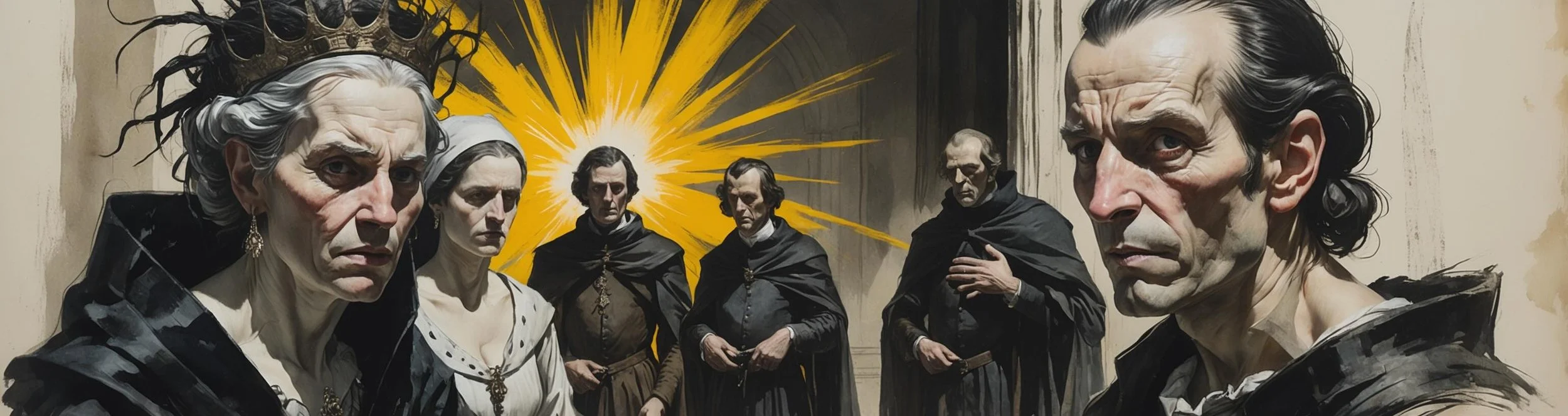
Scene Profile – At a Glance
- Location: London. The palace.
- What Happens: Queen Elizabeth fears for her family if the King dies. Richard bursts in and picks a quarrel with her and her kin. Queen Margaret, the deposed Lancastrian queen, comes forward and curses them all, Richard most of all. Richard plays the repentant, then, alone, explains his method and dispatches two murderers to Clarence.
- Key Characters: Queen Elizabeth, Rivers, Grey, The Duke of Buckingham, Stanley, Richard, Duke of Gloucester, Queen Margaret, Hastings, Dorset, Catesby, two Murderers.
- Dramatic Function: The play’s prophecy scene: Margaret’s curses lay out the plot in advance, and Richard’s closing soliloquy explains how he will make them come true.
- Famous Quote:
"And thus I clothe my naked villainy
With odd old ends stol’n forth of holy writ,
And seem a saint, when most I play the devil."
(Richard, Act 1, Scene 3) - Why It Matters: Almost everything that happens in the next four acts is announced here as a curse, and the audience is invited to keep the tally.
Scene Summary
Rivers and Grey try to comfort the Queen: the King will recover. She asks what would become of her if he died. Her son is young, and his minority is entrusted to Richard of Gloucester, a man who loves neither her nor any of them; it is determined, though not yet concluded, that he will be Protector. Buckingham and Stanley enter. Elizabeth notes that Stanley’s wife, the Countess of Richmond, will hardly say amen to his prayer for her, and Stanley asks her to bear with his wife’s weakness. They have come from the King, who is cheerful and wishes to make atonement between Gloucester and the Queen’s brothers, and between them and Hastings; he has summoned them all. Elizabeth fears their happiness is at its height.
Richard storms in with Hastings, complaining that someone has told the King he is stern and loves them not. Because he cannot flatter, smile, deceive and bow with French nods, he must be held a rancorous enemy; cannot a plain man live and think no harm without silken, insinuating Jacks abusing his simple truth? Grey asks whom he means; Richard turns on him, on Rivers, on the whole faction, and accuses them of troubling the sick King with complaints. Elizabeth says the King sent for him of his own will, to learn the ground of the hatred he shows her family. Richard answers that the world has grown so bad that wrens make prey where eagles dare not perch, and every Jack has become a gentleman. She says he envies her advancement; he says their brother Clarence is imprisoned by her means, himself disgraced, and honours given daily to people who two days ago were worth a noble. Elizabeth swears she pleaded for Clarence. Richard suggests she was behind Hastings’ recent imprisonment too, and when Rivers tries to defend her, turns the word marry into a jibe about her marriage to the King – a bachelor and a handsome stripling, a better match than her grandmother’s. Elizabeth says she has borne his taunts too long and will tell the King; she would rather be a country servant-maid than a queen so baited and scorned.
Queen Margaret, Henry VI’s widow, has entered unseen and comments in asides: the honour Elizabeth complains of is hers by right; Richard killed her husband in the Tower and her son at Tewkesbury. Richard, unaware of her, dares Elizabeth to tell the King, and reminds the court what he did to make Edward king while Elizabeth and her first husband Grey were fighting for Lancaster; Rivers answers that they followed their lawful king and would follow Richard, if he were king. Richard would rather be a pedlar. Margaret can hold her patience no longer and comes forward: they are wrangling pirates, quarrelling over what they have stolen from her. Richard calls her a foul wrinkled witch and asks whether she was not banished on pain of death; she says banishment is worse than death. She claims a husband and a son from Richard, a kingdom from Elizabeth, allegiance from all of them.
Richard answers with the memory the court shares: the curse his father York laid on Margaret when she crowned him with paper, mocked him and gave him a cloth steeped in the blood of his child Rutland. God, he says, not they, has punished that deed. Elizabeth, Hastings, Rivers, Dorset and Buckingham all agree – the whole quarrelling court is united against her for a moment. Margaret asks whether York’s curse could have counted for so much with heaven, and if curses can pierce the clouds, gives way to hers. May Edward die by surfeit, as her Edward died by murder; may the Prince of Wales die young by violence, as her son did; may Elizabeth outlive her glory, see another in her place, and die neither mother, wife nor England’s queen; may Rivers, Dorset and Hastings, who stood by when her son was stabbed, be cut off by accident before their natural age. Richard tells her to have done. She has not begun with him: may heaven keep its worst plague until his sins are ripe; may the worm of conscience gnaw his soul; may he take his friends for traitors and traitors for friends; may no sleep close his eye except with dreams of devils; he is an elvish-marked, abortive, rooting hog, the slave of nature and the son of hell, a slander of his mother’s womb. As she reaches for the last name, Richard supplies one: Margaret. The curse, Elizabeth observes, has ended against herself.
Margaret turns on Elizabeth as a poor painted queen who strews sugar on a bottled spider and whets a knife to kill herself; the day will come when she will want Margaret’s help to curse the bunch-backed toad. Hastings, Rivers and Dorset tell her to stop; she answers each. Richard offers Dorset a lesson in how the high can fall, and Margaret turns his image of the eagle’s nest against him. Buckingham asks for peace, and she softens: she kisses his hand, exempts him from her curse since his garments are not spotted with her blood, and warns him to take heed of yonder dog, who bites when he fawns. Buckingham says curses never pass the lips of those who breathe them; Richard asks what she said and Buckingham replies, nothing that he respects. Margaret tells him he will remember another day, when Richard splits his heart with sorrow, that poor Margaret was a prophetess, and goes. Buckingham’s hair stands on end. Richard says he cannot blame her, she has had too much wrong, and he repents his part in it; as for Clarence, he is franked up to fatting, God pardon those who are the cause. Rivers admires the Christian conclusion. Catesby summons them all to the King. Alone, Richard explains: he does the wrong and begins the brawl, then lays the secret mischiefs he sets in motion on others; he weeps for Clarence to simple gulls like Derby, Hastings and Buckingham, tells them the Queen’s party is to blame, and, when they urge him to revenge, sighs and quotes scripture, clothing his naked villainy in odd old ends of holy writ. His executioners arrive for the warrant. He tells them to be sudden, and not to hear Clarence plead, for Clarence is well-spoken and might move them; they assure him they will use their hands and not their tongues, and go.
If He Were Dead
The scene opens on a frightened woman being told not to worry, and everything she says is right. Elizabeth’s question – what would become of her if the King died – is the play’s political situation stated in a line, and the answer, from her own brothers, is no comfort at all.
Original
Ah! He is young; and his minority
Is put unto the trust of Richard Gloucester,
A man that loves not me, nor none of you.
(Queen Elizabeth, Act 1, Scene 3)
Shakespeare Retold (Modern Verse)
Ah! He is still a child; as he’s a minor,
He’s in the care of Richard, Duke of Gloucester,
A man that neither loves me, nor loves you lot.
The exchange establishes the two facts Act 2 and Act 3 will turn on: the heir is a child, and the man who will govern him hates his mother’s family. The mention of the Countess of Richmond, Stanley’s wife, is a quieter plant – she is the mother of the Earl of Richmond, who will end the play as Henry VII, and the Queen’s suspicion of her is one more fracture in a court that has too many. Buckingham’s news that the King wants to make atonement between the factions sets up the next scene’s ceremony of oaths, and Elizabeth’s response, that their happiness is at the height, is the first of the scene’s prophecies, and the only one that nobody notices. For the argument about power in the play, this opening is the picture of a court in which authority is already draining out of the sick man off-stage and nobody yet knows where it is going.
Cannot a Plain Man Live
Richard enters in the middle of a sentence, already aggrieved, and the performance he gives is one he has prepared in the previous scene’s soliloquy: the plain man, wronged by flatterers, who cannot smile and bow and is therefore called an enemy.
Original
Because I cannot flatter and look fair,
Smile in men’s faces, smooth, deceive, and cog,
Duck with French nods and apish courtesy,
I must be held a rancorous enemy.
(Richard, Act 1, Scene 3)
Shakespeare Retold (Modern Verse)
Because I’m neither fawning nor attractive;
Don’t smile; not suave, deceitful nor conniving;
Can’t bow like Frenchmen with a faux politeness;
I’m seen as a contentious enemy.
Every word of it is a lie, and the lie is built out of the truth: Richard cannot look fair, and he has just told the audience how well he can smile and deceive. The attack that follows is the one he has been rehearsing since his first speech – the Queen’s kin are upstarts, Jacks made gentlemen, wrens preying where eagles dare not perch – and it is aimed at the fact the court cannot answer, that Elizabeth Woodville was a knight’s widow whom a young king married for love. The jibe about marry, may she is the point at which the quarrel becomes personal, and it is Rivers, not the Queen, who walks into it. Richard’s other move is to keep saying the name Clarence, blaming the Queen for a brother he has arranged to have killed, so that by the end of the scene his grief will be common knowledge. This is manipulation as a public style: he does not persuade anyone of anything, he simply makes the argument loud enough that Hastings and Buckingham will remember which side of it he was on.
Hear Me, You Wrangling Pirates
Margaret has been on stage for a hundred lines, commenting in asides that only the audience hears, and her entrance into the quarrel is one of the play’s great coups. The Yorkist court, which has been tearing itself apart, turns as one to face the last Lancastrian.
Original
Hear me, you wrangling pirates, that fall out
In sharing that which you have pilled from me!
Which of you trembles not that looks on me?
If not, that I am queen, you bow like subjects,
Yet that, by you deposed, you quake like rebels?
(Queen Margaret, Act 1, Scene 3)
Shakespeare Retold (Modern Verse)
Listen to me, you quibbling pirates, bickering
About the sovereignty you stole from me!
Which one of you is not afraid to see me?
If you don’t tremble, bowing when I’m queen,
You shiver knowing you wrongly dethroned me.
She has no business being there. History had Margaret of Anjou ransomed to France and dead before most of this play’s events; Shakespeare brings her back, banished on pain of death and indifferent to it, because the play needs a witness. What she witnesses is the past. Richard’s reply to her – the paper crown, York’s tears, the cloth steeped in Rutland’s blood – is the scene the audience of the Henry VI plays remembers, and for a moment the whole court, Queen and Gloucester and Hastings and Buckingham, agrees on something: that Margaret’s crimes were the foulest ever heard of and God has punished them. The agreement lasts exactly as long as she is the target. What the moment shows is that the Wars of the Roses are not over in anyone’s mind, that every person on the stage has blood on somebody’s hands, and that the play’s account of fate and history depends on this shared memory: the curses that follow have force because everyone present already believes that God settles such accounts.
Can Curses Pierce the Clouds
Margaret’s question is the play’s, and her answer is to try. The curses come in order – the King, the Prince, the Queen, the bystanders, and then Richard – and the audience who know the story recognise the plot being read aloud.
Original
If heaven have any grievous plague in store
Exceeding those that I can wish upon thee,
O, let them keep it till thy sins be ripe,
And then hurl down their indignation
On thee, the troubler of the poor world’s peace!
(Queen Margaret, Act 1, Scene 3)
Shakespeare Retold (Modern Verse)
If heaven has a dreadful pestilence
That’s even worse than I can wish upon you,
I hope they keep it till your sins bear fruit,
And then release it with a burst of fury
On you, who’ve wreaked such havoc on the world!
Edward will die of surfeit, in his bed, and does; the Prince will die young by violence, and does; Elizabeth will outlive her glory and die neither mother, wife nor queen, and by Act 4 she is very nearly all three; Rivers and Hastings will be cut off before their natural age, and are. The curse on Richard is the one the play takes most seriously: the worm of conscience, friends taken for traitors and traitors for friends, and no sleep unless some tormenting dream affrights him with a hell of ugly devils. Every clause is honoured on the night before Bosworth. The joke at the end is Richard’s, and it is a good one – he waits for her to reach the last name and says Margaret, so that the curse’s period is her own – but the joke does not unmake the curse, and Elizabeth’s comment that Margaret has cursed herself is only half true. The scene then does something subtler: Margaret turns on Elizabeth, whom she calls a poor painted queen, and warns her about the bottled spider, and the warning, unlike the curse, is meant kindly. For the design of prophecy and curses, this is the source: a scene that announces the play’s deaths in the order they will come, and is believed by nobody on stage except, briefly, Buckingham.
Seem a Saint
Margaret gone, Richard is the first to forgive her: she has had too much wrong, and he repents his part in it. Rivers admires the Christian sentiment. Then the stage empties and Richard tells the audience what they have just watched.
Original
I do the wrong, and first begin to brawl.
The secret mischiefs that I set abroach
I lay unto the grievous charge of others.
(Richard, Act 1, Scene 3)
Shakespeare Retold (Modern Verse)
I do the wrong and instigate the fights.
The secret tricks and traps I set in motion
I surreptitiously pin blame on others.
The soliloquy is a manual. He starts the quarrels; he lays the blame on others; he weeps for Clarence to simple gulls – Derby, Hastings, Buckingham, the three men who will matter most – and tells them the Queen’s party did it; when they urge him to revenge he sighs and quotes scripture. The famous couplet about clothing naked villainy in old ends of holy writ is the play’s definition of the appearance Richard manufactures, and it explains the repentance speech the audience heard a minute earlier: that, too, was a piece of scripture. His last line before the murderers arrive – had I cursed now, I had cursed myself – is the truest thing he says in the scene, and he says it as a joke. The murderers are dispatched with instructions not to listen, since Clarence is well-spoken and may move their hearts, which is Richard’s tribute to the brother he is killing and a clear-eyed note on the danger of pity. The First Murderer’s promise to use hands not tongues, and Richard’s approval of eyes that drop millstones, close the scene on the play’s other register: the plain prose of men who do what the poetry has arranged.
Language and Technique
- The aside: For a hundred lines Margaret speaks only to the audience, correcting every claim the court makes. The device lets the play run two scenes at once: the quarrel, and the judgement on it.
- The curse as list: Margaret curses in order – king, prince, queen, bystanders, Richard – and each curse names a specific fate. The form is a prophecy the audience can check off.
- Animal imagery: “Bottled spider”, “bunch-backed toad”, “rooting hog”, “yonder dog”: Margaret’s names for Richard are all animals, and the play will use every one of them again.
- The turned name: Richard ends Margaret’s curse with her own name, so the sentence grammatically curses her. It is a joke about language, and the play then shows that language was not the point.
- The plain-man pose: “Cannot a plain man live and think no harm”: Richard builds a whole speech on the claim that he cannot flatter, which is itself flattery of the court’s idea of honesty.
- Shared memory: The paper crown and Rutland’s blood are events from an earlier play; the court’s united response to them shows how much of this play’s action is remembered rather than seen.
- Scripture as costume: “Odd old ends stol’n forth of holy writ”: Richard describes his own religious language as stolen rags, the plainest statement in the play of how he uses words.
Key Quotes from Act 1, Scene 3
Quote 1
Cannot a plain man live and think no harm,
But thus his simple truth must be abused
With silken, sly, insinuating Jacks?
(Richard, Act 1, Scene 3)
Shakespeare Retold (Modern Verse)
Why can’t a simple, harmless man exist
Without his honest words being distorted
By slimy slick insinuating cretins?
Quote Analysis: Richard’s pose for the scene, and one he will keep up for two acts: the blunt soldier who cannot flatter and is therefore slandered by smooth courtiers. The audience has just heard him promise to deceive; the court, which has not, hears a plain man. “Jacks” – upstarts, nobodies – is aimed at the Queen’s kin, and is the word Richard will use to lower them until they can be killed.
Out, devil! I do remember them too well:
Thou kill’dst my husband Henry in the Tower,
And Edward, my poor son, at Tewksbury.
(Queen Margaret, Act 1, Scene 3)
Shakespeare Retold (Modern Verse)
Oh, I remember them too well, you devil!
You killed my husband Henry in the Tower
And Edward, my poor son, at Tewksbury.
Quote Analysis: Margaret’s first aside, and the play’s memory speaking. Richard has just complained that his pains for Edward are forgotten; she remembers a different set of pains, her husband’s murder in the Tower and her son’s at Tewkesbury, both by Richard’s hand in the previous play. The audience hears the two accounts side by side, and knows which is true.
Thou elvish-marked, abortive, rooting hog!
Thou that wast sealed in thy nativity
The slave of nature and the son of hell!
(Queen Margaret, Act 1, Scene 3)
Shakespeare Retold (Modern Verse)
You scarred, revolting pig, digging the dirt!
You who became, the day that you were born,
A freak of nature and the son of hell!
Quote Analysis: The climax of the curse on Richard, and the language the play’s women will use for him from now on. Every word attacks his birth: marked by elves, born too soon, a pig that roots in the ground, a slave of nature. Richard has told the audience that nature cheated him; Margaret tells the court that nature marked him, and the play leaves both readings open.
Poor painted queen, vain flourish of my fortune!
Why strew’st thou sugar on that bottled spider
Whose deadly web ensnareth thee about?
(Queen Margaret, Act 1, Scene 3)
Shakespeare Retold (Modern Verse)
You pseudo queen, a shadow of my reign!
Why are you sweet to that fat-bellied spider
Who’s trying to trap you in his deadly web?
Quote Analysis: Margaret’s warning to the woman who has replaced her. Elizabeth is painted – a queen only in the surface – and the bottled spider is Richard, swollen and venomous, spinning a web she cannot see. The prophecy that Elizabeth will one day wish for Margaret’s help in cursing is kept exactly: in 4.4 the two women sit together on the ground and Elizabeth asks for lessons.
O Buckingham, take heed of yonder dog!
Look when he fawns he bites; and when he bites,
His venom tooth will rankle to the death.
(Queen Margaret, Act 1, Scene 3)
Shakespeare Retold (Modern Verse)
Oh Buckingham, beware of that dog Richard!
When he is sucking up, he’ll bite; and his bite
Is venomous, and it’s enough to kill you.
Quote Analysis: The one warning in the scene addressed to a man who might act on it. Buckingham is exempt from the curse and receives advice instead: the dog bites when he fawns, and the bite is poison. Buckingham dismisses it as nothing he respects, and in 5.1, on the way to his execution, he will remember that Margaret was a prophetess.
Your eyes drop millstones, when fools’ eyes fall tears.
(Richard, Act 1, Scene 3)
Shakespeare Retold (Modern Verse)
You must remain stone-faced when fools start crying.
Quote Analysis: Richard’s compliment to his murderers, and the scene’s last word on pity. The proverb – hard men weep millstones – is one the First Murderer will quote back to Clarence in the next scene, as he lessoned us to weep. Richard admires men who cannot be moved because he has just warned them that Clarence is well-spoken enough to move them.
Key Takeaways
- The plot, read aloud: Margaret’s curses name the fates of Edward, the Prince, Elizabeth, Rivers, Hastings and Richard in the order the play delivers them.
- Richard’s method, explained: Begin the brawl, blame others, weep for Clarence, quote scripture: the closing soliloquy is a manual for everything he does until Act 4.
- A court united only against the past: The Yorkist factions agree on nothing except that Margaret’s crimes were worse than theirs; the moment passes and the quarrel resumes.
- The exemption: Buckingham is spared the curse and given a warning instead, and the play makes him the one man who could have listened.
Study Questions and Analysis
Why is Queen Elizabeth afraid at the beginning of Act 1, Scene 3?
Because the King is dying, her son is a child, and the man who will govern that child hates her. She says all three things in her first speeches: if the King were dead, the loss of such a lord includes all harms; the Prince is young, and his minority is put unto the trust of Richard of Gloucester, a man that loves not me, nor none of you; and it is determined, though not concluded, that Richard will be Protector if the King miscarries. Her brothers Rivers and Grey try to comfort her, and the play gives her the better of every exchange.
It is determined, not concluded yet;
But so it must be, if the King miscarry.
(Queen Elizabeth, Act 1, Scene 3)
Shakespeare Retold (Modern Verse)
It’s been agreed, but not as yet confirmed;
But that’s the way it will be if the King dies.
The fear is well founded and precisely placed. Elizabeth Woodville had married Edward IV as the widow of a Lancastrian knight, and her family’s rise had made enemies of the old nobility, of Hastings, and of Richard; the play’s first scene has already shown Richard blaming her for Clarence’s imprisonment. Her remark about the Countess of Richmond – Stanley’s wife, Margaret Beaufort, mother of the future Henry VII – is a small sign of how many quarrels the court contains, and a first mention of the family that will end the play on the throne. For a question on power and ambition, the opening shows power as a thing that has already begun to move before anyone has reached for it.
How does Richard attack the Queen and her family?
By playing the plain man. He enters complaining that someone has told the King he is stern, and turns the complaint into a portrait of himself as the honest soldier who cannot flatter, smile, deceive and duck with French nods, and is therefore held a rancorous enemy by silken, insinuating Jacks. From there the attack is on the Woodvilles’ rank: the world is so bad that wrens make prey where eagles dare not perch, every Jack has become a gentleman, and honours are given daily to men who two days ago were worth a noble. When Rivers defends the Queen, Richard turns the word marry into a jibe about her marriage to a bachelor king – and adds that her grandmother had a worse match.
Since every Jack became a gentleman,
There’s many a gentle person made a Jack.
(Richard, Act 1, Scene 3)
Shakespeare Retold (Modern Verse)
Since peasants all are now considered noble,
Those truly noble are no more than peasants.
The strategy has two aims. The first is to fix the Queen’s family as upstarts in the minds of Hastings, Buckingham and Stanley, who are in the room, so that when Richard moves against Rivers and Grey in Act 2 the old nobility will not object. The second is to keep saying the name Clarence, blaming the Queen for a brother he has himself arranged to kill, so that his grief will be on record. His soliloquy at the end of the scene confirms both: he weeps for Clarence to simple gulls and tells them the Queen’s allies did it. For an essay on manipulation and deceit, the scene is the model of Richard’s public method, which is not to persuade but to be seen taking a side.
Who is Queen Margaret, and why is she in the play?
Margaret of Anjou, widow of Henry VI and mother of the Prince Edward killed at Tewkesbury, the Lancastrian queen who led her husband’s cause through the Henry VI plays. Historically she was captured after Tewkesbury, ransomed to France in 1475 and died there in 1482, before most of this play’s events; Shakespeare brings her back to court, banished on pain of death and past caring, because the play needs someone who remembers everything. She has no power and no allies. What she has is the past, and the scene is built to show that everyone on the stage shares it.
I was; but I do find more pain in banishment
Than death can yield me here by my abode.
(Queen Margaret, Act 1, Scene 3)
Shakespeare Retold (Modern Verse)
I was; but being banished is more painful
Than dying here at home would be to me.
E. M. W. Tillyard, in Shakespeare’s History Plays (1944), treated Margaret as the voice of the providential pattern, the figure who announces that the crimes of the civil wars will be paid for and lives to see the payments made. Wolfgang Clemen, in A Commentary on Shakespeare’s Richard III (1968), stressed her theatrical function: for a hundred lines she is a chorus in asides, and when she steps forward the play’s private quarrel becomes a public judgement. The two readings agree that she is not a character in the ordinary sense so much as the play’s memory given a body. A student can add that Richard treats her as one more voice to be talked over, and that she is the only person in the play he never deceives, because she has nothing left to want.
What does Margaret curse each character with, and do the curses come true?
In order: King Edward is to die by surfeit, not war, as her Edward died by murder to make him king – and he dies in his bed in Act 2. The Prince of Wales is to die in his youth by like untimely violence, as her son did – and he is smothered in the Tower in Act 4. Elizabeth is to outlive her glory, see another decked in her rights, wail her children’s deaths and die neither mother, wife nor England’s queen – and by 4.4 she has lost her husband, her sons and her crown. Rivers, Dorset and Hastings, who stood by when her son was stabbed, are to be cut off before their natural age by some unlooked accident – and Rivers and Hastings are, in Act 3.
Though not by war, by surfeit die your king,
As ours by murder, to make him a king!
Edward thy son, that now is Prince of Wales,
For Edward our son, that was Prince of Wales,
Die in his youth by like untimely violence!
(Queen Margaret, Act 1, Scene 3)
Shakespeare Retold (Modern Verse)
May your king die from gluttony, not war,
For he’s now king due to my husband’s murder!
May your son, Edward, who’s now Prince of Wales,
For my son, Edward, who was Prince of Wales,
Die young and violently whilst in his prime!
The curse on Richard is the fullest and the most exactly kept: no sleep except in tormenting dreams of devils, friends suspected as traitors and traitors taken for friends, and the worm of conscience gnawing his soul. Act 5 delivers all three on the night before Bosworth. The one exception is Dorset, who escapes to Richmond and survives, and the exception is worth noticing: the play keeps the pattern almost perfectly, not perfectly. Jan Kott, in Shakespeare Our Contemporary (1964), read the fulfilment of the curses less as divine justice than as the working of a mechanism in which every occupant of the throne is ground down in turn, and Margaret’s role is to read out the schedule. Whichever reading a student prefers, the scene is the place where the play’s prophecies are issued, and the rest of the play is their receipt.
What is the joke when Richard says “Margaret” at the end of her curse?
Margaret has been building a list of names for him – elvish-marked hog, slave of nature, son of hell, slander of his mother’s womb, rag of honour – and is reaching for the final one when Richard supplies it: Margaret. Grammatically, her sentence now reads as a curse on herself, and Elizabeth says so. Margaret answers that she called him all those names but looked for no reply, and asks to make the period to her curse; Richard tells her it is done, and ends in her name.
Why, so I did, but looked for no reply.
O, let me make the period to my curse!
(Queen Margaret, Act 1, Scene 3)
Shakespeare Retold (Modern Verse)
Well, yes, I did, but didn’t seek an answer.
Now, let me finish off my awful curse!
The trick is a small masterpiece of Richard’s wit, and its meaning is in what it does not do. It defeats the sentence and leaves the curse intact; every clause Margaret has already spoken will be honoured. The moment shows the two kinds of language the play sets against each other: Richard’s, which is quick, turns words on their speakers and wins every exchange, and Margaret’s, which is slow, formal, repetitive and comes true. For a question on language and rhetoric, the exchange is the play’s clearest demonstration that winning the argument and being right are separate things, and that Richard is only good at one of them.
What does “bottled spider” mean?
A spider swollen like a bottle – bloated, round-bodied and poisonous – and the image is aimed at Richard’s shape as well as his nature. Margaret uses it in her warning to Elizabeth: why strew sugar on that bottled spider whose deadly web ensnareth thee about? The Queen is being kind to the creature that is weaving the net she will die in; she is a fool who whets a knife to kill herself. The companion image, the poisonous bunch-backed toad, does the same work: an ugly, venomous animal with a hump.
Fool, fool, thou whet’st a knife to kill thyself.
The day will come that thou shalt wish for me
To help thee curse this poisonous bunch-backed toad.
(Queen Margaret, Act 1, Scene 3)
Shakespeare Retold (Modern Verse)
You’re sharpening a knife to kill yourself, fool.
The day will come when you will ask for me
To help you curse this evil hunchbacked toad.
The scene supplies the play with its bestiary. Richard is a spider, a toad, a rooting hog, a dog that bites when he fawns, an elvish-marked slave of nature; Margaret gives the court the words, and the court’s women will use them until the end. The animal names are also the play’s answer to Richard’s own account of himself. He has said that nature cheated him of shape and that he will therefore prove a villain; Margaret’s images say that the shape is the villainy, visible to anyone who looks. For an essay on appearance and reality, the spider is the play’s central emblem, because a spider’s web is invisible until the fly is in it, and Elizabeth is being told about the web by the only person who can see it.
Why does Margaret spare Buckingham and warn him?
Because his garments are not spotted with her blood. Buckingham took no part in the killing of her husband and son, so he is not within the compass of her curse; she kisses his hand in sign of amity and wishes his house well. Then she gives him the one piece of practical advice in the scene: take heed of yonder dog, who bites when he fawns, whose venom tooth will rankle to the death, on whom sin, death and hell have set their marks. Buckingham replies that curses never pass the lips of those that breathe them, and when Richard asks what she said, answers that it was nothing he respects.
Nor no one here; for curses never pass
The lips of those that breathe them in the air.
(Buckingham, Act 1, Scene 3)
Shakespeare Retold (Modern Verse)
Nobody’s implicated, for your curses
Are nothing more than breath within the air.
The exemption makes Buckingham the scene’s control case. Everyone else is cursed and cannot help what follows; Buckingham is warned and could. He chooses Richard, prospers for two acts, and is executed in Act 5 on the day he once swore he deserved it, remembering on his way to the block that Margaret was a prophetess. His line about curses being only breath is the scene’s sceptical position, and the play spends four acts refuting it. For the argument about fate and free will, Buckingham is the test: the one man given the information in time, and the clearest evidence that the play’s prophecies work through choices rather than around them.
What does Richard’s soliloquy at the end of the scene reveal?
His method, stated as a set of rules. He does the wrong and first begins to brawl; the secret mischiefs he sets abroach he lays to the charge of others; Clarence, whom he has cast in darkness, he weeps for to simple gulls – Derby, Hastings, Buckingham – and tells them the Queen and her allies stirred the King against him; when they urge him to revenge, he sighs, quotes scripture about doing good for evil, and clothes his naked villainy with odd old ends of holy writ. The audience has just watched every one of these rules in action, including the last: his forgiveness of Margaret a minute earlier was the piece of scripture.
But then I sigh, and, with a piece of scripture,
Tell them that God bids us do good for evil...
(Richard, Act 1, Scene 3)
Shakespeare Retold (Modern Verse)
But then I sigh, and, quoting from the Bible,
Say God bids us return good deeds for evil...
Samuel Taylor Coleridge, in his lectures of 1811-12, singled out the pride of intellect in Richard – the pleasure he takes in his own power over others, independent of what it gains him – and this soliloquy is that pride speaking: it explains a trick the audience has already seen work, for the pleasure of explaining it. The naming of Derby, Hastings and Buckingham is exact plotting; they are the three men whose belief he will need in Act 3, and the three the play will treat most differently. The dispatch of the murderers that follows adds the one practical note in the speech, the warning that Clarence is well-spoken and may move their hearts, which is Richard’s admission that the language he uses so well can be used against him. For an essay on appearance and reality, the speech is the play’s definition of the gap between the two.
Why does Richard say he repents his wrongs to Margaret?
Because the court is watching and Buckingham’s hair is standing on end. Margaret has just left, and the first thing Richard says is that he cannot blame her: she has had too much wrong, and he repents his part thereof. He adds that Elizabeth and her family have all the advantage of Margaret’s wrong, that he was too hot to do somebody good who is too cold in thinking of it now, and that Clarence is franked up to fatting for his pains – God pardon those that are the cause. Rivers calls it a virtuous and Christian conclusion.
I cannot blame her; by God’s holy Mother,
She hath had too much wrong, and I repent
My part thereof that I have done to her.
(Richard, Act 1, Scene 3)
Shakespeare Retold (Modern Verse)
I cannot blame her; by the Mother of God,
Too much has gone wrong for her, and I’m sorry
For what I’ve done to contribute to this.
Every sentence has a second meaning. He repents his part in Margaret’s wrong, and in a moment will tell the audience that this is the scripture he uses to clothe villainy; he prays for those who caused Clarence’s imprisonment, and is himself the cause; and when Rivers praises him for praying for his enemies, he says he does so ever, being well advised, for had he cursed now he had cursed himself. The last line is the scene’s truest and is heard as a pleasantry. For a question on conscience, this speech is the reference point for Act 5: Richard performing repentance in Act 1, fluently and to applause, and then, on the night before Bosworth, finding that the performance will not come.