Richard III: Act 1, Scene 4 – Analysis
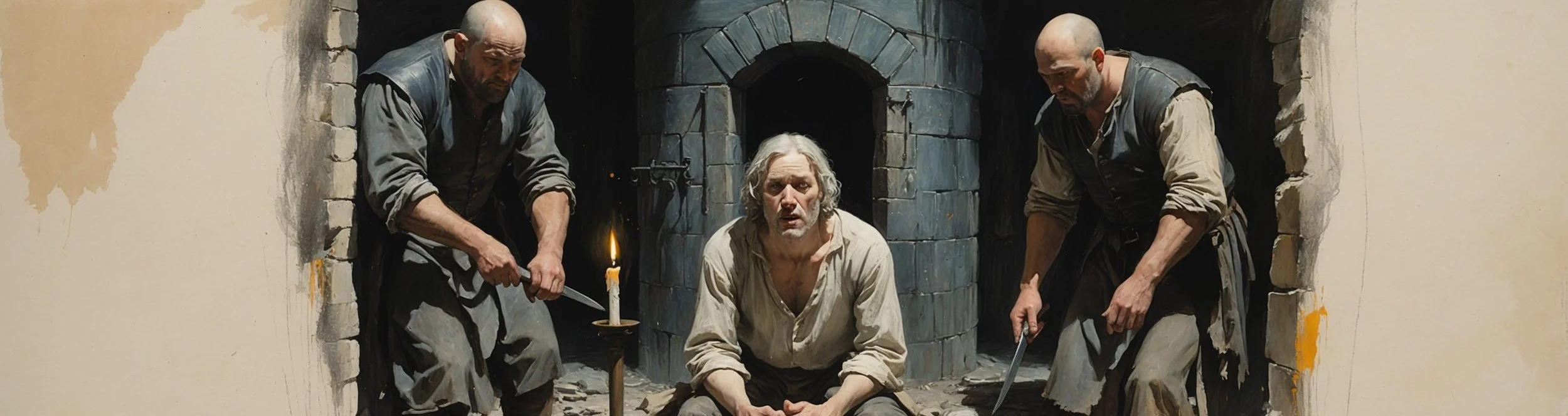
Scene Profile – At a Glance
- Location: London. The Tower.
- What Happens: Clarence tells his keeper a dream of drowning and of hell, prays for his wife and children, and sleeps. Two murderers sent by Richard arrive with a warrant, argue with their consciences, wake him, hear his pleas, and kill him. The Second Murderer repents; the First hides the body.
- Key Characters: George, Duke of Clarence, the Keeper, Sir Robert Brakenbury, the First and Second Murderers.
- Dramatic Function: The play’s first murder, shown in full: a guilty man’s dream of judgement, then the judgement, carried out by two hired men who debate conscience in prose before the Duke wakes.
- Famous Quote:
"O Lord, methought what pain it was to drown!"
(Clarence, Act 1, Scene 4) - Why It Matters: The scene gives the play its most sustained poetry and its most uncomfortable comedy in the same room, and it shows what Richard’s promises are worth: Clarence dies believing his brother loves him.
Scene Summary
In the Tower, the Keeper asks Clarence why he looks so heavy. Clarence has passed a miserable night of fearful dreams, and would not spend another such night for a world of happy days. He tells the dream. He had broken from the Tower and was on a ship for Burgundy with his brother Gloucester, who tempted him up onto the hatches; as they walked, remembering the wars of York and Lancaster, Gloucester stumbled and, in falling, struck Clarence overboard. He describes the pain of drowning, the noise of water in his ears, and the wrecks on the sea floor: a thousand men gnawed by fishes, wedges of gold, anchors and pearls, jewels lying in dead men’s skulls where eyes had been. The Keeper asks how he had leisure to look at such things while dying; Clarence says he tried to yield the ghost, but the flood would not let his soul out.
Nor did he wake. The dream went on after death: he crossed the melancholy flood with the ferryman the poets write of into the kingdom of perpetual night, where his father-in-law Warwick greeted him with a question about what scourge hell could afford false Clarence for his perjury, and then a shadow like an angel with bright hair dabbled in blood shrieked that false, fleeting, perjured Clarence, who stabbed him in the field at Tewkesbury, had come, and called the Furies to seize him. A legion of fiends howled in his ears until he woke, trembling, and could not believe for a time that he was not in hell. The Keeper is afraid just to hear it. Clarence admits he did these things for Edward’s sake, and see how Edward repays him; he prays that if God must be avenged on his misdeeds, the wrath may fall on him alone and spare his guiltless wife and children. He asks the Keeper to sit by him, and sleeps.
Brakenbury, the Lieutenant of the Tower, reflects that sorrow breaks the seasons and that princes have only their titles for their glories, an outward honour for an inward toil, so that nothing differs between them and low names but outward fame. Two men enter with a commission. Brakenbury reads it, says he is commanded to deliver the Duke into their hands, and will not reason what is meant, so as to be guiltless of the meaning; he leaves them the keys and the sleeping Duke, and goes to tell the King he has resigned his charge.
Alone, the murderers hesitate. The Second will not stab a sleeping man, then says the word judgement has bred a kind of remorse in him: he is not afraid to kill with a warrant, but to be damned for it, which no warrant can prevent. He asks the First to wait while the fit passes, and the mention of their reward cures him; his conscience, he says, is in the Duke of Gloucester’s purse. He describes conscience as a thing that makes a man a coward, accuses him when he steals, checks him when he swears, and once made him give back a purse of gold he had found; every man who means to live well tries to do without it. The First Murderer feels it at his own elbow for a moment, and the Second tells him to take the devil in his mind and not believe him. They agree to hit Clarence on the head with the sword-hilts and throw him into the malmsey-butt in the next room.
Clarence wakes and asks for wine; they answer that he shall have wine enough. He asks who they are – a man, as you are; but not, as I am, royal; nor you, as we are, loyal – and reads the threat in their looks. Have they come to murder him? They have. He argues: what is his offence, what jury has convicted him, who pronounced sentence? He charges them by Christ’s blood to depart. They say they act on the King’s command; he answers that the King of kings commands that thou shalt do no murder. They turn his own record on him: he took the sacrament to fight for Lancaster, broke the vow, and stabbed his sovereign’s son. He did that for Edward, he says, and Edward is as deep in that sin as he; if God wants vengeance, God takes it publicly. If they are hired, he will send them to his brother Gloucester, who will reward them better for his life than Edward for his death. Gloucester hates you, they say. He cannot believe it: Richard wept over his fortune, hugged him, swore with sobs to labour his delivery. So he does, says the First Murderer – delivering you from this earth to the joys of heaven. Clarence begs them to relent; the First says relenting is cowardly and womanish, and Clarence answers that not to relent is beastly, savage, devilish. He sees pity in the Second Murderer’s face and pleads with him; the Second tells him to look behind him, and the First stabs him and carries him out to drown in the malmsey. The Second, like Pilate, would wash his hands, refuses his fee and repents. The First calls him a coward, hides the body till Gloucester gives order for its burial, and means to be gone with his reward before the deed comes out.
What Pain It Was to Drown
Nothing in the first three scenes prepares the audience for the poetry of Clarence’s dream. The man who was walked across the stage under guard in Act 1, Scene 1, joking about the letter G, wakes in the Tower with the play’s richest speech, and its subject is his own death by his brother’s hand.
Original
Methoughts I saw a thousand fearful wracks;
A thousand men that fishes gnawed upon;
Wedges of gold, great anchors, heaps of pearl,
Inestimable stones, unvalued jewels,
All scatt’red in the bottom of the sea...
(Clarence, Act 1, Scene 4)
Shakespeare Retold (Modern Verse)
I thought I saw a thousand wretched shipwrecks;
A thousand men half eaten by the fish;
Big chunks of gold, large anchors, heaps of pearls,
Diamonds and jewels impossible to value,
All scattered on the bottom of the sea.
The dream is prophecy disguised as memory. Gloucester tempts him onto the hatches, they recall the wars together, and Gloucester stumbles and knocks him into the sea – the exact shape of what Richard has done in waking life, told as an accident. Then the drowning slows, and the dream turns into a picture: the sea floor strewn with wrecks and bones and treasure, jewels lodged in skulls where eyes once were, in scorn of eyes. The Keeper’s question – how did a drowning man have leisure to look? – is the audience’s, and Clarence’s answer is the speech’s strangest turn: he tried to die and the envious flood would not let his soul out. The passage is often praised on its own, and it should also be read for what it does in the plot. Clarence has seen his murder, named his murderer, and will forget both the moment he wakes; the design of prophecy and dreams in the play is that the warning is always clear and never taken.
The Kingdom of Perpetual Night
The dream does not end with death. Clarence crosses the river with the sour ferryman which poets write of, and the second half of the vision is a court in which the witnesses are the people he has wronged.
Original
A shadow like an angel, with bright hair
Dabbled in blood, and he shrieked out aloud,
"Clarence is come – false, fleeting, perjured Clarence,
That stabbed me in the field by Tewksbury:
Seize on him, Furies, take him unto torment!"
(Clarence, Act 1, Scene 4)
Shakespeare Retold (Modern Verse)
A ghost-like angel, whose bright shining hair
Was daubed in blood, and he shrieked out aloud,
‘Clarence is here – the cheating, lying Clarence,
That stabbed me at the Battle of Tewksbury:
Go grab him, Devils; take him to be tortured!’
Warwick, the father-in-law he betrayed, asks what punishment hell has for perjury; the bloodied angel is Prince Edward of Lancaster, whom Clarence helped to stab at Tewkesbury in the previous play, and whose widow Anne has just been wooed over the corpse of his father. The dream is the play’s memory, and it convicts Clarence of exactly the crimes the murderers will list to his face an hour later. His response, when he wakes, is the scene’s turning point: he admits the things he did for Edward’s sake, and prays that God’s wrath may fall on him alone and spare his guiltless wife and his poor children. The prayer is answered in the only way this play answers prayers. Clarence dies alone, as he asked; his children appear in the next act, still asking where he is. Brakenbury’s short soliloquy, spoken over the sleeping Duke, sets the terms: princes have their titles and their inward toil, and nothing else separates them from low names. The man about to be murdered has just proved it, and the man about to hand over the keys says so, and does nothing. For a question on conscience and guilt, the two speeches together are the play’s fullest early statement that guilt in this world is felt, confessed and useless.
Where’s Thy Conscience Now?
The tone breaks. Two hired men in prose stand over a sleeping duke and argue about whether to kill him, and the argument is funny, which is why it is frightening.
Original
I’ll not meddle with it, it makes a man a coward. A man cannot steal, but it accuseth him; a man cannot swear, but it checks him; a man cannot lie with his neighbour’s wife, but it detects him. ’Tis a blushing shame-faced spirit that mutinies in a man’s bosom.
(Second Murderer, Act 1, Scene 4)
Shakespeare Retold (Modern Verse)
I’ll ignore it, for one’s conscience makes you cowardly. A man can’t steal without a guilty conscience; a man can’t swear without his conscience intervening; a man can’t sleep with his neighbour’s wife without it revealing his guilt. It’s an emotion that makes you blush although you do not want to.
The Second Murderer’s fit of conscience is set off by a single word, judgement, and cured by a single word, reward. In between, the play gives him the fullest account of conscience anyone offers before Richard’s own in Act 5: a thing that accuses a man when he steals, checks him when he swears, detects him with his neighbour’s wife, once made him give back a purse of gold, and is turned out of towns and cities as a dangerous thing. Every item is a joke and every joke is true. The exchange that frames it – where is thy conscience now? in the Duke of Gloucester’s purse – is the play’s whole economics in a line: conscience is a possession, it has a price, and Richard has paid it. The Second Murderer’s advice to his partner, to take the devil in thy mind and believe him not, is conscience described as a devil, which is precisely how Richard will describe it on the night before Bosworth. The scene’s argument about language runs through the shift into prose: verse is for Clarence’s guilt, prose for the men who will profit from it, and the play trusts the audience to hear which register is the more honest.
A Begging Prince
Clarence wakes, asks for wine, and is told he will have wine enough. What follows is a trial in reverse: the condemned man cross-examines his executioners and loses every point.
Original
FIRST MURDERER: Relent? No: ’tis cowardly and womanish.
CLARENCE: Not to relent is beastly, savage, devilish.
(Act 1, Scene 4)
Shakespeare Retold (Modern Verse)
FIRST MURDERER: Give up? No, that’s for cowards and for women.
CLARENCE: To not give up is brutal, vile and evil.
He tries law – no jury, no verdict, no sentence – and they answer with the King’s command. He tries God’s law, the King of kings and thou shalt do no murder, and they answer with his own sacrament broken and his sovereign’s son unripped. He tries Edward’s equal guilt, and they ask who made him a bloody minister. Then he tries the argument that kills him: if they are hired, his brother Gloucester will pay them more to spare him, because Gloucester loves him, wept for him, hugged him and swore with sobs to labour his delivery. The murderers tell him the truth twice – your brother Gloucester hates you; it is he that sends us – and he cannot hear it, because the last thing Richard said to him in Act 1, Scene 1 was a promise. The First Murderer’s answer to the tears is millstones, and to the kindness, snow in harvest: two proverbs for a man who is exactly as kind as Richard told the audience he would be. Clarence’s last plea, a begging prince what beggar pities not, is aimed at the Second Murderer, and it works – he says look behind you, which is a warning and a betrayal at once – but the First does not wait. The scene ends with the Second Murderer’s Pilate, the refused fee, and the body carried out to the malmsey. It is the fullest demonstration in the play of appearance and reality: the victim dies inside the appearance, still arguing for the brother who has already paid for his death.
Language and Technique
- Dream vision: Clarence’s sea floor – jewels in dead men’s skulls, gems in scorn of eyes – is the play’s richest run of pictures, and every picture is about death arranged as treasure.
- Classical allusion: “That sour ferryman which poets write of” is Charon, who rows the dead across the river; the Furies are the Greek spirits of vengeance. The dream borrows the classical underworld to judge a Christian sin.
- Prose against verse: The murderers speak prose; Clarence answers in verse. The shift marks the drop from a prince’s guilt to two men’s wages, and the prose is the sharper of the two.
- Rhyme as argument: “Royal” and “loyal”: Clarence claims rank, the Second Murderer caps it with a rhyme, and the exchange shows who holds the power in the room.
- The double meaning: “When he delivers you From this earth’s thralldom”: Richard promised to deliver Clarence, and the murderer proves the promise true in the other sense of the word.
- Proverbs: “Millstones” and “snow in harvest”: two sayings for false tears and false kindness, and the plainest statements in the scene of what Richard is.
- Biblical echo: “Like Pilate, would I wash my hands”: the Second Murderer reaches for the gospel image of a man disowning a death he has helped to cause.
Key Quotes from Act 1, Scene 4
Quote 1
O God! If my deep pray’rs cannot appease thee,
But thou wilt be avenged on my misdeeds,
Yet execute thy wrath in me alone!
O, spare my guiltless wife and my poor children!
(Clarence, Act 1, Scene 4)
Shakespeare Retold (Modern Verse)
God, if my prayers are not enough to quell you,
And you require revenge for what I’ve done,
Then cast your rage on me, and me alone!
Oh, spare my guiltless wife and my poor children!
Quote Analysis: Clarence’s prayer on waking from the dream, and the play’s first act of real contrition. He asks for the punishment to stop with him. It does not: his children will be on stage in 2.2 asking their grandmother whether their father is dead, and the play never lets the audience forget whose orphans they are.
Princes have but their titles for their glories,
An outward honour for an inward toil,
And for unfelt imaginations
They often feel a world of restless cares;
So that between their titles and low name
There’s nothing differs but the outward fame.
(Brakenbury, Act 1, Scene 4)
Shakespeare Retold (Modern Verse)
All princes have their titles to be proud of,
An outward honour for internal strife,
And for the things they think, that we can’t see,
They carry all the worries of the world;
The only gap between a tramp and king
Is fame the latter social rank will bring.
Quote Analysis: Brakenbury’s soliloquy, spoken over a sleeping duke he is about to hand to his killers. The thought is conventional – a prince’s title is a cover for private toil – and its placing makes it bitter: nothing separates Clarence from a low name now except the name, and the name is what has killed him.
FIRST MURDERER: Where’s thy conscience now?
SECOND MURDERER: O, in the Duke of Gloucester’s purse.
(Act 1, Scene 4)
Shakespeare Retold (Modern Verse)
FIRST MURDERER: Where’s your conscience now?
SECOND MURDERER: Oh, in the Duke of Gloucester’s wallet.
Quote Analysis: The scene’s most quoted exchange and the play’s economics in two lines. Conscience is a thing a man can carry about or leave behind, and the Second Murderer knows exactly where he left it. Richard will make the same calculation about his own conscience in Act 5, and be less sure of the sum.
How fain, like Pilate, would I wash my hands
Of this most grievous murder!
(Second Murderer, Act 1, Scene 4)
Shakespeare Retold (Modern Verse)
I’d like to wash my hands, like Pontius Pilate,
To wash away this awful murder!
Quote Analysis: The Second Murderer’s remorse, and the first time in the play that anyone refuses Richard’s money. He has helped to kill a man and would like not to have; the Pilate comparison is honest about how little washing achieves. He tells his partner to take the whole fee, and disappears from the play.
Key Takeaways
- The dream is the plot: Clarence dreams that Gloucester knocks him into the sea, and wakes to be killed on Gloucester’s order, still sure of his brother’s love.
- Guilt confessed, uselessly: Clarence admits his perjury and his part in the Lancastrian prince’s death, and prays for his children; the confession changes nothing.
- Conscience has a price: The murderers’ prose debate ends with conscience located in Richard’s purse, which is where the rest of the play keeps it.
- Richard’s promise kept: Delivering Clarence, as the murderer says, means delivering him to heaven: the promise of 1.1 is fulfilled exactly and in the wrong sense.
Study Questions and Analysis
What does Clarence dream about in Act 1, Scene 4?
Two things, in sequence: his death and his judgement. In the first half he escapes the Tower and sails for Burgundy with his brother Gloucester, who tempts him onto the hatches, stumbles, and knocks him overboard. He drowns slowly, seeing the sea floor covered with wrecks, drowned men, gold and jewels lodged in dead men’s skulls, and cannot die because the flood keeps his soul in his body. In the second half his dream is lengthened after life: he crosses the river with the ferryman of the poets into the kingdom of perpetual night, where Warwick accuses him of perjury and the ghost of Prince Edward of Lancaster, an angel with bloodied hair, calls on the Furies to take him.
Methought that Gloucester stumbled, and in falling
Struck me (that thought to stay him) overboard,
Into the tumbling billows of the main.
(Clarence, Act 1, Scene 4)
Shakespeare Retold (Modern Verse)
I thought that Richard stumbled; as he fell,
I grabbed him, but he hit me overboard
Into the crashing waves upon the sea.
Wolfgang Clemen, in A Commentary on Shakespeare’s Richard III (1968), treated the dream as the point at which the play’s imagery stops being decoration and starts doing dramatic work: the sea-bottom pictures are beautiful, and they are also the play’s first sustained vision of the dead, anticipating the ghosts of Act 5. The structure is the thing to notice. The dream tells the truth in two stages – Richard will kill him; he deserves to die – and Clarence, awake, keeps the second and forgets the first. For an essay on prophecy and dreams, the scene is the model the play repeats with Hastings and Stanley: the sleeper is shown the future and does not act on it.
What is Clarence guilty of?
Perjury and murder, in the play’s own terms. In the Henry VI plays Clarence deserted his brother Edward for Warwick and the house of Lancaster, took the sacrament to fight in their quarrel, married Warwick’s daughter, and then broke his oath and returned to York; at Tewkesbury he joined his brothers in stabbing Prince Edward, Henry VI’s son. Warwick’s ghost asks what scourge hell has for perjury; the angel with bloodied hair is the stabbed prince; and the murderers will recite the same charges to him when he is awake. Clarence does not deny them. He says he did these things for Edward’s sake, and prays that the punishment may fall on him alone.
Ah, Keeper, Keeper, I have done these things
(That now give evidence against my soul)
For Edward’s sake, and see how he requites me!
(Clarence, Act 1, Scene 4)
Shakespeare Retold (Modern Verse)
Ah, jailer, jailer, I have done those things
The spirits in my dreams accuse me of,
For Edward’s sake, and look how he repays me!
E. M. W. Tillyard, in Shakespeare’s History Plays (1944), read the play as the settling of the whole civil-war account, with every death in it a payment for an earlier crime; Clarence is the cleanest example, because the play makes him name his crimes himself before it collects. What complicates the pattern is that the collector is Richard, who has no interest in justice and is guilty of everything Clarence is guilty of and more. A student writing on conscience and guilt can use the scene to ask whether the play believes in the providential reading or merely stages it: Clarence’s guilt is real, and so is the fact that his executioner has been paid.
Why does Brakenbury hand over the keys?
Because the commission is in the King’s name and he chooses not to ask what it means. His four lines on the subject are a small study in how murder gets done: he is commanded to deliver the Duke, he will not reason what is meant, because he will be guiltless from the meaning, and he leaves the keys and goes to tell the King that he has resigned his charge. Every clause is a way of not knowing, and the audience has just heard the murderers say that they came from the Duke of Gloucester. Brakenbury’s soliloquy a moment earlier, on princes’ titles and inward toil, shows a decent man in the act of thinking about something else.
Sorrow breaks seasons and reposing hours,
Makes the night morning and the noontide night...
(Brakenbury, Act 1, Scene 4)
Shakespeare Retold (Modern Verse)
Sorrow disrupts the seasons and one’s sleep,
Turns night to day and daytime into night...
Shakespeare gives Brakenbury more than the sources do. In Sir Thomas More’s history the same man later refuses to have the princes killed when Richard sends him the order, and dies fighting for Richard at Bosworth; the play keeps both facts, so the Lieutenant who hands over Clarence without a question is the same officer who will draw the line at the children. The scene does not comment on the contrast; it lets the audience notice that the line was drawn one murder too late. For an essay on power, Brakenbury is the play’s picture of the functionary: the instrument of a warrant who keeps his own conscience clean by declining to read it.
What is the point of the murderers’ argument about conscience?
It puts the play’s central question into the mouths of two men who have been paid to answer it. The Second Murderer’s remorse is real and short: it is bred by the word judgement, holds while one tells twenty, and vanishes when he remembers the reward. His description of conscience – a blushing, shame-faced spirit that mutinies in a man’s bosom, that accuses thieves, checks swearers and detects adulterers, that once made him return a purse of gold and beggars any man that keeps it – is comic, accurate and, by the end, an argument for doing without it. When the First Murderer feels it at his elbow, the Second tells him to treat it as the devil and disbelieve it.
It beggars any man that keeps it. It is turned out of towns and cities for a dangerous thing, and every man that means to live well endeavours to trust to himself and live without it.
(Second Murderer, Act 1, Scene 4)
Shakespeare Retold (Modern Verse)
Anyone with a conscience becomes a beggar. It is kicked out of towns and cities for being too dangerous, and every man that wants to be prosperous will try to trust himself and live without a conscience.
Jan Kott, in Shakespeare Our Contemporary (1964), read the play as a machine in which every part is replaceable, and the murderers are its smallest working parts: men with a warrant, a fee and a joke, who do what the great do without the poetry. The exchange also plants the word the play will return to. Richard’s own account of conscience on the eve of Bosworth is the Second Murderer’s speech in verse – a thing for cowards, a nuisance to a man of action – and the audience who laughed at the hired man is asked to recognise the king. For a question on conscience, the scene is the place to start, because it is where the play first defines the word, and defines it as a purchase.
How does Clarence argue for his life?
In order, and losing each round. He begins with law: what is his offence, where is the evidence, what lawful quest gave a verdict, who pronounced sentence; to threaten him before conviction is most unlawful. The murderers answer that they act on the King’s command. He moves to God’s law, the King of kings who commanded thou shalt do no murder, and asks whether they will spurn God’s edict to fulfil a man’s. They answer with his own record: he received the sacrament to fight for Lancaster, broke the vow, and stabbed his sovereign’s son. He admits it, and says he did it for Edward, who is as deep in the sin as he, and that if God wants vengeance he takes it publicly. Who then, they ask, made him a bloody minister? His brother’s love, the devil, and his rage.
Erroneous vassals, the great King of kings
Hath in the table of his law commanded
That thou shalt do no murder. Will you then
Spurn at his edict, and fulfil a man’s?
(Clarence, Act 1, Scene 4)
Shakespeare Retold (Modern Verse)
You’ve got that wrong, for God, the King of kings
Has ordered in the ten commandments that
You shan’t commit a murder. So will you then
Ignore his ruling, yet obey a man’s?
The argument fails because the murderers know his history, and because every principle he invokes – law, scripture, the public justice of God – is one he broke when it suited him. The scene’s design is to give the victim all the good arguments and let the audience watch them count for nothing, which is what the rest of the play will do to Hastings, to Buckingham and, in the end, to Richard. It is the only place where a man condemned in this play gets to conduct his own defence, and the play lets him lose it on the merits; for a question on language and rhetoric, the exchange shows argument itself failing against men who have already been paid.
Why does Clarence believe Richard loves him?
Because Richard told him so, with tears, in the scene where he was arrested. Clarence’s account of that moment is exact: Gloucester bewept his fortune, hugged him in his arms, and swore with sobs that he would labour his delivery. The audience saw the same scene and heard the aside that followed it, and the gap between the two is the play’s dramatic irony at its widest. Clarence offers to send the murderers to Gloucester for a better reward; they tell him Gloucester hates him and has sent them; he says it cannot be, and tells them to remind Richard how their father York blessed his three sons and charged them to love each other, and Richard will weep.
It cannot be, for he bewept my fortune,
And hugged me in his arms, and swore with sobs
That he would labour my delivery.
(Clarence, Act 1, Scene 4)
Shakespeare Retold (Modern Verse)
That can’t be true; he cried at my misfortune,
And hugged me in his arms, and swore whilst crying
That he would work away to set me free.
The First Murderer’s replies are the scene’s driest lines: millstones, for the tears; snow in harvest, for the kindness; and a play on deliver, since Richard is delivering Clarence from this earth’s thralldom to the joys of heaven. The exchange is the clearest single demonstration in the play of what Richard’s performances do to the people who believe them. For an essay on appearance and reality, Clarence is the test case: a man who dies inside the illusion, using his last breath to defend the brother who bought his death. The murderers, who have never seen Richard weep, know him better than his brother does.
Was Clarence really drowned in a butt of malmsey?
The story is older than Shakespeare and was believed in Clarence’s lifetime. George, Duke of Clarence was attainted by Parliament for treason and put to death privately in the Tower in February 1478; the manner of the death was never officially stated, and the report that he was drowned in a butt of malmsey wine circulated almost at once and is recorded by writers of the next generation. Shakespeare found it in his chronicle sources and made it the scene’s grim joke: the First Murderer proposes to hit the Duke on the head and throw him into the malmsey-butt in the next room, the Second admires the device and offers to make a sop of him, and Clarence wakes and asks, of all things, for a cup of wine.
Take that! And that!
If all this will not do,
I’ll drown you in the malmsey-butt within.
(First Murderer, Act 1, Scene 4)
Shakespeare Retold (Modern Verse)
Take that! And that!
And if these stabs don’t kill you,
I’ll drown you in that barrel of sweet wine.
What the play adds to the legend is the stabbing first and the argument before it. The chronicles give a death; Shakespeare gives a trial, a confession, two consciences and a bargain, and keeps the wine for the last line. The point for a student is that the play is not interested in how Clarence died so much as in what he said before it, and that the malmsey – a sweet, expensive wine – turns a royal execution into something closer to a tavern killing, which is the register the murderers’ prose has been preparing.