Richard III: Act 2, Scene 1 – Analysis
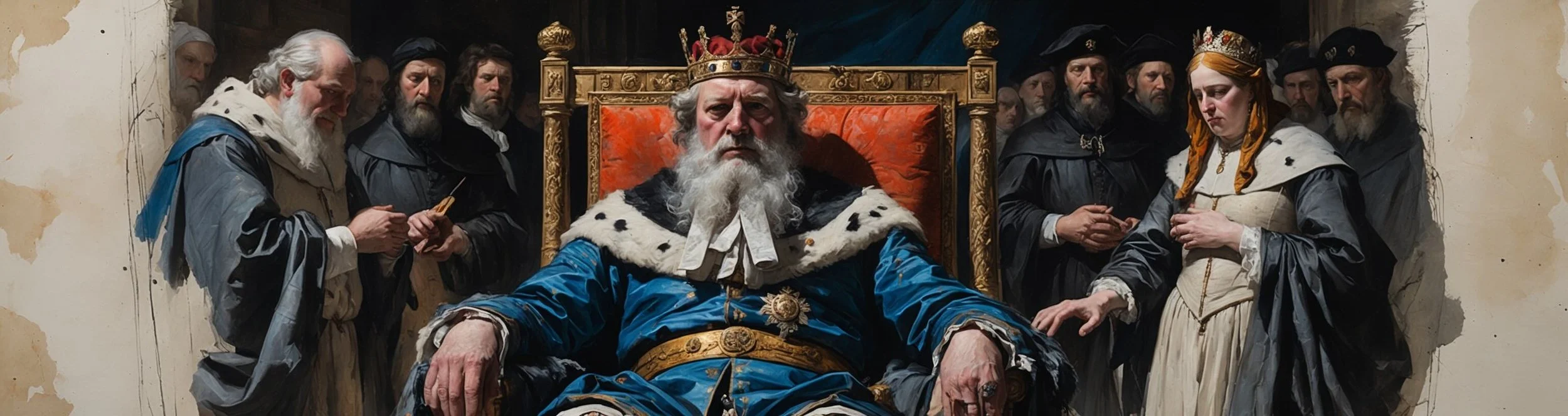
Scene Profile – At a Glance
- Location: London. The palace.
- What Happens: The dying King Edward makes his quarrelling nobles swear friendship. Richard arrives, makes peace with everyone, and then announces that Clarence is dead. The King, who had reversed the death warrant, is broken by the news and blames the court for not pleading for his brother.
- Key Characters: King Edward IV, Queen Elizabeth, Richard, Duke of Gloucester, The Duke of Buckingham, Rivers, Dorset, Hastings, Stanley, Ratcliffe.
- Dramatic Function: A peace ceremony wrecked by one sentence: the scene binds the court with oaths the play will collect on, and removes the last obstacle between Richard and the throne except the King himself.
- Famous Quote:
"I thank my God for my humility."
(Richard, Act 2, Scene 1) - Why It Matters: Every man who swears in this scene is destroyed by the oath he takes, and Richard’s announcement of Clarence’s death shows how a lie about timing can be more useful than the murder itself.
Scene Summary
King Edward, sick and near death, has spent the day reconciling his court. He calls it a good day’s work and asks the peers to continue their united league, since he expects every day to be called from the world and wants to leave his friends at peace. He makes Hastings and Rivers take each other’s hand and swear their love without dissembling, warning that the King of kings will punish hidden falsehood by making each the other’s end. Both swear. The King then turns to the Queen, to her son Dorset and to Buckingham, who have all been factious against one another; the Queen gives Hastings her hand, Dorset embraces him, and Buckingham swears an elaborate oath: if ever he turns his hate on the Queen or her allies, may God punish him with hatred from those he most expects to love him, and may the friend he most trusts prove deep, hollow and treacherous.
Edward calls the vow a pleasing cordial to his sickly heart and says only Gloucester is wanting to complete the peace. Richard enters with Ratcliffe, wishes everyone a happy time of day, and makes a general reconciliation: if anyone in the princely heap holds him a foe by false intelligence, he desires to be at peace, since it is death to him to be at enmity. He asks peace of the Queen, of Buckingham, of Rivers and Dorset and of everyone, declares he is no more at odds with any Englishman alive than the infant born that night, and thanks God for his humility. The Queen, delighted, asks the King to complete the day by pardoning their brother Clarence.
Richard rounds on her: has he offered love to be flouted in the royal presence? Everyone knows the gentle Duke is dead, and it is an injury to scorn his corpse. The court freezes; Buckingham asks Dorset if he looks as pale as the rest. The King says the order was reversed. Richard answers that Clarence died by the first order, which a winged Mercury carried, while some tardy cripple brought the countermand too late; and he adds that some less noble and less loyal people, nearer in bloody thoughts than in blood, deserve worse than Clarence and yet walk free of suspicion.
Stanley enters and kneels for a boon: the life of a servant who has killed a gentleman of the Duke of Norfolk’s. The request breaks the King open. Has he a tongue to doom his brother’s death and then pardon a slave? Clarence killed no man; his fault was a thought, and his punishment was death. Who sued to Edward for him? Who reminded him how Clarence left Warwick to fight for him, rescued him at Tewkesbury, wrapped him in his own clothes in the frozen field? Not one of them; yet when their drunken servants kill, they are all on their knees for pardon. Edward fears God’s justice will fall on him and on all of them for this, and is helped out by Hastings, crying for poor Clarence. Richard remarks to the lords that the Queen’s guilty kindred turned pale at the news, and that God will revenge it; they go to comfort the King.
A Good Day’s Work
The scene opens on the one moment in the play when the court is at peace, and Shakespeare makes the peace a ceremony: hands taken, oaths sworn, embraces given in a set order under the eye of a dying king. Edward’s motive is his own soul. He expects an embassage from his Redeemer, and wants to go to heaven having left his friends at peace on earth.
Original
Take heed you dally not before your king,
Lest He that is the supreme King of kings
Confound your hidden falsehood and award
Either of you to be the other’s end.
(King Edward, Act 2, Scene 1)
Shakespeare Retold (Modern Verse)
Make sure you are not lying to your king,
Or else our God, the real King of kings,
Will penalise your lying and declare
That both of you will die for that one sin.
The warning is the scene’s engine. Edward invokes the King of kings to punish any hidden falsehood by making each false swearer the other’s end, and the audience, who know how the story goes, hear the sentence being passed. Hastings and Rivers swear; both will be dead by the end of Act 3, Rivers at Pomfret and Hastings at the Tower, each destroyed by the man who is about to walk in and swear the same peace. Buckingham’s oath is the most elaborate and the most exactly repaid: he calls down hatred from those he most expects love from, and a friend who is deep, hollow, treacherous and full of guile, and in Act 5 he will remember the words on the morning of his execution. Nobody in the room is lying to the King except in the sense that matters, which is that none of them can keep an oath against the current of the play. The scene is the clearest early statement of the design of prophecy and curses: a wish spoken aloud in this play is a contract, and the terms are enforced.
I Thank My God for My Humility
Richard’s entrance is timed to the King’s cue – there wanteth now our brother Gloucester – and he plays the missing piece to perfection. His reconciliation is general, gracious and completely empty: he is at peace with anyone who holds him a foe by false intelligence, and he names them all, the Queen first.
Original
I do not know that Englishman alive
With whom my soul is any jot at odds
More than the infant that is born tonight.
(Richard, Act 2, Scene 1)
Shakespeare Retold (Modern Verse)
I don’t know any Englishman alive
With whom I am at odds with, any more than
An infant who has just been born tonight.
The comparison is the kind of joke Richard tells for his own benefit. The infant born tonight is at odds with no one because it knows no one; Richard is at odds with no one because he has already decided what to do with them all. The speech is a catalogue of exactly the people he will destroy – the Queen, Buckingham, Rivers, Dorset – offered as a list of new friends, and the line that caps it, thanking God for his humility, is the play’s purest specimen of the appearance he manufactures. The Queen’s response shows how well it works. She calls for a holy day, wishes all strifes were so well compounded, and, in the warmth of the moment, asks for the one thing that will let Richard detonate the scene.
Who Knows Not That the Gentle Duke Is Dead?
Elizabeth’s plea for Clarence is innocent, and Richard treats it as an insult: has he offered love to be flouted? The reversal is immediate and total, and it is a piece of theatre within the theatre.
Original
Why, madam, have I off’red love for this,
To be so flouted in this royal presence?
Who knows not that the gentle Duke is dead?
You do him injury to scorn his corse.
(Richard, Act 2, Scene 1)
Shakespeare Retold (Modern Verse)
Madam, have I just offered love to be
Made fun of in the presence of our king?
Who doesn’t know the gentle Duke is dead?
It is obscene to make fun of his corpse.
Richard has known since Act 1, Scene 4 that Clarence is dead; he ordered it. What he adds here is the timing. He tells the truth – the King’s first order killed Clarence – and attaches a lie about speed: the warrant flew by a winged Mercury, the countermand limped after it with some tardy cripple. The self-mockery is deliberate. Richard is the cripple in the room, and by putting the word in his own mouth he makes it impossible for anyone else to use it. Then he turns the news into an accusation. Some, less noble and less loyal, nearer in bloody thoughts than in blood, deserve worse than Clarence and go current from suspicion: the Queen’s kin, who have been the King’s advisers, are being fitted for the crime as it is announced. Buckingham’s question to Dorset – does he look as pale as the rest – is the stage picture: a court of white faces, and one man who is not surprised. It is manipulation at its most economical, a murder converted into a motive for the next one.
Not a Man of You
Stanley’s kneeling request for a servant’s life is small, and it is the thing that breaks the King. Edward’s speech is the longest and best he is given in the play, and it is about the failure of everyone in the room, himself included.
Original
Have I a tongue to doom my brother’s death,
And shall that tongue give pardon to a slave?
My brother killed no man, his fault was thought,
And yet his punishment was bitter death.
(King Edward, Act 2, Scene 1)
Shakespeare Retold (Modern Verse)
Would I instruct my brother to be killed
And then order a pardon on a slave?
My brother didn’t kill a man; he thought wrong,
And due to that, his punishment was death.
The speech is built on a run of questions – who sued to me, who kneeled, who spoke of brotherhood – and each question is a memory of what Clarence did for Edward: left Warwick, saved him at Tewkesbury, gave him his own clothes in the frozen field. The catalogue is the play’s fullest account of the brother it has killed off-stage, and it arrives too late to do him any good, which is the point. Edward’s wrath plucked the memory from him, and not one courtier had the grace to put it back, though they are on their knees fast enough when their carters commit a drunken slaughter. His last line before he is helped out is a prophecy of his own: he fears God’s justice will take hold on me and you, and mine and yours. The play honours it. The scene closes with Richard noting, for the lords’ benefit, that the Queen’s guilty kindred looked pale, and Buckingham speaking the first words of his new career: we wait upon your Grace. The King who made the peace is dying, and the man who will inherit the room has just chosen his next victims. For the argument about conscience in the play, Edward’s speech matters because it is the only time a guilty man in authority says the whole truth about his guilt while he still holds power, and it changes nothing.
Language and Technique
- Oath and curse: Rivers, Hastings and Buckingham each swear with a conditional curse – so thrive I, God punish me – and the play treats every one as a promise to be kept.
- Dramatic irony: The audience already knows Clarence is dead. Every line of the peace ceremony is heard against that knowledge, so the King’s hope sounds like a dying man’s mistake.
- The turned insult: “Some tardy cripple bare the countermand”: Richard uses the word for his own body before anyone else can, and makes the lie about the warrant sound like modesty.
- Repeated questions: Edward’s “Who sued to me for him? Who” begins a run of questions, each answered by silence; the repetition is his guilt counting itself.
- Classical allusion: “A winged Mercury”: the messenger of the gods carries the death warrant. The image gives the murder the speed of fate and the countermand the slowness of a man.
- The stage picture: “Look I so pale, Lord Dorset, as the rest?”: one line makes the audience look at every face on stage, and then at the one face that is not pale.
Key Quotes from Act 2, Scene 1
Quote 1
Hastings and Rivers, take each other’s hand,
Dissemble not your hatred, swear your love.
(King Edward, Act 2, Scene 1)
Shakespeare Retold (Modern Verse)
Hastings and Rivers, take each other’s hand,
And don’t just hide your hatred, swear your love.
Quote Analysis: The King’s peace in two lines: a handshake and an order not to pretend. “Dissemble not” is the scene’s key word, because dissembling is exactly what the man about to enter does best, and the play’s peace lasts only as long as he is out of the room.
When I have most need to employ a friend,
And most assured that he is a friend,
Deep, hollow, treacherous, and full of guile
Be he unto me! This do I beg of God,
When I am cold in love to you or yours.
(Buckingham, Act 2, Scene 1)
Shakespeare Retold (Modern Verse)
When I most need a friend to help me out,
And think for sure he is a loyal friend,
He can be insincere, false and deceptive
To me! And this is what I beg of God
If ever I don’t love you and your family.
Quote Analysis: Buckingham’s oath, and the most precise curse anyone in the play calls down on himself. He asks that the friend he most trusts prove deep, hollow, treacherous and full of guile if he is ever false to the Queen’s family; the friend will be Richard, and Buckingham will remember every word of this on the morning of his execution in 5.1.
But he, poor man, by your first order died,
And that a winged Mercury did bear;
Some tardy cripple bare the countermand,
That came too lag to see him buried.
(Richard, Act 2, Scene 1)
Shakespeare Retold (Modern Verse)
But poor old Clarence died from your first order
Which came as though flown in by Mercury;
Whilst some slow cripple brought the cancellation,
Which came so late, he was already buried.
Quote Analysis: Richard’s account of the two messengers is a lie about timing wrapped round a truth about the order. The countermand was real; the delay is his invention. The self-description – a tardy cripple – is the kind of joke only Richard can make, and it turns a murder he arranged into an accident of the post.
But for my brother not a man would speak,
Nor I (ungracious) speak unto myself
For him, poor soul. The proudest of you all
Have been beholding to him in his life;
Yet none of you would once beg for his life.
O God! I fear thy justice will take hold
On me and you, and mine and yours, for this.
(King Edward, Act 2, Scene 1)
Shakespeare Retold (Modern Verse)
But for my brother, nobody would speak up,
Nor did I, to my shame, convince myself
On his behalf, poor soul. The proudest of you
All owed him something whilst he was alive,
Yet none of you would plead to save his life.
Oh God! I fear you will inflict your justice
On me and you, and all our loved ones, for this.
Quote Analysis: The King’s verdict on his court and on himself. Nobody spoke for Clarence, Edward least of all, and the fear that God’s justice will take hold on me and you, and mine and yours is a prophecy the rest of the play fulfils in order: Edward’s sons, the Queen’s kin, Hastings, Buckingham, Richard.
Key Takeaways
- Oaths as contracts: Hastings, Rivers and Buckingham all swear conditional curses on themselves; the play collects on every one.
- The timing lie: Richard tells the truth about Clarence’s death and lies about the messengers, turning the King’s own order into a weapon against the Queen’s kin.
- The cripple’s joke: Richard names his own deformity before anyone else can, and makes the word do his work.
- Edward’s confession: The King’s speech is the play’s fullest memory of Clarence, spoken by the man who killed him, to the men who let him.
Study Questions and Analysis
Why does King Edward make his nobles swear friendship?
Because he is dying and wants to die with his affairs in order, on earth and in heaven. His opening speech says so plainly: he expects every day an embassage from his Redeemer, and his soul will part to heaven more in peace if he has made his friends at peace on earth. The reconciliation is also practical. Edward’s heir is a boy of twelve, and the boy’s minority will be governed by the very factions in this room – the Queen’s family on one side, the old nobility and Hastings on the other – so a united league among the peers is the only protection Edward can leave his son.
I every day expect an embassage
From my Redeemer to redeem me hence;
And more in peace my soul shall part to heaven,
Since I have made my friends at peace on earth.
(King Edward, Act 2, Scene 1)
Shakespeare Retold (Modern Verse)
Each day I now expect to get a message
From God to say my days on earth are done;
And I’ll ascend to heaven peacefully
Because I’ve brought my friends on earth to peace.
The scene follows Sir Thomas More’s account, in which Edward on his deathbed called the lords together and made them clasp hands in his presence, though More’s version is a long speech and Shakespeare’s is a ceremony of oaths. Shakespeare’s change is to make the King’s warning – that the King of kings will award either of the swearers to be the other’s end – the frame for the whole scene, so that a deathbed reconciliation becomes a set of curses waiting to fall. For the design of power and ambition in the play, Edward’s peace is the last act of legitimate authority before the Protectorate, and it fails within a hundred lines.
What is the dramatic irony of the oaths in Act 2, Scene 1?
Every man who swears is destroyed on the terms of his own oath. Rivers and Hastings swear perfect love with the formula so thrive I, and neither thrives: Rivers is executed at Pomfret in 3.3 and Hastings beheaded in 3.4, and in each case the other faction’s ruin is bound up with his own. Buckingham’s oath is the most elaborate and the most exactly repaid, and he says so himself in 5.1, on the morning of his execution, remembering that this is the day he wished might fall on him when he was false to Edward’s children or his wife’s allies.
So prosper I, as I swear perfect love!
(Hastings, Act 2, Scene 1)
Shakespeare Retold (Modern Verse)
So may I prosper, for my love is real!
E. M. W. Tillyard, in Shakespeare’s History Plays (1944), read the play as the last movement of a providential pattern in which every crime of the civil wars is paid for, and this scene is the clearest place to see the machinery: the oaths are sworn under an invocation of divine justice, and divine justice, in the shape of Richard, collects. Wolfgang Clemen, in A Commentary on Shakespeare’s Richard III (1968), noted how the scene’s ceremonial form – hand, oath, embrace, in sequence – gives the reconciliation the feel of a ritual, and how the ritual is emptied by the audience’s knowledge that Clarence is already dead. A student can hold both readings together: the oaths are a providential trap, and they are also stage business whose hollowness the audience is meant to feel while the King is still smiling.
Why does Richard say “I thank my God for my humility”?
Because it is the perfect false note, and he knows the audience will hear it. Richard has just made peace with the whole court in a speech that names each of his future victims as a friend, and has compared his own freedom from malice to that of an infant born that night. Thanking God for humility caps the performance with a virtue nobody in the play possesses less. The line is aimed in two directions: at the court, who take it as piety, and at the audience, who have been told in Act 1 that he is determined to prove a villain and are being invited to admire the craftsmanship.
I hate it, and desire all good men’s love.
(Richard, Act 2, Scene 1)
Shakespeare Retold (Modern Verse)
I hate it, and I want good men to love me.
William Hazlitt, in Characters of Shakespear’s Plays (1817), described Richard as a character in whom boldness, cunning and treachery are combined with complete confidence in his own powers, and this speech is the cunning at full stretch. The comparison with the newborn infant deserves attention: it is technically true, since Richard is at odds with nobody in the sense that he has no quarrel he has not already resolved to settle by murder. The scene’s argument about appearance and reality is that the court cannot tell a real reconciliation from a performed one because the performance is better.
How does Richard use the news of Clarence’s death?
In three moves. First he withholds it until the Queen has asked the King to pardon Clarence, so that her innocent request becomes the trigger and she appears to be mocking a dead man. Second he explains the death with a story about speed – the warrant went by a winged Mercury, the countermand by some tardy cripple – which is true about the order and false about the delay, and which makes the death the King’s doing rather than his own. Third he turns the news into an accusation, wishing aloud that some less noble and less loyal people, nearer in bloody thoughts than in blood, might deserve no worse than Clarence and yet walk free of suspicion.
God grant that some, less noble and less loyal,
Nearer in bloody thoughts, but not in blood,
Deserve not worse than wretched Clarence did,
And yet go current from suspicion!
(Richard, Act 2, Scene 1)
Shakespeare Retold (Modern Verse)
It seems God’s let someone less loyal and noble –
Who’s bloody-minded, not a blood relation,
Who should receive the punishment of Clarence –
Who now just walks away without suspicion.
The third move is the one that matters for the plot. The Queen’s kin have been Edward’s advisers; by hinting that they urged Clarence’s death, Richard begins the story he will tell the citizens in Act 3 and that Buckingham will repeat to the Lord Mayor. The scene’s last speech makes the hint explicit: the guilty kindred of the Queen looked pale, and they urged it still unto the King. None of it is true, and all of it is plausible, because the court has just watched everyone turn white. For an essay on manipulation and deceit, the scene is a model of how Richard works: he never invents a fact, he invents the timing and the motive around a fact, and lets the room draw the conclusion.
Why is King Edward’s speech about Clarence important?
It is the play’s only moment of full confession from a man in power. Stanley’s plea for a servant who killed in a brawl puts the question Edward cannot avoid: he doomed his brother for a thought and is now asked to pardon a slave for a killing. The speech that follows is a run of questions – who sued to me, who kneeled, who spoke of brotherhood – and each is a memory of what Clarence did for him: left Warwick, rescued him at Tewkesbury, wrapped him in his own garments in the frozen field. The memory is exact, and it is useless. Not a man in the room had the grace to put it in the King’s mind, and the King did not put it there himself.
Who sued to me for him? Who (in my wrath)
Kneeled at my feet and bid me be advised?
(King Edward, Act 2, Scene 1)
Shakespeare Retold (Modern Verse)
Who begged his case to me? Who, in my anger,
Kneeled down to ask that I should reconsider?
Shakespeare took the substance from Sir Thomas More, whose history records Edward lamenting, when anyone sued for a pardon, that no man had made suit for his brother. What the play adds is the placing: the speech comes the moment after Richard has used Clarence’s death against the Queen, so that the King’s remorse and Richard’s slander sit side by side, and the audience can see which of them the court will believe. Edward’s closing fear that God’s justice will fall on me and you, and mine and yours joins the scene’s other curses, and it is the one curse in the play that its speaker means as a confession rather than a weapon. For a question on conscience and guilt, Edward is the counter-example to Richard: a man whose conscience works, too late, on the one death he did not intend.
What does the ending of the scene show about Buckingham?
That he has changed sides without being asked. When Richard tells the lords that the Queen’s kindred looked pale and that God will revenge Clarence’s death, Buckingham answers for them all: we wait upon your Grace. It is his first line as Richard’s man. Earlier in the scene he swore, at length, to love the Queen’s allies; the oath is an hour old and he is already following the man who has just accused them. The play does not show a moment of decision – Buckingham simply appears on Richard’s side, as if the alliance had been settled off-stage – and his exit line is the sound of the court’s balance tipping.
This is the fruits of rashness! Marked you not
How that the guilty kindred of the Queen
Looked pale when they did hear of Clarence’ death?
O, they did urge it still unto the King!
(Richard, Act 2, Scene 1)
Shakespeare Retold (Modern Verse)
Rash actions caused this! Didn’t you observe
How all the Queen’s relations acted guilty
And all turned pale at news of Clarence’s death?
Yet they all urged the King himself to do it!
The exchange also sets up the play’s most instructive partnership. Buckingham is not a dupe; his pallor question to Dorset shows a man watching the room as closely as Richard does, and his oath has told the audience the exact terms on which he will be broken. The scene’s design gives the two men a shared method – a truth about Clarence, a lie about the messengers, a suspicion planted on the Queen’s kin – which they will use together in Act 3 to remove Hastings and to sell the crown to the citizens. For an essay on power, the scene shows how a faction forms in this play: not by conspiracy, but by two men reading the same silence and agreeing what it means.