Richard III: Act 2, Scene 2 – Analysis
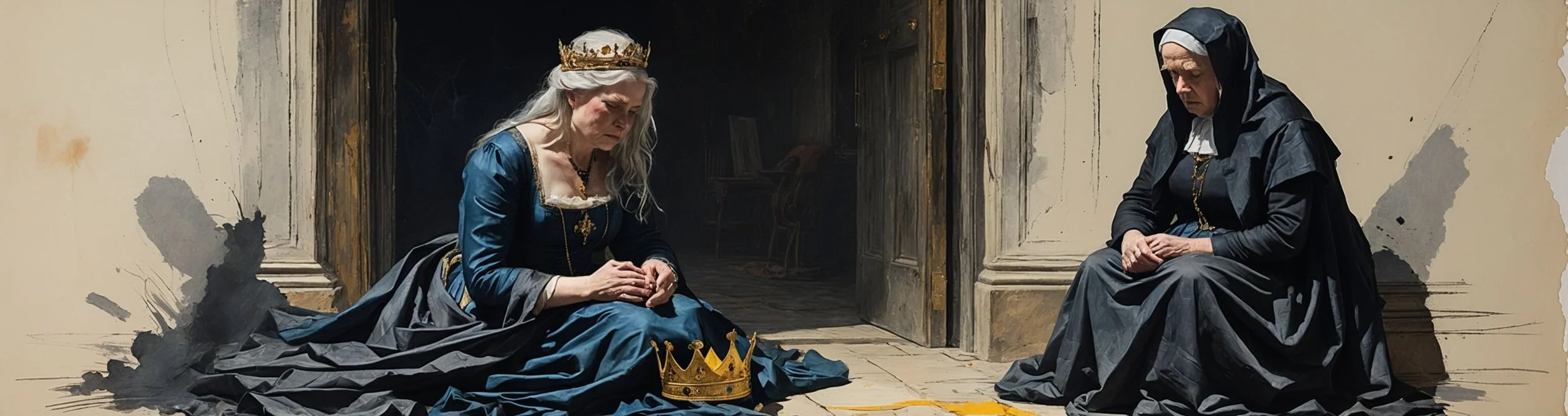
Scene Profile – At a Glance
- Location: London. The palace.
- What Happens: Clarence’s children question their grandmother about their father’s death; Queen Elizabeth enters with news that King Edward is dead. Three generations compete in grief. Richard asks his mother’s blessing and mocks it; The Duke of Buckingham proposes fetching the Prince from Ludlow with a small escort, and the two plan to separate him from the Queen’s kin on the way.
- Key Characters: The Duchess of York, Clarence’s children (Edward and Margaret Plantagenet), Queen Elizabeth, Richard, Duke of Gloucester, The Duke of Buckingham, Rivers, Dorset, Hastings.
- Dramatic Function: The play’s first formal lament, and the launch of the plot against the queen’s family: grief on one side of the stage, a plan on the other.
- Famous Quote:
"And with a virtuous visor hide deep vice!"
(Duchess of York, Act 2, Scene 2) - Why It Matters: The scene sets the pattern of the women’s chorus that will dominate Act 4, and shows Richard and Buckingham agreeing, in the same room, to take the Prince away from his protectors.
Scene Summary
George, Duke of Clarence’s two children ask the Duchess of York whether their father is dead. She says no, and then admits it: she has been lamenting the King’s sickness, not their father’s death, since it is lost sorrow to wail one that is lost. The boy blames the King his uncle and says God will revenge it; the Duchess tells them they cannot guess who caused their father’s death. The boy can: his good uncle Gloucester told him the King, provoked by the Queen, devised charges to imprison Clarence, and wept as he said it, kissed his cheek and bade him rely on him as a father. The Duchess groans that deceit should steal such gentle shape and hide deep vice with a virtuous visor; he is her son, and her shame, but he did not draw the deceit from her breast.
Queen Elizabeth enters with her hair about her ears, followed by Rivers and Dorset. Edward, her husband and the Duchess’s son, the King, is dead. Why grow the branches when the root is gone? The Duchess answers with her own losses: a husband long dead, and now two mirrors of him cracked by death – Clarence and Edward – leaving her one false glass in which she sees her shame. Elizabeth is a widow but still a mother; the Duchess has lost husband and two crutches. The children reproach their aunt for not weeping for their father; Elizabeth says she needs no help lamenting. The three parties cry in turn – for a husband, for a father, for both – until the Duchess claims all their griefs as hers, since she is the mother of them, and offers to be their sorrow’s nurse.
Dorset tells his mother that God is displeased by her ingratitude for the loan of a king; Rivers tells her to think like a careful mother of the young Prince, and send for him to be crowned. Richard enters with The Duke of Buckingham, Stanley and Hastings. He tells his sister to have comfort, that wailing cannot help, and then, seeing his mother, kneels for her blessing. She gives it – meekness, love, charity, obedience, true duty – and he says amen, and, aside, that she has left out the usual ending about dying a good old man. Buckingham urges the cloudy princes and sorrowing peers to cheer one another; the harvest of the old King is spent, and they will reap the harvest of his son; the newly knit peace must be kept. He proposes that the young Prince be fetched from Ludlow with some little train. Rivers asks why so few, and Buckingham explains that a multitude might break open the new-healed wound of malice while the state is green and ungoverned. Richard hopes the King’s peace holds firm in all, Rivers agrees that the peace being green should not be strained, Hastings assents, and the Duchess and Elizabeth are invited to help decide who shall go.
Left alone, Buckingham tells Richard that whoever goes to the Prince, they two must not stay at home, because on the way he will find occasion, as index to the story they lately talked of, to part the Queen’s proud kindred from the Prince. Richard calls him his other self, his counsel’s consistory, his oracle and prophet, and says he will go by his direction as a child. Toward Ludlow, then.
A Virtuous Visor
The scene begins with children asking the question adults will not answer. Clarence’s son has been told a story about his father’s death by his uncle Gloucester – with tears, a kiss and a promise – and he believes it. His grandmother knows better.
Original
Ah! That deceit should steal such gentle shape,
And with a virtuous visor hide deep vice!
He is my son – ay, and therein my shame,
Yet from my dugs he drew not this deceit.
(Duchess of York, Act 2, Scene 2)
Shakespeare Retold (Modern Verse)
It’s awful that a liar may seem kind,
Disguising evil with an honest face!
He is my son, and I’m ashamed of that,
Although it’s not my genes that made him wicked.
The Duchess’s four lines are the first thing anyone says about Richard’s deceit from the inside of the family, and they are precise: deceit has stolen a gentle shape, and a virtuous visor – a mask – hides deep vice. She names him her son and her shame in one breath, and disowns the deceit as not drawn from her breast. The boy’s reply is the play’s argument about appearance and reality in a child’s voice: think you my uncle did dissemble, grandam? Ay, boy. I cannot think it. The audience heard Richard, in Act 1, Scene 3, boast that he would tell the fools that God bids us do good for evil and seem a saint while playing the devil; here is a fool of nine believing it, and a grandmother who cannot make him stop. Shakespeare places the exchange before the news of Edward’s death so that the audience knows, before the lament starts, that the man about to kneel for a blessing has already lied to his brother’s orphans about his brother’s murder.
Was Never Widow Had So Dear a Loss
Elizabeth’s entrance with her hair about her ears is the play’s first formal lament, and Shakespeare writes it as a competition. Three parties – a widow, two orphans, a mother – claim the largest grief in turn, and the lines answer one another like a chant.
Original
QUEEN ELIZABETH: What stay had I but Edward? And he’s gone.
CHILDREN: What stay had we but Clarence? And he’s gone.
DUCHESS OF YORK: What stays had I but they? And they are gone.
QUEEN ELIZABETH: Was never widow had so dear a loss.
CHILDREN: Were never orphans had so dear a loss.
DUCHESS OF YORK: Was never mother had so dear a loss.
(Act 2, Scene 2)
Shakespeare Retold (Modern Verse)
QUEEN ELIZABETH: Who’d help me out but Edward? Now he’s dead.
CHILDREN: Who’d help us out but Clarence? Now he’s dead.
DUCHESS OF YORK: Who’d help me out but them? And now they’re dead.
QUEEN ELIZABETH: A widow never suffered so much loss.
CHILDREN: And orphans never suffered so much loss.
DUCHESS OF YORK: A mother never suffered so much loss.
The pattern is liturgical: a line for Elizabeth, a line for the children, a line for the Duchess, each with the same shape and a different name. Modern audiences sometimes find it cold; the point is that the grief is being organised into a ritual because ritual is what the powerless have. The Duchess ends the sequence by claiming all three griefs as hers – she is the mother of these griefs, theirs parcelled, hers general – and offering to nurse their sorrow. Her earlier image is the scene’s best: two mirrors of her husband cracked by death, and one false glass left, in which she sees her shame. The false glass is Richard, and he is about to walk in. The ritual lament, tried out here on a small scale, is the form the women will use at length in Act 4, Scene 4, when Margaret joins them; this scene is the rehearsal, and it teaches the audience the shape of the play’s mourning.
The Butt-End of a Mother’s Blessing
Richard enters, comforts the widow in two lines, and kneels to his mother. She blesses him with the virtues he lacks – meekness, love, charity, obedience, true duty – and he answers with an aside about what she left out.
Original
DUCHESS OF YORK: God bless thee, and put meekness in thy breast,
Love, charity, obedience, and true duty!
RICHARD: Amen! –
And make me die a good old man!
That is the butt-end of a mother’s blessing.
I marvel that her Grace did leave it out.
(Act 2, Scene 2)
Shakespeare Retold (Modern Verse)
DUCHESS OF YORK: God bless you, and adopt the humble traits of
Love, charity, obedience and duty!
RICHARD: Amen!
And let me live to be an old man!
That should be how my mother ends her blessing.
I am surprised the lady left it out.
The joke is that the conventional blessing ends with a wish that the child die a good old man, and the Duchess has not said it; Richard notices, and tells the audience. It is a small moment and a complete one: a mother who cannot bring herself to wish her son long life, and a son who turns her reticence into a wisecrack. The play has just shown the Duchess calling him her shame and a virtuous visor; now she blesses him to his face with the list of what he is not, and he kneels through it. Buckingham’s speech that follows is the public version of the same hypocrisy – cheer each other, keep the new peace, fetch the Prince with a little train – and Rivers’ question, why so few, is the one moment anyone in the scene resists. Buckingham’s answer, that a large escort might reopen the wound of malice in a green and ungoverned state, is the reasoning of a man who intends to do exactly that with a small one. Richard’s line that the compact is firm and true in him is spoken by the man who will break it within a scene, and the Duchess and Elizabeth are invited to help choose the escort that will remove the Queen’s protectors. The play’s account of manipulation here is collective: a room agrees to the plan that will destroy it, because the plan is phrased as peace.
My Other Self
The scene ends with the plotters alone, and Buckingham’s proposal made plain: on the road to the Prince, he will find the occasion to separate the boy from the Queen’s kindred. Richard’s reply is the partnership’s love letter.
Original
My other self, my counsel’s consistory,
My oracle, my prophet, my dear cousin,
I, as a child, will go by thy direction.
Toward Ludlow then, for we’ll not stay behind.
(Richard, Act 2, Scene 2)
Shakespeare Retold (Modern Verse)
You are the other part of me, my guardian,
My priest and prophet, and my dearest cousin,
Who, like a child, I’ll follow where you lead me.
Let’s head to Ludlow then, and not stay here.
Consistory, oracle, prophet, other self: Richard piles up the titles, and then says he will follow Buckingham’s direction as a child follows a parent. The audience has just watched a real child follow his direction into a lie, so the image is loaded. It is also the beginning of an arrangement whose end the play has already fixed: the child who follows Buckingham here will be the king who refuses him an earldom in Act 4, Scene 2. Buckingham’s phrase for the plan – the story we late talked of – tells the audience that the two men have a script, and the arrests at Stony Stratford, reported in Act 2, Scene 4, are its first act. The scene’s design of power is that the coup is agreed in the room where the family is mourning, in the language of comfort, and confirmed in an exit line about Ludlow.
Language and Technique
- Children as truth-tellers: Clarence’s son repeats Richard’s lie with the tears and the kiss included, so the audience hears the technique described by its victim.
- The mask: “A virtuous visor”: the Duchess’s image makes deceit a face worn over a face, the play’s plainest picture of Richard’s method.
- Ritual lament: Three parties, three losses, matched lines: grief is shaped into a chant, and the shape is the point – order imposed on what cannot be helped.
- Mirrors: Two mirrors of the Duchess’s husband cracked, one false glass left: her sons as reflections, and Richard the distorting one.
- The aside as commentary: Richard’s remark on the butt-end of a mother’s blessing turns a benediction into a joke, and the audience laughs with the man being blessed.
- Peace as pretext: Buckingham’s argument for a small escort is phrased entirely in terms of keeping the peace, and it is the plan to break it.
Key Quotes from Act 2, Scene 2
Quote 1
Grandam, we can; for my good uncle Gloucester
Told me the King, provoked to it by the Queen,
Devised impeachments to imprison him;
And when my uncle told me so, he wept,
And pitied me, and kindly kissed my cheek...
(Clarence's son, Act 2, Scene 2)
Shakespeare Retold (Modern Verse)
Grandma, we can; for my good uncle Richard
Told me the King, encouraged by the Queen,
Invented reasons to imprison him;
And when my uncle told me this, he cried,
And, feeling sorry for me, kissed my cheek...
Quote Analysis: A child’s account of being lied to. Every detail is Richard’s method – the blame shifted to the Queen, the tears, the kiss, the promise to be a father – and the boy reports it as kindness. The audience, which watched Richard arrange Clarence’s murder in Act 1, hears the lie whole.
Edward, my lord, thy son, our king, is dead!
Why grow the branches when the root is gone?
Why wither not the leaves that want their sap?
(Queen Elizabeth, Act 2, Scene 2)
Shakespeare Retold (Modern Verse)
Edward, my lord, your son, our king, is dead!
Why bother growing branches when the root’s gone?
Why don’t leaves wither when they’re starved of water?
Quote Analysis: The news, and the image that follows it. Elizabeth names the dead man by every relation he had – lord, son, king – and then asks why the branches should grow when the root is gone. The tree of the royal family is the play’s recurring image, and this is where its root is cut.
But now two mirrors of his princely semblance
Are cracked in pieces by malignant death,
And I for comfort have but one false glass,
That grieves me when I see my shame in him.
(Duchess of York, Act 2, Scene 2)
Shakespeare Retold (Modern Verse)
But now those two reflections of my husband
Lie shattered by the hand of spiteful death,
And all that’s left is Richard’s buckled image
That pains me when I see that man I’ve made.
Quote Analysis: The Duchess’s mirrors: Edward and Clarence reflected their father, and both are broken; Richard is the one glass left, and it is false. The image gives the audience the family as the mother sees it – two true likenesses dead, one distortion alive – and the word shame is hers for him throughout the play.
Amen! –
And make me die a good old man!
That is the butt-end of a mother’s blessing.
I marvel that her Grace did leave it out.
(Richard, Act 2, Scene 2)
Shakespeare Retold (Modern Verse)
Amen!
And let me live to be an old man!
That should be how my mother ends her blessing.
I am surprised the lady left it out.
Quote Analysis: Richard’s aside on his mother’s blessing. She wished him meekness, love, charity, obedience and duty, and not long life; he supplies the omission himself and marvels at her. The joke is at his own expense and hers, and the audience is made complicit in it – which is the play’s habit, and the reason Richard’s charm is dangerous.
For by the way, I’ll sort occasion,
As index to the story we late talked of,
To part the Queen’s proud kindred from the Prince.
(Buckingham, Act 2, Scene 2)
Shakespeare Retold (Modern Verse)
For on the way, I’ll find a decent time,
As per the plan we spoke of recently,
To separate the Prince from his proud family.
Quote Analysis: Buckingham’s plan in three lines: on the road, an occasion will be found to part the Queen’s kin from the Prince. “Index” means prologue, and the story they lately talked of is the coup. The arrests at Stony Stratford follow within a scene.
Key Takeaways
- A lie told to a child: Clarence’s son believes his uncle wept for his father; the audience knows who killed him, and the grandmother says so.
- Grief as ritual: Widow, orphans and mother claim the greatest loss in matched lines – the form of lament the women will use again in Act 4.
- A blessing without long life: The Duchess blesses Richard with virtues, omits the wish that he grow old, and he jokes about it to the audience.
- Peace as the pretext for a coup: Buckingham’s small escort is argued from the fragility of the new peace, and it is the means of breaking it.
- The partnership sealed: My other self, my oracle: Richard hands direction to Buckingham as a child to a parent, and the road to Ludlow begins.
Study Questions and Analysis
What does the Duchess mean by a “virtuous visor”?
A visor is the front of a helmet, or a mask, and the Duchess is saying that Richard hides deep vice behind a face that looks virtuous. She says it after Clarence’s son has repeated Richard’s story about his father’s death – that the King, provoked by the Queen, had Clarence imprisoned, and that Richard wept and kissed him and promised to be a father to him. The Duchess knows the story is false and the tears were a performance; the boy does not, and cannot be persuaded.
Ah! That deceit should steal such gentle shape,
And with a virtuous visor hide deep vice!
(Duchess of York, Act 2, Scene 2)
Shakespeare Retold (Modern Verse)
It’s awful that a liar may seem kind,
Disguising evil with an honest face!
The line is the play’s plainest statement of its theme of appearance and reality, and it is given to Richard’s mother, who has more reason than anyone to know the face behind the mask. Her next lines – he is my son, and therein my shame, yet from my dugs he drew not this deceit – are the first stirring of the disowning that becomes a curse in Act 4, Scene 4. Richard himself boasted in Act 1, Scene 3 that he would seem a saint when most he played the devil; the Duchess’s visor is the same idea seen from the side of the deceived.
Why is the lament so formal and repetitive?
Because Shakespeare is writing it as a ritual, not as a conversation. Elizabeth, Clarence’s children and the Duchess each state their loss in a line of the same shape – what stay had I but Edward, what stay had we but Clarence, what stays had I but they – and then each claims that no widow, orphan or mother ever had so dear a loss. The pattern comes from Senecan tragedy and from the formal laments of The Mirror for Magistrates, and it turns private grief into a public ceremony in which everyone’s loss is weighed against everyone else’s.
QUEEN ELIZABETH: Ah for my husband, for my dear Lord Edward!
CHILDREN: Ah for our father, for our dear Lord Clarence!
DUCHESS OF YORK: Alas for both, both mine, Edward and Clarence!
(Act 2, Scene 2)
Shakespeare Retold (Modern Verse)
QUEEN ELIZABETH: All for my husband, for my dear Lord Edward!
CHILDREN: All for our father, for our dear Lord Clarence!
DUCHESS OF YORK: It’s sad for both of mine, Edward and Clarence!
The form is easy to mock and productions often cut it, but it does two things. It shows the family competing even in grief – the children reproach their aunt for not weeping for their father, and the Duchess insists her sorrow is general where theirs is parcelled – and it establishes the shape the play’s women will use at greater length in Act 4, Scene 4, when Margaret joins the chorus. Samuel Johnson, in his 1765 edition, found parts of the play trifling and others noble; the lament is where readers divide, and a student can argue that its artificiality is its meaning – grief made orderly because nothing else can be.
What is the joke about the mother’s blessing?
Richard kneels and asks his mother’s blessing, which was the custom, and the Duchess gives him one: God bless thee, and put meekness in thy breast, love, charity, obedience and true duty. Richard says amen and then, aside, adds the line she left out – and make me die a good old man – remarking that this is the usual ending of a mother’s blessing and he is surprised she omitted it. The joke is that she cannot wish him long life, and he has noticed.
Amen! –
And make me die a good old man!
That is the butt-end of a mother’s blessing.
I marvel that her Grace did leave it out.
(Richard, Act 2, Scene 2)
Shakespeare Retold (Modern Verse)
Amen!
And let me live to be an old man!
That should be how my mother ends her blessing.
I am surprised the lady left it out.
The exchange is a small masterpiece of the play’s double register. To the room, Richard is a dutiful son; to the audience, he is a man who has just been called a virtuous visor by the woman blessing him and knows exactly what her omission means. The blessing lists everything he is not, and his aside turns the list into comedy at his own expense. Charles Lamb, writing in 1802, thought unstrained mirth a prime feature of Richard’s character; this is the mirth turned on his mother, and it is funnier than it should be, which is the play’s trap for the audience.
Why does Buckingham want the Prince fetched with a small escort?
Ostensibly to protect the peace. The old King made the court swear friendship in Act 2, Scene 1, and Buckingham argues that a large escort of nobles might reopen the new-healed wound of malice while the state is green and ungoverned – too many horses, each bearing its own rein. Rivers, the Queen’s brother, agrees that the peace being new should not be strained, and Hastings assents. The real reason is given when the room empties: on the road, Buckingham will find the occasion to part the Queen’s proud kindred from the Prince, as the prologue to the plan he and Richard have already discussed.
Me seemeth good that, with some little train,
Forthwith from Ludlow the young Prince be fet
Hither to London, to be crowned our king.
(Buckingham, Act 2, Scene 2)
Shakespeare Retold (Modern Verse)
It seems to me a good idea some folk
Should swiftly bring the young Prince back from Ludlow,
Returning him to London to be crowned king.
The argument is a model of the play’s political method: a plan to seize the Prince is presented as a plan to keep the peace, and the people it will destroy agree to it. Rivers’ question – why so few? – is the only moment of resistance, and it is answered with more talk of peace. Historically Richard and Buckingham intercepted the Prince’s party at Stony Stratford on 30 April 1483 and arrested Rivers, Grey and Vaughan; the play reports the arrests in Act 2, Scene 4. For an essay on manipulation and deceit, the escort debate is the clearest example of a room being talked into its own undoing.
What does Richard mean when he calls Buckingham his “other self”?
He is accepting Buckingham’s direction. Buckingham has just proposed the plan for the road to Ludlow, and Richard answers with a string of titles – my other self, my counsel’s consistory (the council chamber of his thoughts), my oracle, my prophet – and says he will go by Buckingham’s direction as a child. It is the fullest declaration of partnership in the play, and it comes at the moment the coup passes from talk to action.
The audience should hear it against two things. First, the child image: Richard has just been shown lying to a real child, Clarence’s son, who trusted him as a father, so his offer to follow Buckingham like a child is a promise made in the vocabulary of his own deceptions. Second, the future: the man who is Richard’s other self here will be refused, in Act 4, Scene 2, the earldom promised for his service, and will die at Salisbury remembering it. The play’s partnerships are all provisional, and this speech is the high point of the one that matters most. A student writing on power and ambition can trace the arc from my other self to not in the giving vein in two acts.