Richard III: Act 2, Scene 3 – Analysis
Scene Profile – At a Glance
- Location: London. A street.
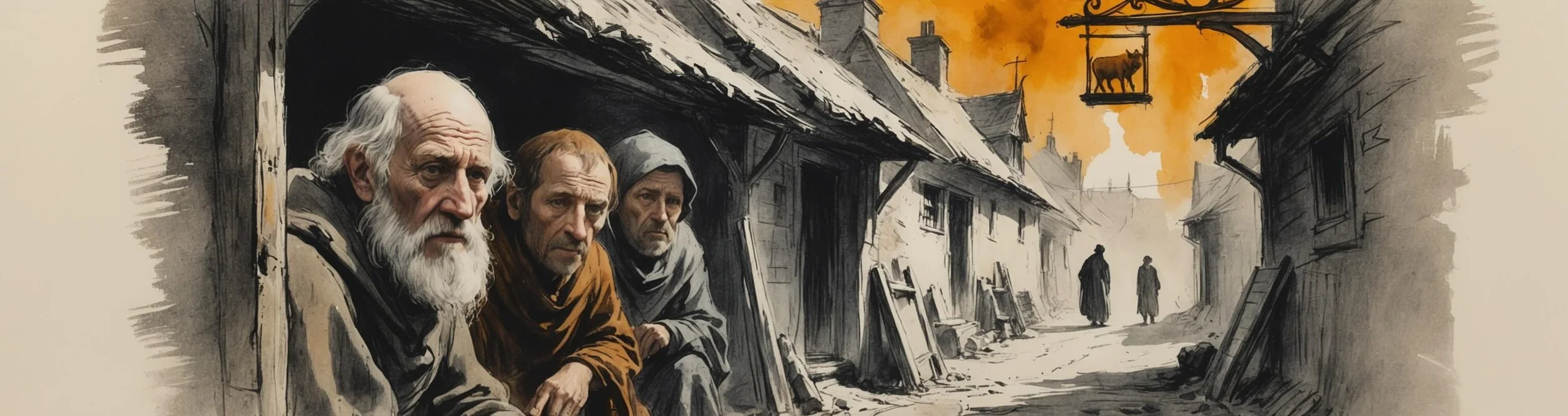
- What Happens: Three citizens meet with the news that King Edward is dead and a child will succeed him. One hopes for the best; the Third Citizen fears a land governed by a child, the Duke of Gloucester, and the queen’s proud kin, and reads the coming storm in the signs.
- Key Characters: First, Second and Third Citizens.
- Dramatic Function: The play’s chorus of ordinary Londoners: forty-nine lines in which the people say what the court will not, and are right.
- Famous Quote:
"Woe to that land that’s governed by a child!"
(Third Citizen, Act 2, Scene 3) - Why It Matters: Nobody in the scene has a name or a title, and between them they predict the play – the citizens’ fear is the audience’s knowledge spoken from the street.
Scene Summary
Two citizens meet in the street. The Second Citizen scarcely knows where he is going; has the First heard the news? Yes: the King is dead. It is bad news, says the Second, and seldom comes the better; he fears a giddy world. A Third Citizen joins them and confirms it – good King Edward is dead, God help the while – and warns them to look for a troublous world. The First Citizen is confident: by God’s grace, the King’s son will reign. The Third Citizen answers with a proverb: woe to the land that is governed by a child.
The Second Citizen hopes there is a hope of government in the boy, with a council to guide him until he is of age. The First recalls that the state stood so when Henry VI was crowned in Paris at nine months old. Not so, says the Third: then the land had grave political counsel and the King had virtuous uncles to protect him. This prince has uncles on both sides, says the First. Better, says the Third, that they all came by his father, or that there were none by his father at all; the contest over who shall stand nearest the King will touch them all. The Duke of Gloucester is full of danger, and the queen’s sons and brothers are proud; if they were ruled and did not rule, the sick land might recover as before.
The First Citizen says they fear the worst and all will be well. The Third answers with the signs: when clouds appear, wise men put on cloaks; when the leaves fall, winter is at hand; when the sun sets, everyone looks for night; untimely storms make men expect a dearth. All may be well, but if God sorts it so, it is more than they deserve or he expects. The Second observes that men’s hearts are full of fear and nobody looks other than heavy and full of dread. The Third says it is always so before days of change – men’s minds mistrust danger by a divine instinct, as the water swells before a storm – but leave it all to God. They have all been sent for to the justices, and go together.
Woe to That Land
The scene is a small debate about the succession, held by people who have no part in deciding it. The First Citizen is an optimist, the Third a pessimist, and the play gives the pessimist the proverb and the last word.
Original
Woe to that land that’s governed by a child!
(Third Citizen, Act 2, Scene 3)
Shakespeare Retold (Modern Verse)
It’s awful when a child rules the country!
The line is from the book of Ecclesiastes, and its force here is that it is answered on stage: a child is about to be governed by an uncle, and the audience knows the uncle. The Third Citizen’s history is exact – Henry VI was crowned as an infant and the land survived because it had good counsel and virtuous uncles – and his analysis of the present is exacter still: a king with uncles on two sides means a contest over who shall be nearest, and the contest will touch everyone. His naming of the danger is the plainest thing anyone says about Richard in the first two acts: O, full of danger is the Duke of Gloucester. Nobody at court has said it. The citizens can, because they have nothing to lose but the country, and the scene’s argument about power is that the people see the shape of it before the people who hold it do.
When Clouds Are Seen
The First Citizen’s comfort – we fear the worst, all will be well – is met with a speech built entirely from weather. The Third Citizen reads the political sky as a farmer reads the real one.
Original
When clouds are seen, wise men put on their cloaks;
When great leaves fall, then winter is at hand;
When the sun sets, who doth not look for night?
Untimely storms makes men expect a dearth.
(Third Citizen, Act 2, Scene 3)
Shakespeare Retold (Modern Verse)
Wise men put on their raincoats when it’s cloudy;
When leaves fall from the trees, it’s nearly winter;
At dusk, who doesn’t know the night is coming?
With early storms, we fear a ravaged harvest.
Four signs, four consequences, all from the natural world: cloaks for clouds, winter for falling leaves, night for sunset, dearth for early storms. The speech is a lesson in reading omens, and its point is that the reading is easy – anyone can see night coming from the sun’s setting – so the only question is whether the signs will be acted on. The play has shown, and will show, courtiers refusing to act on plainer signs than these; Hastings will laugh at a dream and die within the day. The Third Citizen’s final observation, that men’s minds mistrust danger by a divine instinct before days of change, as the water swells before a storm, is the play’s account of the dread that runs through Act 2, and it is accurate. What the citizens cannot do is anything at all; they have been sent for to the justices, and they go. The scene’s contribution to the design of prophecy is to show that prophecy in this play needs no witches: the weather is enough, for anyone who looks up.
Language and Technique
- Anonymous chorus: Three numbered citizens with no names: the scene gives the play’s clearest political judgement to the people with the least power to act on it.
- Proverb as argument: “Woe to that land that’s governed by a child” is scripture used as a forecast, and it silences the optimist because it cannot be argued with.
- Historical precedent: Henry VI crowned at nine months: the citizens argue from the last child king, which is the same history the play’s noble characters keep forgetting.
- Weather omens: Clouds, leaves, sunset, storms: the Third Citizen’s speech is a run of natural signs, so that political foresight sounds like common sense about rain.
- The swelling water: “The water swell before a boist’rous storm”: dread given a physical image, the rising sea before the weather breaks.
Key Quotes from Act 2, Scene 3
Quote 1
I fear, I fear ’twill prove a giddy world.
(Second Citizen, Act 2, Scene 3)
Shakespeare Retold (Modern Verse)
I’m worried that our world will be unstable.
Quote Analysis: The Second Citizen’s first reaction to the King’s death. “Giddy” – dizzy, unstable, spinning – is the play’s word for a world without a settled head, and the repeated “I fear” is the sound of a man who does not yet know what to be afraid of.
O, full of danger is the Duke of Gloucester,
And the Queen’s sons and brothers haught and proud!
(Third Citizen, Act 2, Scene 3)
Shakespeare Retold (Modern Verse)
For Richard, Duke of Gloucester, is a danger,
And the Queen’s sons and brothers all are snooty!
Quote Analysis: The plainest statement about Richard in the first two acts, and it is made in the street by a man without a name. The queen’s kin get their share too – haught and proud – so the citizen’s fear is not partisan: he sees two factions and a boy between them.
By a divine instinct men’s minds mistrust
Ensuing danger; as by proof we see
The water swell before a boist’rous storm.
(Third Citizen, Act 2, Scene 3)
Shakespeare Retold (Modern Verse)
Instinctively we all start getting nervous
When danger’s near, such as when we observe
The sea waves rise before a raging storm.
Quote Analysis: The scene’s closing image. Fear before change is not superstition but instinct, and the instinct is compared to the sea rising ahead of a storm – a physical fact, not a fancy. The line explains the dread that fills Act 2, and gives it the authority of nature.
Key Takeaways
- The people see it first: Three anonymous citizens name the danger – Gloucester, the proud queen’s kin, a child king – before anyone at court does.
- Scripture as forecast: Woe to the land governed by a child: the proverb from Ecclesiastes is the scene’s argument, and the play proves it.
- The last child king: Henry VI’s infancy is the precedent, and the difference – virtuous uncles then, a dangerous one now – is the point.
- Omens are ordinary: Clouds, leaves and sunset: the Third Citizen’s foresight is weather-wisdom, and it is more accurate than the court’s.
Study Questions and Analysis
What is the purpose of the citizens’ scene?
To give the audience the view from the street at the moment the succession opens. The court scenes of Act 2 have shown the King’s death and the queen’s grief; this scene shows three Londoners hearing the news and working out what it means, and their conclusions are the play’s. A child will reign; his uncle on one side and his mother’s family on the other will contend to be nearest him; the Duke of Gloucester is dangerous; the land is sick. Everything they fear happens.
Then, masters, look to see a troublous world.
(Third Citizen, Act 2, Scene 3)
Shakespeare Retold (Modern Verse)
Then, friends, prepare yourselves for troubling times.
The scene also stands for the people whose consent Richard will later need and fail to get. In Act 3, Scene 7 the citizens of London answer Buckingham’s call to acclaim Richard with silence, and this scene has told the audience why: they saw the danger the day the old King died. Shakespeare uses anonymous citizens in several plays as a chorus of common sense – the tribunes’ scenes in Coriolanus, the plebeians in Julius Caesar – and here their function is to be right and powerless. The pattern is the play’s picture of power: the truth is common knowledge, and common knowledge cannot vote.
Why does the Third Citizen mention Henry VI being crowned at nine months old?
Because he is answering the argument that a child king with a good council can govern well. The First Citizen cites Henry VI, who succeeded as an infant in 1422 and was crowned in Paris as a small child, and whose minority did not immediately collapse; the Third Citizen agrees on the fact and disputes the comparison. Then, he says, the land had grave political counsel and the King had virtuous uncles – Bedford and Gloucester, Henry V’s brothers – to protect him. This prince has uncles too, but on two sides, and the contest between them is the danger.
Stood the state so? No, no, good friends, God wot,
For then this land was famously enriched
With politic grave counsel; then the King
Had virtuous uncles to protect his Grace.
(Third Citizen, Act 2, Scene 3)
Shakespeare Retold (Modern Verse)
Was that the same as now? God knows it’s not,
For then this country was richly imbued
With serious political advisers
And caring uncles to protect the King.
The reference does two things. It shows the citizens thinking historically, which is more than most of the play’s nobles do, and it points the audience back to the Henry VI plays, where the virtuous uncle Humphrey of Gloucester was destroyed by court faction. The name Gloucester is the joke: the good Duke of Gloucester protected the last child king, and a different Duke of Gloucester is about to destroy this one. A student writing on fate and history in the play can use the exchange as evidence that the play’s characters live inside a remembered pattern and expect it to repeat.
What does “Woe to that land that’s governed by a child” mean?
It is a quotation from the book of Ecclesiastes – woe to thee, O land, when thy king is a child – and the Third Citizen uses it to answer the First Citizen’s confidence that Edward’s son will reign. A child king means a regency, a regency means factions, and factions mean disorder; the biblical proverb compresses the argument into a curse. The modern verse gives it in a Londoner’s plain register: it is awful when a child rules the country.
The line has an afterlife in the play. Richard, as Lord Protector, is the man who will govern the child, and the scene’s fear is of him by name. The proverb is also part of the play’s habit of turning sayings into prophecies – Hastings’ boar, Richard’s herbs and weeds, Margaret’s curses – so that folk wisdom and scripture become forecasts the plot then honours. For an essay on prophecy and curses, the citizens are useful as the play’s proof that foresight needs no supernatural help: a man who reads Ecclesiastes and watches the weather sees the same future the ghosts will announce.