Richard III: Act 4, Scene 2 – Analysis
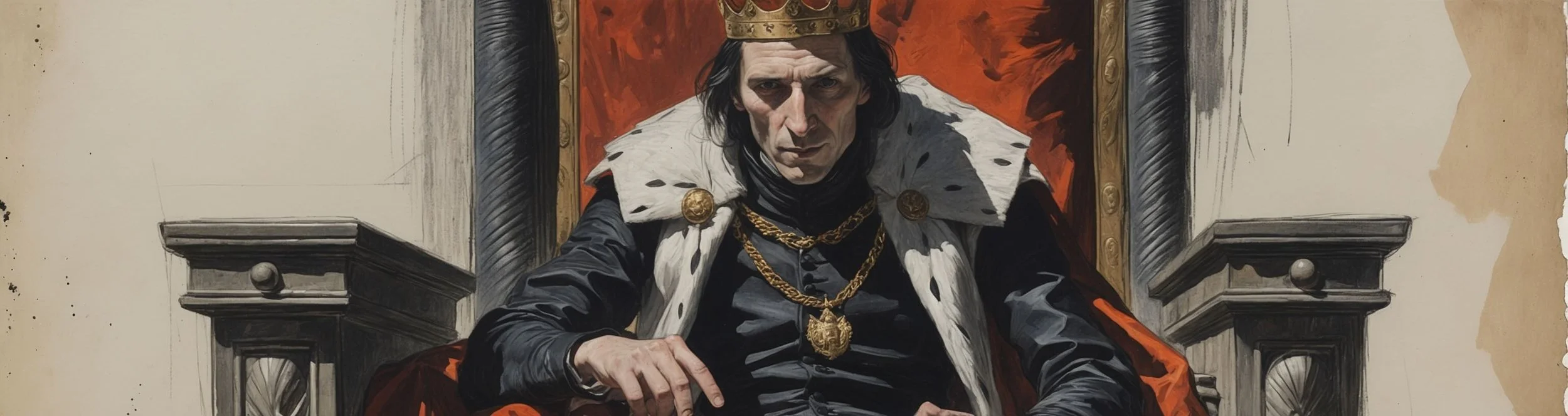
Scene Profile – At a Glance
- Location: London. The palace – Richard’s first scene as king, crowned and in state.
- What Happens: Richard tests The Duke of Buckingham by asking him to kill the princes; Buckingham hesitates. Richard hires Tyrrel through a page, plans to be rid of Lady Anne and marry his niece, and refuses Buckingham the earldom he was promised. Buckingham flees to raise rebellion.
- Key Characters: King Richard, The Duke of Buckingham, Catesby, Lord Stanley, a Page, Sir James Tyrrel.
- Dramatic Function: The reign begins and the partnership ends: within a hundred lines of his coronation Richard orders the murder of two children and discards the man who made him king.
- Famous Quote:
"I am not in the giving vein today."
(King Richard, Act 4, Scene 2) - Why It Matters: The scene shows what Richard is like with the crown on – no soliloquies, no charm, only orders – and plants the two things that will destroy him: the murdered princes and the abandoned ally.
Scene Summary
A sennet sounds and Richard enters crowned, with The Duke of Buckingham, Catesby, Ratcliffe, Lovel, a page and others. He takes Buckingham’s hand, credits him with his elevation, and asks whether these glories will last a day or forever. Then he tests him, as gold is tested on a touchstone: young Edward lives. Buckingham does not take the hint. Richard says it plainly – he wishes the bastards dead and wants it done at once – and Buckingham asks for a little breath before he answers.
Catesby notices the King gnawing his lip. Richard, aside, decides that he will deal only with iron-witted fools and careless boys from now on, since high-reaching Buckingham has grown circumspect, and asks his page whether he knows anyone that gold would tempt to a secret killing. The page names a discontented gentleman, Tyrrel, and is sent to fetch him. Richard notes that Buckingham will no longer be the neighbour to his counsels. Stanley brings news that Dorset has fled to Richmond.
Richard gives Catesby his orders: spread a rumour that Lady Anne is grievously sick, arrange for her to be kept close, and find some poor gentleman to marry Clarence’s daughter; Clarence’s son is foolish and no threat. Alone for a moment, he reasons that he must marry his brother’s daughter or his kingdom stands on brittle glass – murder her brothers and then marry her, an uncertain way of gain, but he is so far in blood that sin will pluck on sin. Tyrrel arrives, says he would rather kill two enemies than one friend, and is told whom Richard means: those bastards in the Tower. Richard whispers the details, gives him a token, and promises love and preferment.
Buckingham returns having considered the request. Richard brushes it aside – Dorset is fled to Richmond – and tells Stanley to look to his wife. Buckingham claims the earldom of Hereford and the moveables Richard promised him. Richard talks past him: Henry VI once prophesied that Richmond would be king; a bard in Ireland told him he would not live long after he saw Richmond; the mayor of Exeter showed him a castle called Rouge-mount. Buckingham asks three times. Richard asks what o’clock it is, says Buckingham strikes like a clock’s jack between his begging and his meditation, and tells him he is not in the giving vein today. Alone, Buckingham asks whether this is how his service is repaid, remembers Hastings, and resolves to go to Brecknock while his head is still on.
The Touchstone
Richard’s first act as king is to test the man who crowned him. The image he uses is a goldsmith’s – the touch, the stone on which gold is rubbed to see if it is current – and the test is whether Buckingham will agree to kill two children without being asked in so many words.
Original
Shall I be plain? I wish the bastards dead,
And I would have it suddenly performed.
What say’st thou now? Speak suddenly, be brief.
(King Richard, Act 4, Scene 2)
Shakespeare Retold (Modern Verse)
Shall I be clear? I want those bastards dead,
And I would like it done immediately.
What do you say now? Speak up and be brief.
Buckingham has understood everything Richard has hinted for three acts; here he fails, or pretends to fail, four times in a row, until Richard has to say the thing itself. “Shall I be plain?” is a question the play’s most oblique speaker has never had to ask before. The plainness is what changes the relationship: an accomplice who would take a hint is one thing, an accomplice who requires an explicit order is a witness. Buckingham’s request for breath is answered with “thou art all ice”, and Richard’s aside that follows – he will converse with fools and boys, none for him that look into him with considerate eyes – is the moment the partnership dies. It dies over conscience, or over caution that looks like it; the play does not tell us which Buckingham feels, only that he stops for breath, and that stopping is enough.
Sin Will Pluck on Sin
Between dismissing Buckingham and hiring Tyrrel, Richard gives Catesby a set of instructions that dispose of his wife, his niece’s rivals and his brother’s children in eight lines, and then, briefly, thinks aloud.
Original
I must be married to my brother’s daughter,
Or else my kingdom stands on brittle glass.
Murder her brothers and then marry her –
Uncertain way of gain! But I am in
So far in blood that sin will pluck on sin.
Tear-falling pity dwells not in this eye.
(King Richard, Act 4, Scene 2)
Shakespeare Retold (Modern Verse)
I have to wed my brother Edward’s daughter,
Or else I’ll have a fragile kingdom, glass-like.
I’ll kill her brothers then I’ll marry her –
It’s risky! But I am now so committed
In blood, each sin requires another sin.
There’ll be no tears of pity in these eyes.
This is the closest thing to a soliloquy the crowned Richard is given, and it is not addressed to the audience; it is a man doing sums. The kingdom stands on brittle glass unless he marries young Elizabeth; the way to her is through her brothers’ murder, which he calls, with a bureaucrat’s understatement, an uncertain way of gain. Then the line that anticipates Macbeth: so far in blood that sin will pluck on sin. The image is of a chain, one sin dragging the next behind it, and Richard states it without regret and moves on – tear-falling pity does not live in this eye. The rumour about Anne’s sickness is the play’s only account of how she dies: he announces her illness before she is ill. The scene’s argument about power is that the crown has not changed Richard’s methods, only removed the audience he used to explain them to.
Not in the Giving Vein
Buckingham comes back to give his answer and finds that the question has been withdrawn. What follows is a scene of a man asking for what he is owed and a king refusing to hear him, and it is played as comedy until the last four lines.
Original
Because that like a Jack thou keep’st the stroke
Betwixt thy begging and my meditation.
I am not in the giving vein today.
(King Richard, Act 4, Scene 2)
Shakespeare Retold (Modern Verse)
Because, just like the man that strikes the bell,
Your begging’s interrupting all my thoughts.
I am not in a giving mood today.
Richard’s technique is distraction. Each time Buckingham names the earldom, Richard produces something else – Dorset’s flight, Stanley’s wife, Henry VI’s prophecy, the Irish bard, Rouge-mount, the time – so that the claim is never refused, only never answered. The jack is the little mechanical figure that strikes the bell on a clock; Buckingham, to Richard, has become a machine interrupting his thoughts. Then the refusal, in one flat line, and its repetition when Buckingham persists. Buckingham’s four-line exit is the answer the audience has been waiting for since Act 1: made I him king for this? He remembers Hastings, who was beheaded for hesitating, and goes to Brecknock while his head is on – which is the beginning of the rebellion reported in the next scene, and of the road that ends at Salisbury on All Souls’ Day. The prophecies Richard rambles through while ignoring him are the scene’s second subject: the man refusing to listen to Buckingham is also refusing to listen to Henry VI, the bard and the castle’s name, all of which are telling him the same thing about Richmond.
Language and Technique
- The touchstone: “Play the touch”, “current gold”: Richard tests Buckingham as a goldsmith tests metal, and the scene is built around whether the ally rings true.
- Plainness as a weapon: “Shall I be plain?” – Richard, the master of hints, is forced into a direct order, and the directness is what turns his accomplice into a liability.
- Brittle glass: The kingdom “stands on brittle glass”: a throne pictured as something that shatters, in the voice of the man who has just sat on it.
- Chain of sin: “Sin will pluck on sin” – one crime pulling the next after it, an image of momentum that Macbeth will inherit.
- Distraction: Richard answers each request for the earldom with an unrelated memory – prophecy, castle, clock – until the refusal arrives as a single line of flat prose-like verse.
- The clock’s jack: Buckingham compared to the mechanical figure that strikes the hour: the ally has become a noise the king would like to stop.
Key Quotes from Act 4, Scene 2
Quote 1
Ah, Buckingham, now do I play the touch,
To try if thou be current gold indeed.
(King Richard, Act 4, Scene 2)
Shakespeare Retold (Modern Verse)
I’m testing purity, now, Buckingham,
To see if you are truly made of gold.
Quote Analysis: The metaphor of the touchstone makes the test explicit before it is set. Richard is not asking for advice; he is assaying his partner, and gold that is not current – not legal tender – is to be discarded. The next fifteen lines find Buckingham wanting.
Tut, tut, thou art all ice, thy kindness freezes.
(King Richard, Act 4, Scene 2)
Shakespeare Retold (Modern Verse)
Oh dear, you’ve gone all cold, and rather frosty.
Quote Analysis: Richard’s response to hesitation is a temperature reading. Warmth, in his vocabulary, is compliance, and Buckingham’s request for breath has frozen the room. The line is light and fatal: from here Richard treats him as a stranger.
Come hither, Catesby. Rumour it abroad
That Anne, my wife, is very grievous sick;
I will take order for her keeping close.
(King Richard, Act 4, Scene 2)
Shakespeare Retold (Modern Verse)
Come closer, Catesby. Go and spread a rumour
That Anne, my wife, has fallen very ill;
I will ensure that she’s kept out of sight.
Quote Analysis: The disposal of Anne in three lines. The rumour precedes the illness, and “keeping close” – confinement – is the mechanism. The play never shows Anne again; the next news of her is that she has bid the world good night, and this is the order that produced it.
And is it thus? Repays he my deep service
With such contempt? Made I him king for this?
O, let me think on Hastings, and be gone
To Brecknock while my fearful head is on!
(Buckingham, Act 4, Scene 2)
Shakespeare Retold (Modern Verse)
And this is how it is? He pays me back
With deep contempt? I made him king for this?
I’ll leave, recalling Hastings now is dead,
And go to Wales while I still have my head!
Quote Analysis: Buckingham’s only speech alone, and the play’s last word from its most successful accomplice. The two questions are the questions of every enabler in the play; the answer is Hastings’ head. Brecknock is his Welsh seat, and the flight there is the rebellion’s first step – taken, the play insists, not from principle but from fear.
Key Takeaways
- The reign begins with a murder order: Crowned in the first line, Richard has asked for the princes’ deaths by the thirtieth.
- Buckingham fails the test: A hesitation of a few lines ends the partnership; Richard will deal only with fools and boys from now on.
- Anne and the niece: The rumour of Anne’s sickness and the plan to marry Elizabeth of York are given in the same breath – the next wooing is planned before the widow is made.
- Not in the giving vein: The promised earldom is refused by distraction and then by a flat line, and Buckingham leaves for Brecknock and rebellion.
- Richard stops listening: Henry VI’s prophecy, the Irish bard and Rouge-mount all say Richmond; Richard rambles through them without hearing.
Study Questions and Analysis
Why does Richard test Buckingham instead of simply ordering the murder?
Because he wants an accomplice, not an instrument. For three acts Buckingham has understood Richard’s hints – about Hastings, about the citizens, about the crown – and acted on them without being told in plain words; the arrangement gave Richard deniability and Buckingham a share. The touchstone speech is an attempt to continue it: young Edward lives, think what I would say. When Buckingham will not complete the thought, Richard is forced to say it himself, and the moment he does, Buckingham becomes a man who has heard the king order the murder of children and asked for time.
Ah, Buckingham, now do I play the touch,
To try if thou be current gold indeed.
Young Edward lives: think now what I would speak.
(King Richard, Act 4, Scene 2)
Shakespeare Retold (Modern Verse)
I’m testing purity, now, Buckingham,
To see if you are truly made of gold.
Prince Edward lives: what do you think I’ll say next?
The test is really of Buckingham’s usefulness, and it has only one passing grade. His request for breath may be conscience or calculation – the play does not decide – but either way it makes him unreliable, and Richard’s aside says the rest: he will use fools and boys who do not look into him with considerate eyes. Tyrrel, hired within a few lines through a page, is exactly that. The scene shows the play’s theory of manipulation reaching its limit: the manipulator needs partners who will not think, and his best partner has started to.
What does “I am not in the giving vein today” mean?
A vein, in the period’s usage, was a mood or disposition, and Richard is telling Buckingham that he is not feeling generous. The line answers Buckingham’s fourth request for the earldom of Hereford, which Richard promised him in Act 3, Scene 1 as payment for helping him to the throne. Everything before it has been evasion – Dorset, Stanley’s wife, prophecies, the time of day – and the line is the moment evasion becomes refusal.
I am not in the giving vein today.
(King Richard, Act 4, Scene 2)
Shakespeare Retold (Modern Verse)
I am not in a giving mood today.
Its fame comes from its flatness. Richard has spent the play in high rhetoric and dazzling asides; here he refuses a man his due in the language of a shopkeeper closing early. The modern verse keeps the register – not in a giving mood – because the register is the insult. Buckingham repeats his request once more and gets a shorter version of the same answer, and the audience watches the partnership end not with a quarrel but with a shrug. A student can use the line to mark the point where Richard’s rhetoric stops persuading and starts merely dismissing.
Why does Richard keep talking about Richmond and prophecies?
Because the prophecies are on his mind, and the scene lets him ramble through them while Buckingham is asking for something else. Henry VI, he remembers, once foretold that the boy Richmond would be king; an Irish bard told him he would not live long after he saw Richmond; and the mayor of Exeter showed him a castle called Rouge-mount, at whose name he started. Each memory is offered as a distraction from the earldom, and each is also a warning he is choosing not to hear.
The pattern is the play’s. Every prophecy in Richard III is fulfilled, and Richard’s habit of noticing them and dismissing them – the G prophecy about Clarence, which he exploited; these, which he ignores – is one of the scene’s quiet jokes. The Henry VI prophecy is real within the plays: it is spoken in Henry VI, Part 3, with Richard standing by, and his question here – why did the prophet not tell me then that I should kill him? – is the first sign that he takes it seriously. Wolfgang Clemen, in his commentary on the play (English edition 1968), treated the network of prophecy and fulfilment as the play’s main structural device; this scene shows the device working on the one character who thought he stood outside it.
How does Buckingham’s fall compare with Hastings’ in Act 3?
Buckingham makes the comparison himself: let me think on Hastings, and be gone. Hastings was beheaded in Act 3, Scene 4 for a moment’s hesitation – for saying “if” – and Buckingham, who arranged that execution, has just hesitated over a murder in front of the same man. The difference is that Buckingham sees it coming. Hastings was told he was safe and believed it; Buckingham is told nothing, reads the refusal correctly, and runs.
O, let me think on Hastings, and be gone
To Brecknock while my fearful head is on!
(Buckingham, Act 4, Scene 2)
Shakespeare Retold (Modern Verse)
I’ll leave, recalling Hastings now is dead,
And go to Wales while I still have my head!
The parallel is the play’s rule about its accomplices: nobody is kept. Hastings backed Richard against the queen’s family and was killed when he would not back him further; Buckingham backed him all the way to the crown and is discarded the moment he pauses. Both men are destroyed for a hesitation measured in lines. What Buckingham has that Hastings did not is a head start and a Welsh castle, and even those buy him only until All Souls’ Day. Stephen Greenblatt, in Tyrant (2018), argued that Shakespeare’s tyrants depend on enablers who expect to be rewarded and are instead used up; this scene is the play’s clearest instance, and the earldom of Hereford is the reward that never comes.
What happens to Anne, and why is it dealt with so briefly?
Richard orders Catesby to spread a rumour that Anne is grievously sick and to keep her confined; in Act 4, Scene 3 he reports that she has bid the world good night. That is all the play says. The order comes in the same breath as the plan to marry Clarence’s daughter to a poor gentleman and the resolution to marry his own niece, and its brevity is deliberate: Anne, whose wooing filled the great scene of Act 1, is disposed of in three lines of instructions to a servant.
The economy is the point. Anne’s curse in Act 1, Scene 2 – that the killer’s wife should be made more miserable by his life than she was by her husband’s death – has been fulfilled on herself, as she recognised in Act 4, Scene 1, and her death is the curse’s last clause. Historically Anne Neville died in March 1485, probably of illness, and rumour at the time accused Richard of poisoning her; Shakespeare keeps the rumour and makes it an order. What the scene adds is the timing: Richard plans her replacement before he has planned her death, which is as exact a portrait of his inner life as the play gives.
Is this the first scene where Richard is not in control?
Not yet – he gets everything he wants in it – but it is the first where the audience is shut out. Richard has no soliloquy here. His one reflective speech, on brittle glass and sin plucking on sin, is spoken with Buckingham still on stage and is not a confidence but a calculation; the asides about Buckingham are practical. The intimacy of the first three acts, in which Richard told the audience his plans and invited them to enjoy the results, ends with the coronation.
That withdrawal has consequences for how the scene plays. Without Richard’s commentary the audience watches him from outside for the first time, and what it sees is a man ordering the murder of children, disposing of his wife, and refusing to pay a debt. Sigmund Freud, in his 1916 essay on The Exceptions, argued that the opening soliloquy recruits the audience into Richard’s side by inviting a secret identification; this scene is where the invitation lapses, and the play’s later scenes – the women’s curses, the ghosts – address an audience that has already begun to let go.