Richard III: Act 5, Scene 1 – Analysis
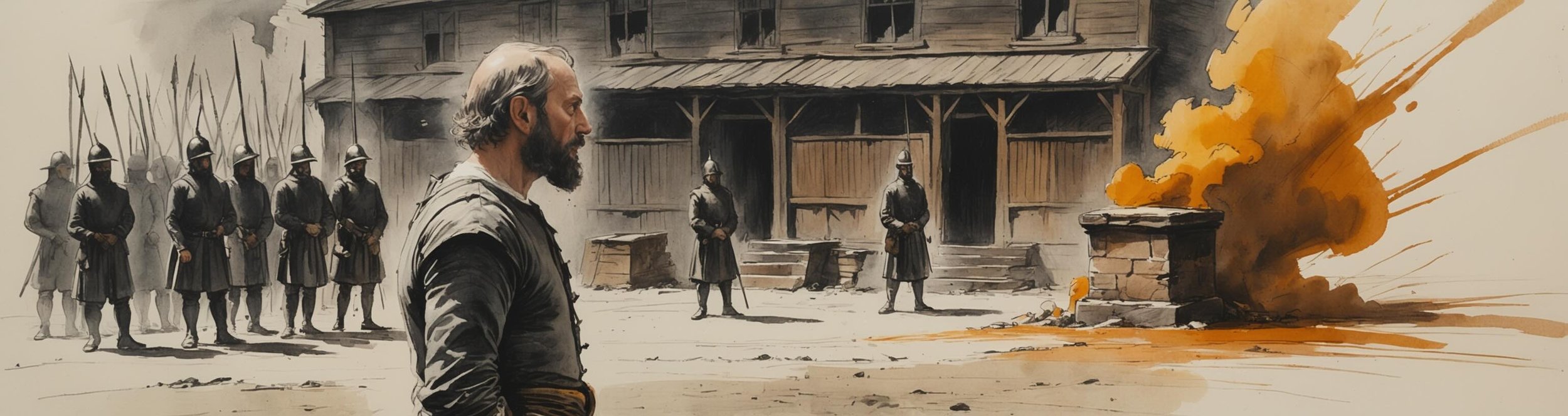
Scene Profile – At a Glance
- Location: Salisbury, an open place – the way to the scaffold.
- What Happens: The Duke of Buckingham, captured after his failed rebellion, is led to execution. Refused a last word with the king, he calls on the ghosts of Richard’s victims, realises it is All Souls’ Day – the day he once wished for as his doom – and remembers Margaret’s curse.
- Key Characters: The Duke of Buckingham, the Sheriff of Wiltshire, officers with halberds.
- Dramatic Function: The last of Margaret’s curses to fall before Bosworth, and the model for the play’s pattern of recognition: a victim naming the day, the curse and his own guilt on the way to the block.
- Famous Quote:
"Thus Margaret’s curse falls heavy on my neck..."
(Buckingham, Act 5, Scene 1) - Why It Matters: Buckingham was the first to help Richard to the crown; his death is the play’s proof that the helpers go the same way as the victims, and that the curses are keeping time.
Scene Summary
The Duke of Buckingham is brought in under guard by the Sheriff of Wiltshire. He asks whether King Richard will not let him speak with him; the Sheriff says no, and tells him to be patient. Buckingham turns to the dead: Hastings, Edward’s children, Grey and Rivers, holy King Henry and his son Edward, Vaughan, and all who died by underhand injustice – if their discontented souls are watching through the clouds, let them mock his destruction for their revenge.
He asks the Sheriff what day it is, and is told it is All Souls’ Day. Then, he says, All Souls’ Day is his body’s doomsday. It is the day he swore on, in King Edward’s time, that he might die on if he were ever false to Edward’s children or the queen’s family; the day he wished might fall on him if the man he most trusted betrayed him. God, whom he dallied with, has turned his mock prayer on his own head and given in earnest what he begged in jest, and so turns the swords of wicked men into their own bosoms. Margaret’s curse has fallen on his neck: when Richard should split his heart with sorrow, she said, remember Margaret was a prophetess. He tells the officers to lead him to the block of shame: wrong has but wrong, and blame the due of blame.
All Souls’ Day
The scene turns on a date. All Souls’ Day is the feast of the dead, and Buckingham discovers on the way to the scaffold that it is also the day he swore an oath on in Act 2, Scene 1, when he asked God to punish him with hate from the man he most trusted if he ever broke faith with the queen’s kin. He broke it within an act.
Original
This is the day which, in King Edward’s time,
I wished might fall on me when I was found
False to his children and his wive’s allies;
This is the day wherein I wished to fall
By the false faith of him whom most I trusted...
(Buckingham, Act 5, Scene 1)
Shakespeare Retold (Modern Verse)
Today’s the day, when Edward was alive,
I wished would fall on me if I was found
To cheat his children or friends of his wife;
Today’s the day I wished would happen to me
If he whom I had trusted most deceived me...
The speech is a recognition scene of a particular kind: the victim reads his own history and finds it exact. Every clause he swore has been honoured to the letter – false to Edward’s children, false to the queen’s allies, betrayed by the man he trusted – and the date is the signature. “Determined respite” is a difficult phrase and a precise one: the day was fixed in advance, and his sentence was only postponed until it. The play’s argument about fate is that the oaths and curses people speak carelessly are recorded somewhere and paid on time, and Buckingham, who dealt in words as Richard’s manager, understands it as a matter of language: God gave in earnest what he begged in jest.
Remember Margaret Was a Prophetess
Having named the day, Buckingham names the curse. Margaret warned him in Act 1, Scene 3, when he was the one courtier who spoke to her kindly, and he laughed; now he quotes her back almost word for word.
Original
Thus Margaret’s curse falls heavy on my neck:
"When he," quoth she, "shall split thy heart with sorrow,
Remember Margaret was a prophetess."
(Buckingham, Act 5, Scene 1)
Shakespeare Retold (Modern Verse)
And so that curse from Margaret has come true:
She said, ‘When Richard breaks your heart from sorrow,
Remember Margaret said that this would happen.’
The quotation is the point. Buckingham repeats Margaret’s words almost as she said them – the play has trained its audience to hear her curses as a script the plot follows – and the phrase “falls heavy on my neck” makes the curse the axe. His last couplet is a maxim, not a plea: wrong has only wrong for its wages, blame is owed blame. There is no appeal to Richard, no protest at the injustice of the sentence, and no claim to innocence, because he is guilty and knows precisely of what. Hastings in Act 3 and Clarence in Act 1 made the same discovery on the way to their deaths; Buckingham makes it last and most clearly, and the audience knows that Richard’s own turn comes in two scenes. The pattern of prophecy and curse has one name left on its list.
Language and Technique
- The roll-call: Buckingham names the dead – Hastings, the princes, Grey and Rivers, Henry and his son, Vaughan – and the list is the play’s own casualty register, spoken before the ghosts speak it again.
- Repetition of the day: “This is the day” three times in eight lines: the speech hammers the date until the coincidence sounds like a sentence.
- Prayer turned on its head: “Given in earnest what I begged in jest”: the antithesis of earnest and jest is the scene’s whole theology – careless words are binding.
- Quotation within the speech: Buckingham quotes Margaret directly, with “quoth she”, so the audience hears the original curse and its fulfilment in one breath.
- Closing maxim: The exit couplet is a proverb – wrong has but wrong – which turns a personal death into a general law.
Key Quotes from Act 5, Scene 1
Quote 1
Hastings, and Edward’s children, Grey and Rivers,
Holy King Henry and thy fair son Edward,
Vaughan; and all that have miscarried
By underhand corrupted foul injustice,
If that your moody discontented souls
Do through the clouds behold this present hour,
Even for revenge mock my destruction!
(Buckingham, Act 5, Scene 1)
Shakespeare Retold (Modern Verse)
Hastings; and Edward’s children, Grey and Rivers;
Holy King Henry, and your kind son Edward;
Vaughan; everyone who has unfairly suffered
By this corrupt and underhanded treatment;
If your souls are all stuck in purgatory,
And you can see me right now through the clouds,
Out of revenge, enjoy watching me die!
Quote Analysis: Buckingham’s appeal to the dead is unusual: he asks them not for mercy but for mockery. If they are watching, let them enjoy this. It is the honest position of a man who helped kill most of them, and it prepares the audience for the ghosts of Act 5, Scene 3, who will do exactly what he invites – though to Richard, not to him.
That high All-Seer, which I dallied with,
Hath turned my feigned prayer on my head,
And given in earnest what I begged in jest.
(Buckingham, Act 5, Scene 1)
Shakespeare Retold (Modern Verse)
Our God on high, who I have messed about with,
Has flipped my empty prayers upon my head,
And given me what jokingly I asked for.
Quote Analysis: God is the “All-Seer”, and the man who “dallied” – played, trifled – with him has been answered in his own coin. The lines are the scene’s centre and the play’s clearest account of how oaths work: a mock prayer is still a prayer, and heaven files it. The modern verse keeps the joke-turned-serious shape of the original.
Come lead me, officers, to the block of shame;
Wrong hath but wrong, and blame the due of blame.
(Buckingham, Act 5, Scene 1)
Shakespeare Retold (Modern Verse)
So, to the execution block of shame;
I’ve done much wrong, and only I’m to blame.
Quote Analysis: The exit. Buckingham goes to the “block of shame” and sums up his case in a proverb that leaves nothing to argue with. It is the calmest death in the play: no terror, no bargaining, and no last message for Richard, whom he does not name. Contrast Richard’s own waking speech two scenes later, which reaches the same verdict in twenty broken lines instead of two.
Key Takeaways
- The helper goes the way of the victims: Buckingham, first to help Richard to the crown, is executed like Hastings and the queen’s kin – the play’s rule that no one is safe.
- A curse with a date: All Souls’ Day was the day Buckingham swore on in Act 2; the coincidence is the play’s way of showing that oaths are kept.
- Margaret quoted back: Her Act 1 warning is repeated almost word for word on the scaffold, so the audience hears prophecy and fulfilment together.
- Recognition without protest: Buckingham names his guilt and accepts the sentence; the scene is a model for Richard’s own reckoning, which will be far less composed.
Study Questions and Analysis
Why is All Souls’ Day important in this scene?
Because Buckingham chose it himself. In Act 2, Scene 1, when the dying King Edward made the court swear friendship, Buckingham prayed that if he ever turned against the queen and her family, God should punish him with hatred from the very people he expected to love him. Here he adds that he wished the punishment might fall on this day. He then betrayed the queen’s kin in the next act, trusted Richard, and was refused and hunted by him. All Souls’ Day, 2 November, is the church’s feast for the souls of the dead, which makes it the fitting day for a man who has just called on the dead to watch him die.
Why then All-Souls’ day is my body’s doomsday.
(Buckingham, Act 5, Scene 1)
Shakespeare Retold (Modern Verse)
Well then, All-Souls’ day is the day I’ll die.
The date is historically exact – the real Duke of Buckingham was beheaded at Salisbury on 2 November 1483 – and Shakespeare uses the fact as if it were design. The scene is the play’s most compact statement of its logic: words spoken lightly are recorded, and the account is settled on the day named. A student can link it to Anne’s curse on Richard’s future wife in Act 1, Scene 2, which she also brings down on her own head.
What was Margaret’s curse on Buckingham, and how is it fulfilled?
In Act 1, Scene 3 Buckingham was the only courtier to speak to Margaret with any courtesy, and she spared him her curses – but warned him that Richard would one day split his heart with sorrow, and that when it happened he should remember that Margaret was a prophetess. Buckingham laughed it off. Here he quotes the warning back, nearly word for word, on the way to the block.
Thus Margaret’s curse falls heavy on my neck:
"When he," quoth she, "shall split thy heart with sorrow,
Remember Margaret was a prophetess."
(Buckingham, Act 5, Scene 1)
Shakespeare Retold (Modern Verse)
And so that curse from Margaret has come true:
She said, ‘When Richard breaks your heart from sorrow,
Remember Margaret said that this would happen.’
Every curse Margaret spoke in that scene has now landed except the one on Richard, and the play arranges Buckingham’s death immediately before Bosworth so that the audience goes into the battle with the score in mind. Wolfgang Clemen, in his commentary on the play (English edition 1968), treated this pattern of prophecy and fulfilment as the play’s principal way of organising its action; Buckingham’s scene is where a character notices the pattern himself and reads his own death by it.
Why does Richard refuse to see Buckingham?
The play does not say, and the refusal is its own answer. Buckingham was the partner of Acts 2 and 3 – the man who managed the citizens, staged the Baynard’s Castle scene and put the crown on Richard’s head – and the request for a last word is the only thing he asks for. Richard, who in Act 4, Scene 2 would not even hear his claim for the earldom of Hereford, will not hear him now. The refusal completes the pattern: Richard uses people and disposes of them, and Buckingham was the largest instance.
Dramatically the refusal keeps the scene private. A meeting would have produced a confrontation; instead Buckingham has nobody to address but the Sheriff and the dead, and the speech becomes a confession rather than an accusation. Colley Cibber’s 1700 adaptation added the line “Off with his head! So much for Buckingham” to give Richard a part in the death; Shakespeare’s Richard is absent, and the absence is colder than any line.