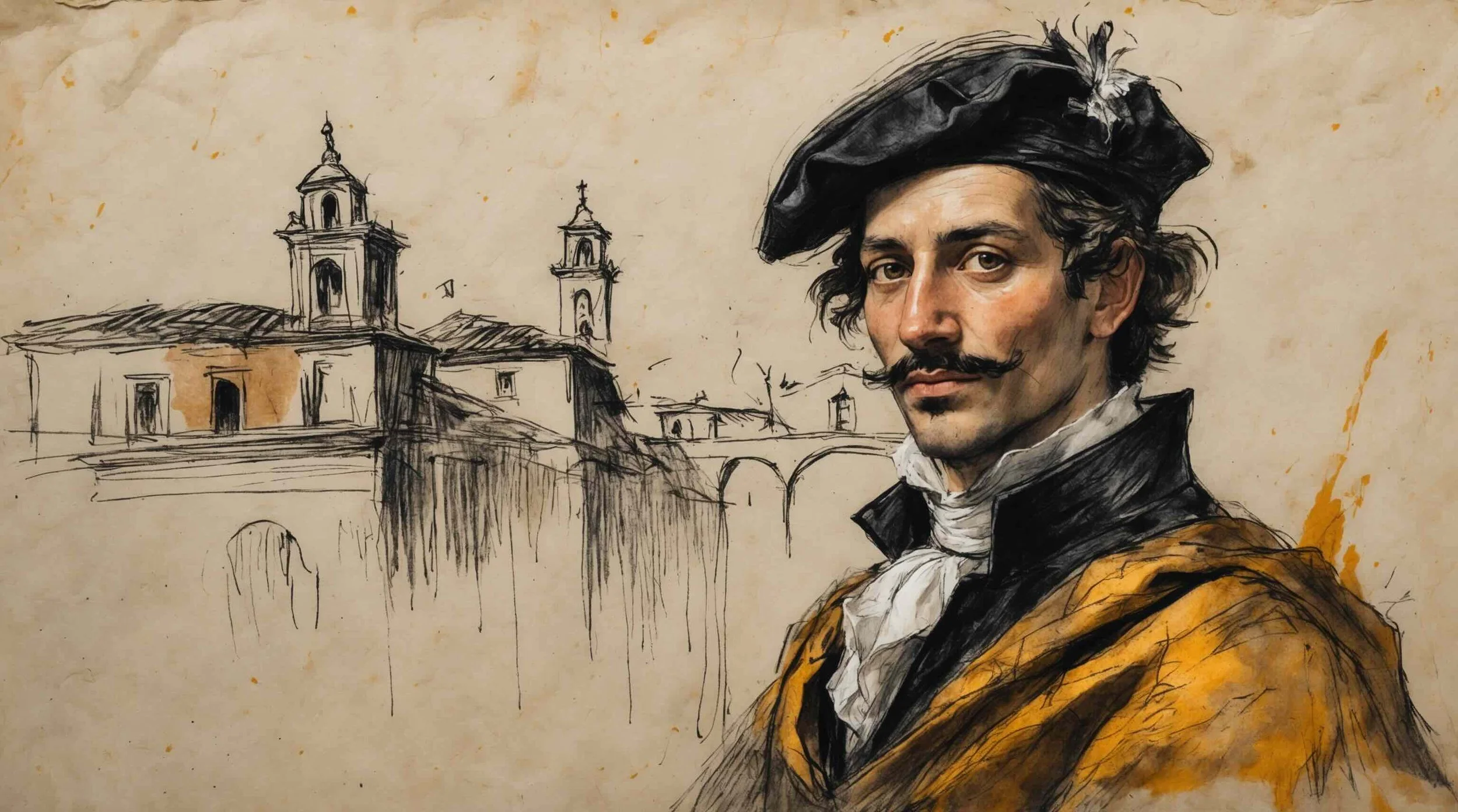
Character Profile – At a Glance
- Role: Servant to Lucentio. He takes his master’s name and clothes, and woos Bianca in public as "Lucentio" so that the real one can court her in secret.
- Key Traits: Clever, cool, loyal and a born actor. He thinks faster than anyone he serves and enjoys the game.
- The Core Conflict: Tranio must pass as a rich gentleman among people who would have him whipped if they knew. Each lie needs a bigger one to hold it up, and the real father is on his way.
- Key Actions: Advises his master on study and on love (A1S1). Becomes "Lucentio" (A1S1). Outbids Gremio for Bianca with a fortune that is not his (A2S1). Tricks Hortensio into giving her up and recruits a false father (A4S2). Denies his old master Vincentio to his face (A5S1). Is pardoned and jokes at the feast (A5S2).
- Famous Quote:
"I am content to be Lucentio,
Because so well I love Lucentio."
(Act 1, Scene 1) - The Outcome: Exposed when Vincentio arrives, he runs for it and is forgiven at his master’s plea. He ends the play at the wedding table, among the gentlemen he fooled.
Ovid and Aristotle
Tranio is on stage from the first line of the play proper, and he talks like nobody’s idea of a servant. His young master has announced a solemn course of philosophy. Tranio agrees, with a reservation.
Original
Let's be no stoics nor no stocks, I pray;
Or so devote to Aristotle's checks
As Ovid be an outcast quite abjured...
(Act 1, Scene 1)
Shakespeare Retold (Modern Verse)
Let’s not remove emotion, turning wood-like;
Or focus on the formal Aristotle
So much we overlook erotic Ovid.
The pun on "stoics" and "stocks", blocks of wood, is a scholar’s joke, and so is the advice not to let Aristotle drive out Ovid. Tranio has clearly sat through his master’s lessons and taken in more of them. He speaks verse as easily as Lucentio does, with an Italian tag thrown in, and he gives the better counsel: study what you enjoy. There is affection in the scene, and a hint of who is really in charge. When Lucentio then falls in love at the sight of Bianca and goes into a trance, it is Tranio who has been watching what actually happened in the street, and Tranio who brings him round. The theme of class and status is raised at once. The servant is the sharper of the two, and both of them know it.
I Am Content to Be Lucentio
The plan to reach Bianca is worked out between them, each finishing the other’s thought. The master will become a tutor. But someone must be Lucentio in Padua, and the master says who.
Original
So had you need.
In brief, sir, sith it your pleasure is,
And I am tied to be obedient;
For so your father charged me at our parting,
'Be serviceable to my son,' quoth he,
Although I think 'twas in another sense;
I am content to be Lucentio,
Because so well I love Lucentio.
(Act 1, Scene 1)
Shakespeare Retold (Modern Verse)
You’ll need to do that.
To summarise, since this is what you want,
And I must do exactly what you tell me,
Because your father told me to when leaving,
‘Do what my son requires,’ he said to me,
Although I think he didn’t mean for this.
I’m happy to be you, Lucentio,
Because I love Lucentio so much.
It is a graceful speech. He is "tied to be obedient", his old master Vincentio told him at parting to be serviceable to the son, and so he will serve by ceasing to be a servant. The last two lines turn on the name: he will be Lucentio because he loves Lucentio. Then they change clothes. In a world where a coloured cloak and hat announce a man’s rank, that is all it takes. Tranio walks into the next scene as a gentleman and is greeted as one, and from here to the last act almost every line he speaks is spoken as someone else. The theme of disguise and deception has many players in this comedy. Tranio is the one who never fluffs his part.
A Card of Ten
His great scene is the auction. Baptista has promised Bianca to whichever suitor can settle the larger fortune on her, and old Gremio lists his wealth: a city house, plate, hangings, a hundred milk cows, all hers if he dies. Tranio lets him finish.
Original
That 'only' came well in. Sir, list to me:
I am my father's heir and only son:
If I may have your daughter to my wife,
I'll leave her houses three or four as good,
Within rich Pisa walls, as any one
Old Signior Gremio has in Padua...
(Act 2, Scene 1)
Shakespeare Retold (Modern Verse)
Good job that you said ‘only’. Hear me out, sir:
I am my father’s heir and only son:
If I may take your daughter as my wife,
I’ll leave her three or four houses as good,
Inside the fancy walls of Pisa, as those
That old Signior Gremio has in Padua...
Gremio has said the estate will be hers only if she will be only his. Tranio seizes the word and builds on it: he is an only son, with houses in Pisa as good as anything in Padua. When Gremio adds a merchant ship, Tranio answers with three great argosies, two galliasses and twelve galleys, and offers to double whatever is named next. None of it exists. He is betting another man’s inheritance without leave, and he wins. Baptista asks only that the father confirm it, and Tranio, alone for a moment, works out what that means.
Original
I see no reason but supposed Lucentio
Must get a father, called 'supposed Vincentio...
(Act 2, Scene 1)
Shakespeare Retold (Modern Verse)
I see no reason why my false Lucentio
Can’t get a father called the false Vincentio.
A false son needs a false father. It is the logic of every lie in the play: one pretence has to be propped up with another. Tranio sees it clearly and is amused. He finds his "Vincentio" in A4S2, a travelling schoolmaster whom he frightens with a tale of a death sentence on all visitors from Mantua, and has him dressed and rehearsed within the scene.
Pearl and Gold
The reckoning comes when the real Vincentio walks up to his son’s door. He finds a stranger at the window using his name, and then his own servant, the boy he brought up from the age of three, comes out in silk and velvet. Tranio does the only thing he can. He does not know the old man.
Original
Sir, you seem a sober ancient gentleman by your habit, but your words show you a madman. Why, sir, what 'cerns it you if I wear pearl and gold? I thank my good father, I am able to maintain it.
(Act 5, Scene 1)
Shakespeare Retold (Modern Verse)
Sir, you seem like a sensible older gentleman by the way you dress, but you’re speaking like a madman. Why, sir, what do you care if I wear pearls and gold? I am grateful to my good father that I can do this.
It is superbly done, and it is the one moment in the play when the game turns ugly. He calls his master a madman, thanks his "good father" for the fine clothes, and sends for an officer to take the old man to gaol. Vincentio is certain that his son has been murdered for his money. Then Lucentio appears with Bianca on his arm, and Tranio and his fellow plotters run, in the stage direction’s words, as fast as may be. Vincentio wants his nose slit. Lucentio pleads that the servant only did what he was ordered to do, and the matter is dropped. At the feast Tranio is at the table, trading jokes with Petruchio. Nobody mentions that he is a servant again.
"The plot depends on a trick or twist usually involving money and perpetrated by a servant or slave that allows the lovers to be united."
— Karen Newman, A Modern Perspective: The Taming of the Shrew, Folger Shakespeare Library
Key Quotes
Quote 1
I pray, sir, tell me, is it possible
That love should of a sudden take such hold?
(Act 1, Scene 1)
Shakespeare Retold (Modern Verse)
I say, sir, is it really possible
That one can fall in love so suddenly?
Quote Analysis: Tranio to his master, who has just fallen in love with a girl he has watched for a few minutes. The question is polite and faintly amused. Tranio is the realist of the pair, and he would like to know whether people really behave like this outside poems. It also shows the easy footing between them. A servant who can tease his master about love is not much afraid of him.
Master, you looked so longly on the maid,
Perhaps you marked not what's the pith of all.
(Act 1, Scene 1)
Shakespeare Retold (Modern Verse)
As you were drooling over that fair lady,
I think you might have missed the key point here.
Quote Analysis: Tranio bringing Lucentio back to earth. "Longly" means longingly, and for a long time; the "pith" is the core of the matter. While the master was gazing at Bianca’s lips, the servant was listening to her father, and he has grasped the point Lucentio missed: nobody can court her until her sister is married. The line sums up their partnership. One of them does the feeling and the other does the thinking.
A vengeance on your crafty withered hide!
Yet I have faced it with a card of ten.
(Act 2, Scene 1)
Shakespeare Retold (Modern Verse)
I’ll curse your crafty, old and wrinkly skin!
But I have bluffed this card game with a poor hand.
Quote Analysis: Tranio alone, after out-bidding old Gremio. The first line is a parting curse on his rival. The second is a gambler’s boast: to have "faced it with a card of ten" is to have bluffed with a middling card as if it were a winner. He knows exactly what he has just done. He had nothing in his hand, and he won the daughter of the richest man in Padua by keeping a straight face.
TRANIO: Faith, he is gone unto the taming-school.
BIANCA: The taming-school! What, is there such a place?
TRANIO: Ay, mistress, and Petruchio is the master;
That teacheth tricks eleven and twenty long,
To tame a shrew and charm her chattering tongue.
(Act 4, Scene 2)
Shakespeare Retold (Modern Verse)
TRANIO: He did, and he has gone to taming-school.
BIANCA: To taming-school! Well, is there such a place?
TRANIO: Yes, lady, and Petruchio is the teacher;
He teaches tricks, like counting in a card game,
To tame a shrew and silence her sharp tongue.
Quote Analysis: Tranio and Bianca on Hortensio, who has gone off to learn from Petruchio. The phrase "taming-school" is Tranio’s, and it has stuck to the play ever since. He says it lightly, as gossip, and Bianca’s surprise that there is such a place gets a laugh. The exchange ties the two plots together. It also lets a servant sum up the main action in a phrase, with Petruchio as schoolmaster and "tricks" on the timetable.
Key Takeaways
- The Clever Servant: Tranio is quicker and cooler than his master, and plans most of the plot to win Bianca.
- Supposed Lucentio: He plays a rich gentleman so well that a whole city believes him on the strength of a cloak.
- The Bidder: He wins Bianca at auction with ships and estates that do not exist.
- The Reckoning: When the real Vincentio appears he denies his own master, and escapes with a pardon.
Study Questions and Analysis
Why is Tranio so much cleverer than his master?
Because he comes from a long line of clever servants. The type is as old as comedy, and Shakespeare signals it in Tranio’s first words, which begin in Italian.
Mi perdonato, gentle master mine,
I am in all affected as yourself...
(Act 1, Scene 1)
Shakespeare Retold (Modern Verse)
I have to beg your pardon, gentle master,
I do agree with everything you’ve said...
"Mi perdonato" means "pardon me", and it is the opening of a tactful correction. He is of the same mind as his master in everything, he says, and then proceeds to change his master’s mind. That is how Tranio works throughout. He never contradicts; he improves.
Karen Newman, in her "Modern Perspective" essay for the Folger edition, sets out his ancestry. The Bianca plot derives from the Roman comedies of Plautus and Terence by way of the Italian stage, and in that tradition the plot "depends on a trick or twist usually involving money and perpetrated by a servant or slave that allows the lovers to be united". Tranio’s very name is taken from a scheming slave in a play by Plautus. So his cleverness is partly inherited from the form: the young lover in such comedies is helpless by convention, and the servant exists to do his thinking. Shakespeare makes more of him than the pattern requires. Tranio is educated, or has picked up an education at second hand, and William Hazlitt, in Characters of Shakespear’s Plays (1817), thought his counsel on study the best thing in the opening scene: "Nothing, however, can be better than the advice which Tranio gives his master". He is also loyal. In Roman comedy the slave schemes for his freedom or his skin; Tranio schemes because he is fond of Lucentio and enjoys being good at it. What he does not have is any stake in the result. He wins Bianca for another man and goes back to waiting at table. The theme of class and status is sharpest here: the ablest person in the subplot is the one with no prospect of profiting from it.
Why do Tranio and Lucentio swap places?
For a practical reason. Bianca can be approached only by tutors, so Lucentio must become one; but a rich young man from Pisa has just arrived in Padua, and if he vanished there would be questions. Someone has to keep up the household, and Lucentio decides who.
Thou shalt be master, Tranio, in my stead,
Keep house and port and servants as I should...
(Lucentio, Act 1, Scene 1)
Shakespeare Retold (Modern Verse)
You will be master, Tranio, in my place,
And keep my house and servants and my lifestyle.
"Keep house and port" means keep up the style of living that goes with the rank. The servant is to have the servants. It is done in a moment, with an exchange of hat and cloak, and when the page Biondello comes in and stares, he is told a story about a killing and ordered to treat Tranio as his master in company.
The swap is a stage convention, but critics have seen that the play makes a theme of it. Karen Newman, in her "Modern Perspective" essay for the Folger edition, groups it with the trick played on the tinker in the Induction: there "Sly is persuaded he is a lord", and here "Lucentio and Tranio exchange identities as master and servant". Together, she argues, these exchanges work "to undermine notions of an essential self or a fixed identity". If a tinker can be a lord for an evening and a serving-man a gentleman for a week, then rank begins to look like a matter of clothes and other people’s belief. Newman connects this with real anxieties of the 1590s, a time when, as she puts it, "servants and apprentices" among others were moving into places "customarily closed to them", and when men complained of upstarts. The play is not a protest. Tranio hands the cloak back without complaint, and nobody suggests he should keep it. But for most of five acts the audience has watched a servant be a better gentleman than the gentlemen. Barbara Mowat and Paul Werstine, the Folger editors, note how lightly Lucentio "throws off his social status". It takes a little longer to notice how lightly his servant puts it on. The theme of illusion vs reality runs through both: the people of Padua see what the costume tells them to see.
How convincing is Tranio as a gentleman?
Entirely. Nobody in Padua doubts him for a moment, and his first entrance in the part shows why. He comes on finely dressed, with a page behind him, and addresses a group of gentlemen as an equal.
Gentlemen, God save you. If I may be bold,
Tell me, I beseech you, which is the readiest way
To the house of Signior Baptista Minola?
(Act 1, Scene 2)
Shakespeare Retold (Modern Verse)
Gentlemen, God bless you. If I may ask you,
Please tell me what’s the quickest way to get to
The house of Signior Baptista Minola?
The manner is exact: courteous, confident, a touch grand. Within a few speeches he has announced himself a suitor to Bianca, argued the point with two rivals, quoted the story of Helen of Troy and her thousand wooers, and proposed that they all go and drink together as lawyers do, who "strive mightily" in court and "eat and drink as friends" afterwards. The others accept him at once.
It is a lesson in what makes a gentleman in this play: clothes, a servant, easy speech and the assumption that one will be believed. Tranio has had years to study the original. The performance gets better as it goes on. He bids for Bianca like a merchant prince, stands at Petruchio’s elbow at the wedding as an old friend of the family, and negotiates a marriage settlement with Baptista in the tone of a young man humouring his elders. Critics who write on the play’s treatment of rank often set him beside Christopher Sly. The tinker, dressed as a lord, keeps asking for small ale and cannot quite manage the part; in William Hazlitt’s words (1817), he "is very slow in giving up his personal identity in his sudden advancement". Tranio is the opposite case. He gives his identity up in a line and never looks back. The contrast suggests that what separates the servant from the master is training, which Tranio has had, and Sly has not. Karen Newman, in her "Modern Perspective" essay for the Folger edition, makes the general point that audiences now take pleasure in the play’s picture of "the instability both of conventional gender hierarchies and of human identity itself". Tranio is that instability in a good suit. The theme of disguise and deception depends on someone being very good at it, and he is.
How does Tranio find a false Vincentio?
He stops a stranger in the street and frightens him. The man is an elderly schoolmaster on his way through Padua, who mentions that he comes from Mantua. Tranio at once looks grave, and explains why Mantuans are in danger.
Your ships are stayed at Venice, and the duke,
For private quarrel 'twixt your duke and him,
Hath published and proclaimed it openly...
(Act 4, Scene 2)
Shakespeare Retold (Modern Verse)
Your ships are seized in Venice, and the duke,
Who’d argued privately with your own duke,
Has publicly announced the penalty.
There are no ships and no quarrel between dukes. Tranio has made up a war on the spot. He then offers, as a favour, to save the old man’s life: he may lodge in Tranio’s house and pass for his father, Vincentio of Pisa, whom he happens to resemble. The grateful Pedant agrees to everything, including signing a marriage contract.
The episode is lifted from the play’s source. Karen Newman, in her "Modern Perspective" essay for the Folger edition, identifies this as George Gascoigne’s Supposes (1566), and "supposes", meaning false identities and mistaken assumptions, is the word Shakespeare keeps: Tranio has already spoken of a "supposed Lucentio" who must get a "supposed Vincentio". The trick shows his method at its purest. He does not bribe or threaten. He tells a story in which the other person is in danger and he is the rescuer, and lets gratitude do the rest. It is, on a small scale, what Petruchio does to Katharina when he starves her "in reverend care of her", and the play may intend the echo. Both men control others by supplying a false account of the world and insisting on it. The difference is that Tranio’s victim is a stranger, and the lie is for a master’s sake. Whether that makes it better is not a question the comedy presses. Samuel Johnson, in 1765, thought the consequences clumsy, finding that the arrival of the real father "produces more perplexity than pleasure". Tranio would probably agree. He has piled one pretence on another, and he is the person standing underneath when it falls. The theme of illusion vs reality shows through him how easily a confident voice can rearrange what other people take to be true.
What happens when the real Vincentio arrives?
Tranio brazens it out, and for a few minutes it works. The old man recognises his servant in a gentleman’s clothes and cries out that he is ruined. Tranio treats him as a lunatic, and when Vincentio names him and insists that the real Lucentio has been murdered, Tranio gives an order.
Call forth an officer.
(Act 5, Scene 1)
Shakespeare Retold (Modern Verse)
Call a police officer.
It is four words, and it is the boldest thing he does. A servant is having his master arrested. The officer comes, Baptista backs the supposed Lucentio, and Vincentio is on the point of being marched to prison when the real son arrives and kneels.
The scene is farce at full speed, and it has a serious underside. Vincentio’s outburst about the "silken doublet", the "velvet hose" and the "scarlet cloak" is a father’s horror at money wasted, and also a master’s horror at a servant dressed above his station; in Elizabethan England there were laws about who could wear what. He reminds the company that Tranio’s father is a sail-maker in Bergamo. For a moment the play lets us feel what the joke would cost if it were real. Karen Newman, in her "Modern Perspective" essay for the Folger edition, reads such moments against the period’s fear of "upstart" servants and "masterless men". Tranio in this scene is that fear acted out: the man who put on his master’s coat and will not take it off. Then the comedy closes over it. Lucentio explains, and takes the blame: what Tranio did, "myself enforced him to". Vincentio mutters about slitting the villain’s nose and is led indoors. Samuel Johnson (1765) thought the whole sequence the weakest part of an otherwise well-joined play. On stage it is usually one of the funniest, and Tranio’s nerve is what drives it. The theme of class and status reaches its crisis here, with a master unable to prove who he is against a servant who looks the part.
Is Tranio punished for what he does?
No. He is last seen at the wedding feast, at ease, taking part in the teasing. When Petruchio twits him that he aimed at Bianca and missed, he has his answer ready.
O, sir, Lucentio slipped me like his greyhound,
Which runs himself and catches for his master.
(Act 5, Scene 2)
Shakespeare Retold (Modern Verse)
Lucentio let me slip off like his greyhound,
Which runs and catches what his master wants.
A greyhound is "slipped" when it is let off the leash. It does the running and makes the kill, and the catch belongs to the man who owns it. Tranio says it as a joke, and Petruchio calls it "a good swift simile, but something currish". It is also the plain truth of his position. He did the work, and his master has the bride.
That he goes unpunished belongs to the kind of play this is. In the Roman comedies behind the Bianca plot, the clever slave is threatened with dreadful things and let off in the last scene, and Karen Newman, in her "Modern Perspective" essay for the Folger edition, shows how closely Shakespeare keeps to the pattern. What is unusual is the last image of him. Tranio is not sent back to the kitchen. He sits with the gentlemen and holds his own in their wit, and nobody objects. A hopeful reading takes this as a sign that his talents have been recognised. A more sceptical one notes that his best line at the feast is about being a dog, and that it is offered for his betters’ amusement. Critics interested in the play’s social world have observed that every disguise in it is temporary. Christopher Sly is a lord for one evening, Lucentio goes back to being rich, and Tranio goes back to service. Only the marriages last. The comparison with Katharina is hard to avoid. She, too, ends the play performing brilliantly for the people who have power over her, to general applause, and we are left to guess what she thinks. The theme of power and control gives the servant and the wife the same choice in the end: to play the part well, and to be liked for it.