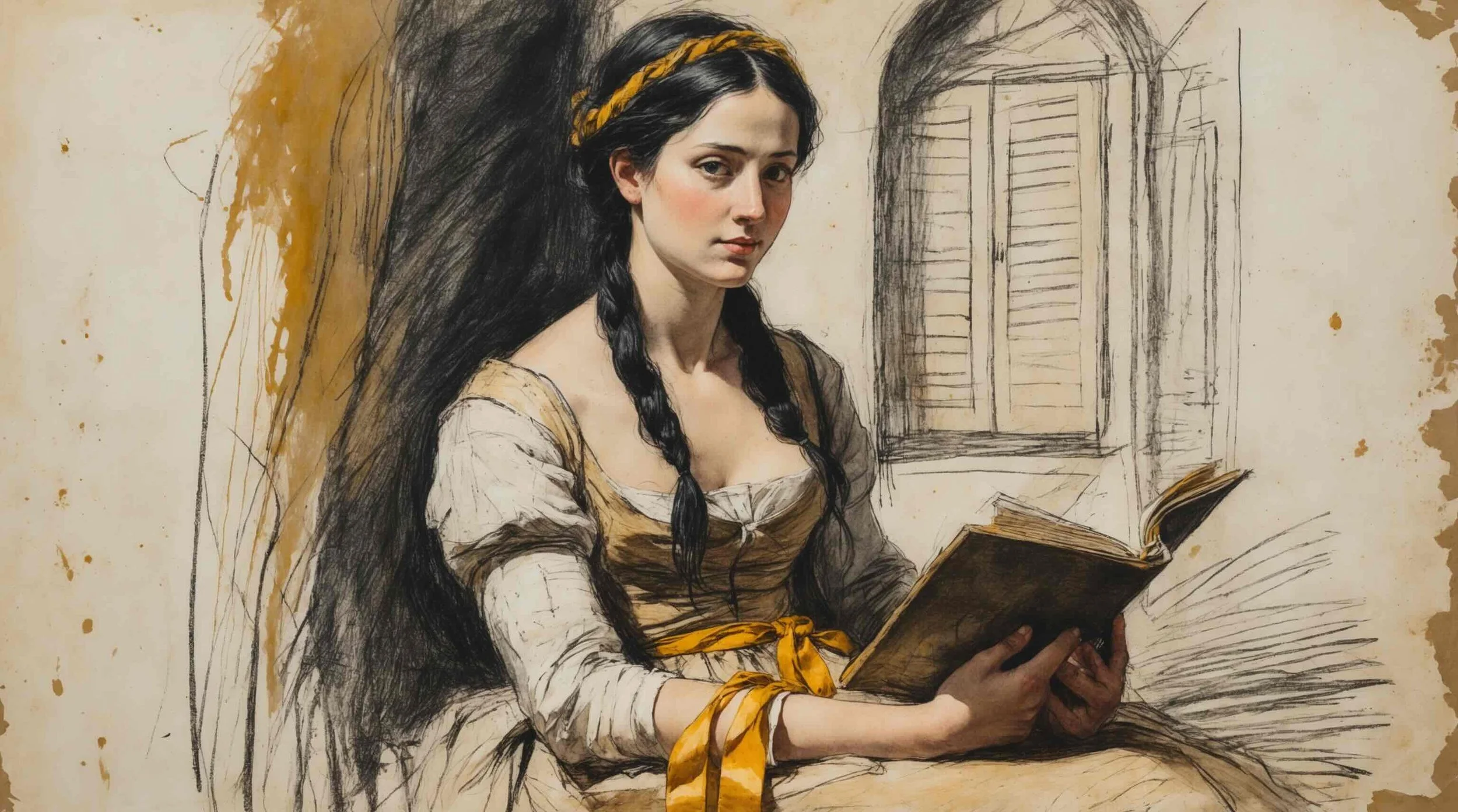
Character Profile – At a Glance
- Role: The younger daughter of Baptista and sister of Katharina. Every suitor in Padua wants her, and her father will not let her marry until her sister does.
- Key Traits: Quiet, pretty and obedient in public. In private she is sharp, knows her own mind and likes to get her way.
- The Core Conflict: Bianca is praised for silence and duty, and locked away because of them. To choose her own husband she must deceive her father, and she turns out to be good at it.
- Key Actions: Accepts her father’s order to stay indoors (A1S1). Is tied up and questioned by her sister (A2S1). Takes charge of her two disguised tutors and encourages Lucentio (A3S1). Marries him in secret (A5S1). Refuses to come when her husband sends for her (A5S2).
- Famous Quote:
"I'll not be tied to hours nor 'pointed times,
But learn my lessons as I please myself."
(Act 3, Scene 1) - The Outcome: Married to the man she chose, and exposed at the wedding feast as a wife who will not come when called. The mild sister ends the play with a rebuke from the shrew.
Maid's Mild Behaviour
Bianca speaks four lines in her first scene, and they are enough to make every man on stage fall in love with her. Her father has just announced, in the street, that she is to be shut up at home until her sister is married. Katharina is furious. Bianca is not.
Original
Sister, content you in my discontent.
Sir, to your pleasure humbly I subscribe:
My books and instruments shall be my company,
On them to look and practise by myself.
(Act 1, Scene 1)
Shakespeare Retold (Modern Verse)
Sister, be happy in my misery.
Sir, I’ll obey your wish respectfully:
My books and instruments will keep me company,
And I will read and practise by myself.
It is a perfect answer, and it is worth noticing how perfect. She begins with a small dig at her sister, who may be content with her discontent. She submits "humbly" to her father. She will keep company with her books and her music. A watching stranger, Lucentio, hears wisdom itself speaking; her sister hears a spoilt favourite who knows exactly how to cry on cue. The play does not tell us at once which of them is right. The theme of illusion vs reality begins with Bianca, because what Padua admires in her is what she chooses to show.
A Bondmaid and a Slave
At home, with no audience, the two sisters are seen alone together for the only time. Katharina has tied Bianca’s hands and wants to know which suitor she prefers.
Original
Good sister, wrong me not, nor wrong yourself,
To make a bondmaid and a slave of me;
That I disdain: but for these other gawds,
Unbind my hands, I'll pull them off myself,
Yea, all my raiment, to my petticoat;
Or what you will command me will I do,
So well I know my duty to my elders.
(Act 2, Scene 1)
Shakespeare Retold (Modern Verse)
Dear sister, do not wrong both me and you
By making me your bondmaid and your slave;
I cannot do it. If you want this jewellery,
Untie my hands and I will take it off,
Yes, everything down to my petticoat;
Or I’ll do anything you tell me to,
Because I know I must obey my elders.
Bianca is the victim here, and she is also holding her own. She offers to strip off her jewellery, even her clothes down to her petticoat, which makes her sister look absurd. She ends on "my duty to my elders", a reminder that Katharina is the older one and still unmarried. When Katharina presses, Bianca offers to plead for her with whichever man she wants, as if handing down a dress she has grown out of. Then their father comes in, and Bianca weeps and says nothing at all. He sends her inside to her needlework. She has won the scene without raising her voice.
As I Please Myself
The lesson scene is where Bianca comes into focus. Her father has hired two tutors, one for Latin and one for music. Both are suitors in disguise, and they squabble over who goes first. The pupil settles it. She is no schoolboy to be whipped, she tells them; she will learn her lessons as she pleases. Then she sends the musician to tune his lute and turns to the Latin.
Lucentio uses a line of Ovid to tell her who he really is, slipping his message between the Latin words. Bianca gives it back to him the same way.
Original
Now let me see if I can construe it: 'Hic ibat Simois,' I know you not, 'hic est Sigeia tellus,' I trust you not; 'Hic steterat Priami,' take heed he hear us not, 'regia,' presume not, 'celsa senis,' despair not.
(Act 3, Scene 1)
Shakespeare Retold (Modern Verse)
Now let me see if I can translate it: ‘Hic ibat Simois’ means ‘I do not know you’; ‘hic est Sigeia tellus’ means ‘I do not trust you’; ‘Hic steterat Priami’ means ‘make sure he doesn’t hear us’; ‘regia’ means ‘do not assume’; ‘celsa senis’ means ‘do not despair.’
She does not know him, she does not trust him, he must take care the other man does not overhear, he should not presume, and he should not despair. It is as neat a piece of management as anything Petruchio does. She keeps her suitor at a distance and on the hook in a single sentence, and she does it in a code that only the two of them can read. When the music master then offers his own love-note hidden in a scale, she dismisses it in two lines. Bianca has had her choice of men in the scene, and she has made it. The theme of disguise and deception is usually about the men’s costumes. Hers needs no change of clothes.
The More Fool You
Bianca marries Lucentio in secret, behind her father’s back, while a hired stranger pretends to be her father-in-law and signs for a fortune that does not exist. Nobody in the play blames her for it. At the feast that follows she is at ease, joining in the jokes, and when the women withdraw the men bet on whose wife is most obedient. Lucentio sends for Bianca first, sure of the answer. She sends back that she is busy and cannot come. When Katharina finally fetches her, husband and wife have their first exchange as a married couple.
Original
BIANCA: Fie! What a foolish duty call you this?
LUCENTIO: I would your duty were as foolish too:
The wisdom of your duty, fair Bianca,
Hath cost me an hundred crowns since supper-time.
BIANCA: The more fool you, for laying on my duty.
(Act 5, Scene 2)
Shakespeare Retold (Modern Verse)
BIANCA: Oh, please! What foolish duty do you call this?
LUCENTIO: I wish your duty was as foolish too:
Because your lack of duty, fair Bianca,
Has cost me a hundred crowns since suppertime.
BIANCA: The more fool you for betting on my duty.
"The more fool you" is not how the girl of A1S1 spoke to men. Nothing about Bianca has changed except that she no longer needs to please anyone. The sister Padua called a shrew now lectures her on obedience, and Bianca makes no reply; the play gives her no more lines. The theme of gender and patriarchy closes on a neat reversal, with the model daughter turned into the difficult wife.
"As many readers of The Taming of the Shrew have noted, if in the end one shrew is tamed, two more reveal themselves: Bianca and the widow refuse to do their husbands’ bidding at the very moment Kate has ostensibly learned to obey."
— Karen Newman, A Modern Perspective: The Taming of the Shrew, Folger Shakespeare Library
Key Quotes
Quote 1
Why, gentlemen, you do me double wrong,
To strive for that which resteth in my choice:
I am no breeching scholar in the schools;
I'll not be tied to hours nor 'pointed times,
But learn my lessons as I please myself.
(Act 3, Scene 1)
Shakespeare Retold (Modern Verse)
Hey, gentlemen, you’re both doing me wrong
By arguing on what is my decision:
I’m not a schoolboy you can freely flog;
And won’t be tied to timetables or schedules,
But I will learn my lessons when I want to.
Quote Analysis: Bianca to her two tutors, who are quarrelling over which lesson comes first. The key word is "choice". The men are fighting over something that, as she points out, is hers to decide. A "breeching scholar" is a schoolboy young enough to be whipped, and she will not be treated as one, nor "tied to hours". It is the first time she speaks without her father or sister in the room, and the meek daughter of A1S1 is nowhere to be heard.
Old fashions please me best; I am not so nice,
To change true rules for old inventions.
(Act 3, Scene 1)
Shakespeare Retold (Modern Verse)
I like the old ways best; I’m not so fickle
As to change the tried and trusted rules we have.
Quote Analysis: Her reply to Hortensio, who has disguised his proposal as a new way of teaching the musical scale. She prefers the old way, thank you. On the surface it is a pupil’s polite preference. Underneath it is a refusal, and both of them know it. Bianca turns down a suitor without ever admitting that she has understood him, which leaves him nothing to complain of.
That, being mad herself, she's madly mated.
(Act 3, Scene 2)
Shakespeare Retold (Modern Verse)
That as she’s mad, she’s found the perfect match.
Quote Analysis: Bianca’s verdict on her sister’s wedding, after Katharina has been carried off by a bridegroom who behaved like a lunatic in church. Asked what she thinks, she offers one line, with a pun in it: mad and madly mated. There is no pity in the remark and some satisfaction. It is a small moment, but it shows that the dislike between the sisters runs both ways.
Am I your bird? I mean to shift my bush;
And then pursue me as you draw your bow.
You are welcome all.
(Act 5, Scene 2)
Shakespeare Retold (Modern Verse)
Am I the bird you’re hunting? I’ll switch bushes,
Then you can chase me as you draw your bow.
You’re welcome, everyone.
Quote Analysis: Bianca at the feast, leaving the table after Petruchio has teased her. The image is from hunting: if she is the bird they are aiming at, she will move to another bush, and they may follow with their bows if they can. It is quick, and a little bawdy, and it shows a woman quite at home in a battle of wits. A few minutes later her husband will send for her and find that the bird does not come to the hand.
Key Takeaways
- The Ideal Daughter: Bianca's silence and obedience make her the prize of Padua, but they are a manner she can put on and take off.
- The Favourite: Her father's open preference for her is the main cause of Katharina's anger.
- Her Own Choice: In the lesson scene she manages two suitors at once and picks the one she wants without seeming to.
- The Reversal: By the end the mild sister disobeys her husband and the shrew obeys hers.
Study Questions and Analysis
Is Bianca as mild as she seems?
Her sister never thought so. The moment Bianca has given her meek little speech in the street, Katharina says what she thinks of it.
A pretty peat! It is best
Put finger in the eye, an she knew why.
(Katharina, Act 1, Scene 1)
Shakespeare Retold (Modern Verse)
A spoiled brat! If she could
Start crying, then she would if she knew how to.
A "peat" is a pet, a spoilt darling. Katharina’s charge is that Bianca can produce tears to order, and would do so now if she could think of an excuse. It sounds like plain spite when we first hear it. By the end of the play it sounds more like information.
The evidence builds slowly. In A2S1 Bianca answers her sister’s bullying with a string of remarks that are meek in form and stinging in effect. In A3S1 she tells two men she will do as she pleases. In A5S1 she marries without her father’s consent, and in A5S2 she refuses to come when called and tells her husband he is a fool for expecting it. Karen Newman, in her "Modern Perspective" essay for the Folger edition, traces the same line: the suitors admire Bianca "for her silence, mildness, and sobriety", but in her dealings with the two tutors "even she shows herself less docile than she seems". Barbara Mowat and Paul Werstine, the Folger editors, are careful to call her only "an apparently ideal woman". Not everyone reads her as a hypocrite. It can be argued that Bianca behaves well when she has no choice and freely when she does, which is hardly a fault. She is confined to the house for something that is not her doing, and wins her freedom by the only means open to her. Productions have played her as a sly minx and as a sensible girl making the best of a foolish father, and the lines allow both. What the text does not support is the Bianca the suitors think they see. The theme of illusion vs reality depends on the gap between that picture and the woman.
Why does Katharina resent Bianca so much?
Because Bianca has everything Katharina has been told she cannot have: suitors, praise and their father’s love. In the scene where Katharina ties her up, Bianca guesses, or pretends to guess, that the trouble is one particular man.
Is it for him you do envy me so?
Nay then you jest, and now I well perceive
You have but jested with me all this while...
(Act 2, Scene 1)
Shakespeare Retold (Modern Verse)
Is it because of him you’re jealous of me?
No, you are joking, and I realise now
You have been joking with me all the while...
The word "envy" is Bianca’s, and it is well aimed. She treats her sister’s rage as jealousy over old Gremio, a suitor neither of them could want, and then decides the whole thing must be a joke. It is hard to say whether this is innocence or a very cool head. Either way it is the reply most likely to make Katharina angrier, and she strikes her.
When Baptista arrives he takes Bianca’s side at once, calls his elder daughter a "hilding of a devilish spirit", and asks why she wrongs a sister who never crossed her with a bitter word. Katharina’s answer is that Bianca’s silence is the insult: it "flouts" her. Critics have generally found the father more to blame than either daughter. Karen Newman, in her "Modern Perspective" essay for the Folger edition, places the family in a society where authority "was vested in men", in fathers before husbands, and where a daughter’s worth was measured by how little trouble she gave. In such a house the quiet child is rewarded and the outspoken one is punished, and each learns her part. Bianca has learnt that meekness works. The Folger editors, Barbara Mowat and Paul Werstine, observe that Katharina’s temper "denies her the status of ‘ideal woman’ accorded Bianca". One sister’s reputation is built on the other’s. That is why the last scene, where the two change places, feels less like a surprise than a debt being paid. The theme of gender and patriarchy is worked out between the sisters as much as between husbands and wives.
Does Bianca choose Lucentio herself?
Yes, and it is one of the few real choices any woman makes in the play. Her father intends to give her to the highest bidder. She has other ideas, and she is cautious about them. When Lucentio first declares himself, under cover of the Latin lesson, this is all he gets.
In time I may believe, yet I mistrust.
(Act 3, Scene 1)
Shakespeare Retold (Modern Verse)
I may come to believe you, but I don’t yet.
She may believe him in time; for now she mistrusts. Bianca has known this man for one lesson, and he has just admitted that he is in the house under a false name. Her caution is sensible. By A4S2 she has made up her mind, and Hortensio, spying on them, sees her kissing her Latin tutor.
The freedom to choose is something Shakespeare added to his source. Karen Newman, in her "Modern Perspective" essay for the Folger edition, explains that the Bianca plot comes from George Gascoigne’s Supposes (1566), an English version of an Italian comedy, and that in such plays the young woman is usually just the prize. Shakespeare, she writes, "adds a rival for Bianca’s hand (Hortensio) to enhance the romantic plot by allowing her a choice between possible husbands." So while the men believe they are competing for her father’s consent, the contest that matters is being decided by Bianca in the schoolroom. There is an irony here that critics have enjoyed. Katharina, who speaks her mind, is married off without being asked. Bianca, who says "I subscribe" to everything, marries exactly as she likes. Some readers take this as the play’s quiet comment on which kind of woman a world like Padua really produces: open defiance is crushed, and quiet deceit gets its way. Others simply see the usual business of romantic comedy, in which young lovers outwit an old father. The theme of marriage and economics sets the two matches side by side, one arranged over the bride’s head and one arranged behind the father’s back.
How do the men of Padua see Bianca?
As a picture of what a woman should be. Lucentio has been in Padua for a few minutes when he sees the two sisters, hears one of them shout, and draws his conclusion about the other.
But in the other's silence do I see
Maid's mild behaviour and sobriety.
(Lucentio, Act 1, Scene 1)
Shakespeare Retold (Modern Verse)
But in her sister’s silence, I observe
A gentle woman with a steady nerve.
He falls in love with a silence. Bianca has not yet spoken when he says this, and what he praises, mildness and "sobriety", is exactly what the conduct books of the time asked of a young woman. A moment later she speaks her four lines and he hears the goddess of wisdom. Soon he is telling his servant about her coral lips and her perfumed breath.
Barbara Mowat and Paul Werstine, introducing the Folger edition, describe his love as "idealized love of an apparently ideal woman", and note that he "speaks of her as if she were a goddess come to earth". William Hazlitt, in Characters of Shakespear’s Plays (1817), admired the poetry of it and called Lucentio’s description of his mistress "elegant". The older suitors are less poetic. To Gremio and Hortensio she is "sweet Bianca" and a "treasure", and when her father puts her up for offer they bid for her in houses, cattle and ships. None of them asks what she thinks. Karen Newman, in her "Modern Perspective" essay for the Folger edition, connects this to the period’s ideal of womanhood as "chastity, silence, and obedience", and the men of Padua plainly share it: they like Bianca for the things she does not do. The play’s joke on them is that they never look further. Lucentio marries an idea, and at the wedding feast he meets his wife. The theme of illusion vs reality makes the romantic lover the most deceived man in the play.
Why does Bianca marry in secret?
Because the official courtship is a fraud, and a secret marriage is the only way to make it real. The "Lucentio" her father has accepted is the servant Tranio in his master’s clothes, and the "father" who has guaranteed her dower is a passing stranger. While the old men sign papers, Bianca slips away to church with her Latin tutor. When they return as husband and wife, her father asks where Lucentio is, and Bianca explains.
Cambio is changed into Lucentio.
(Act 5, Scene 1)
Shakespeare Retold (Modern Verse)
Cambio has changed into Lucentio.
It is a pun. "Cambio" is the name Lucentio took as a tutor, and it is the Italian for "change" or "exchange". Bianca delivers the line as coolly as everything else. Her father has been tricked, and her new father-in-law, who has nearly been hauled off to gaol, is beside himself. She offers no apology beyond kneeling beside her husband.
The elopement comes straight from the tradition of comedy Shakespeare was using. Karen Newman, in her "Modern Perspective" essay for the Folger edition, describes the pattern: young lovers are opposed by "some representative of an older generation", and a trick, usually "perpetrated by a servant", brings them together. In that kind of play nobody asks whether the daughter was right to deceive her father. Samuel Johnson, in his edition of 1765, found this part of the plot the least satisfying, remarking that "At the marriage of Bianca, the arrival of the real father, perhaps, produces more perplexity than pleasure." Later readers have been more interested in the contrast with Katharina. The elder sister is punished throughout for wilfulness and is married in public, in church, with her father’s blessing. The younger does the most wilful thing in the play and is forgiven in a dozen lines. Baptista grumbles for a moment and follows the others indoors. The theme of disguise and deception ends happily for Bianca. Whether it should is a question the comedy does not stop to ask.
Is Bianca the real shrew of the play?
The last scene invites the thought. When Katharina has obeyed and Bianca and the Widow have not, Petruchio gives his wife her instructions.
Katharina, I charge thee, tell these headstrong women
What duty they do owe their lords and husbands.
(Petruchio, Act 5, Scene 2)
Shakespeare Retold (Modern Verse)
Katharina, tell these headstrong women
Their obligations to their lords and husbands.
"Headstrong women" now means Bianca. The word that was Katharina’s for four acts has changed owner. It is the title’s final twist: a play called The Taming of the Shrew ends with a tamed shrew and two untamed wives.
Karen Newman, in her "Modern Perspective" essay for the Folger edition, sums up what many readers have felt: "if in the end one shrew is tamed, two more reveal themselves". She adds that Bianca and the Widow, "who begin by conforming to oppressive codes of womanly duty, reveal their independence", and the word she chooses is "independence", not shrewishness. That is the modern way of seeing it. Bianca declines to perform for a bet, which is not an unreasonable thing to decline. An older tradition was harder on her. For critics who took Katharina’s speech at face value, Bianca is the warning: the sweet girl who becomes a scold once she has a ring on her finger. Germaine Greer, in The Female Eunuch (1970), had little time for the conventional heroine and thought Katharina much the better wife; submission, she argued, means something only from a woman with "something to lay down". Bianca has never laid anything down, because she has never openly held anything up. The fairest summary may be that the play shows two ways of dealing with a world run by fathers and husbands. Katharina fights it in the open and is beaten into a new shape. Bianca agrees with everyone and does what she likes. The theme of power and control leaves us to decide which sister has kept more of herself.