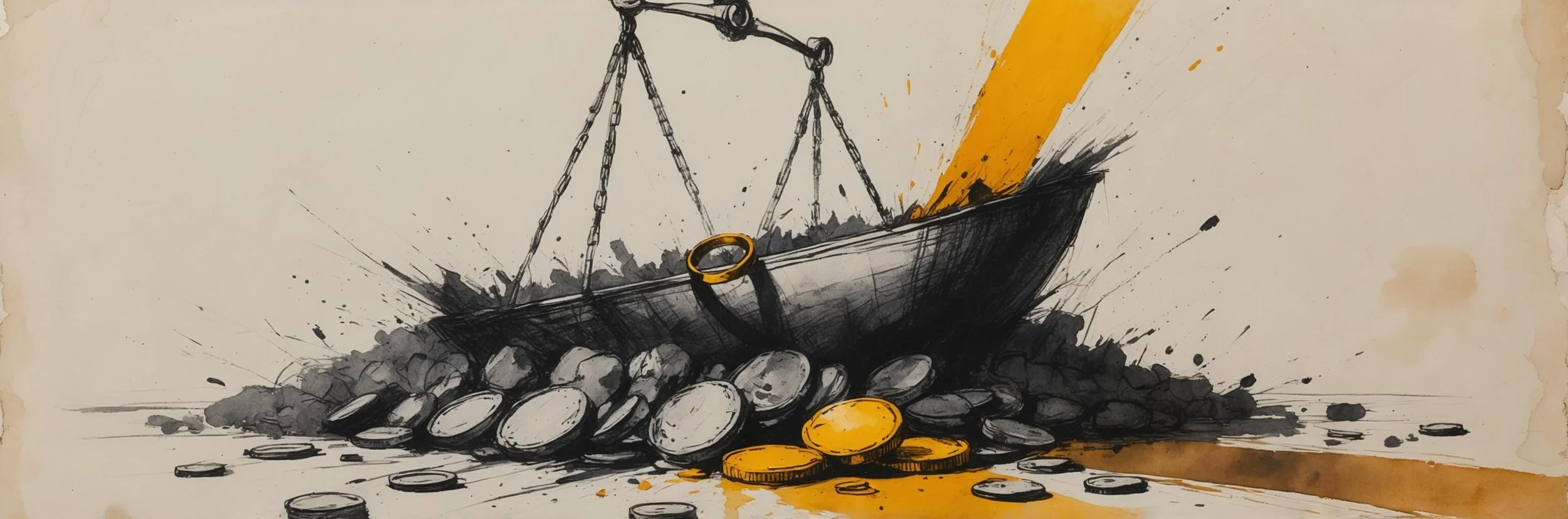
Theme Profile – At a Glance
- Focus: How marriage in Padua is a matter of money: dowries, settlements, bids and bets. The play sets a match made for cash beside a match made for love and asks what each is worth.
- Key Characters: Petruchio, Katharina, Baptista, Bianca, Lucentio, Hortensio, Tranio, Gremio, the Widow.
- The Core Tension: Everyone talks about love, and everyone does the sums first. The play asks whether a marriage that begins as a bargain can become anything more, and who pays for it.
- Key Manifestations: The pact to find Katharina a husband (A1S1); Petruchio’s search for a rich wife (A1S2); the dowry agreed and Bianca put up for bids (A2S1); the bride claimed as goods (A3S2); the wager on the wives (A5S2).
- Famous Quote:
"I come to wive it wealthily in Padua;
If wealthily, then happily in Padua."
(Act 1, Scene 2) - The Outcome: Three marriages are made and one bet settles their value. Petruchio leaves with two dowries and two hundred crowns; the men who married for love or for a widow’s wealth pay up.
Money Enough
The first marriage plan in the play is made by two men who do not want the bride. Baptista has ruled that his younger daughter cannot be courted until the elder is married, so Bianca’s rival suitors agree to find someone for Katharina. Hortensio thinks a man can be found who will take her with all her faults, "and money enough". Old Gremio would pay towards it.
Original
I am agreed; and would I had given him the best horse in Padua to begin his wooing that would thoroughly woo her, wed her and bed her and rid the house of her!
(Gremio, Act 1, Scene 1)
Shakespeare Retold (Modern Verse)
I agree; and I would give whoever wants her sister the best horse in Padua to start him off, so long as he woos her well, marries her, sleeps with her and gets her out of the house!
Woo her, wed her, bed her, and rid the house of her: four verbs, and the fourth is the point. Katharina is spoken of as stock that is blocking a sale. Nobody on stage is shocked, because this is how Padua talks. Marriage here is arranged by fathers and paid for in land and coin, and the question about any match is what it will cost and what it will bring.
Crowns in My Purse
The man they need walks on in the next scene. Petruchio explains himself to his friend in the plainest terms.
Original
Antonio, my father, is deceased;
And I have thrust myself into this maze,
Haply to wive and thrive as best I may:
Crowns in my purse I have and goods at home,
And so am come abroad to see the world.
(Petruchio, Act 1, Scene 2)
Shakespeare Retold (Modern Verse)
Antonio, my father, is deceased;
And I have forced myself into the world
To find a wife and do the best I can.
I’ve money in my purse, a well-stocked home,
And so I’ve come abroad to see the world.
His father is dead, he has inherited, and he has come abroad "to wive and thrive". The two words rhyme, and for him they mean the same thing. When Hortensio mentions a rich woman with a foul temper, Petruchio’s servant sums up his master’s position for the company.
Original
Why give him gold enough and marry him to a puppet or an aglet-baby; or an old trot with ne'er a tooth in her head, though she have as many diseases as two and fifty horses: why, nothing comes amiss, so money comes withal.
(Grumio, Act 1, Scene 2)
Shakespeare Retold (Modern Verse)
if you give him enough money, he’ll marry a puppet or a doll; or an old hag without any teeth in her mouth, although she has as many diseases as fifty-two horses. You see, nothing will stop him, as long as money is involved.
A puppet, a doll, a toothless old woman with every disease a horse can have: nothing comes amiss, "so money comes withal". Grumio is joking, and he is also accurate. What is new about Petruchio is not that he wants money. Every suitor in the play wants it. It is that he says so, and skips the poetry.
Let Specialties Be Drawn
The marriage of Katharina is agreed in a dozen lines, and she is not in the room. Petruchio asks her father what dowry comes with her. Baptista names twenty thousand crowns down and half his lands at his death. Petruchio replies with his side of the bargain.
Original
And, for that dowry, I'll assure her of
Her widowhood, be it that she survive me,
In all my lands and leases whatsoever:
Let specialties be therefore drawn between us,
That covenants may be kept on either hand.
(Petruchio, Act 2, Scene 1)
Shakespeare Retold (Modern Verse)
And in return, I’ll promise her that if
She’s widowed, that is if she will outlive me,
She will get all my land and all my rent.
So let us sign contractual obligations
So that we both hold up what we’ve agreed.
This is a marriage settlement, in the proper legal form. The bride’s father pays a dowry; the groom guarantees her "widowhood", an income from his estate if she outlives him; and "specialties", sealed contracts, are drawn up so that neither side can go back on it. It is prudent, and it protects Katharina. It also treats the wedding as a transfer of property between two men, with her consent mentioned afterwards as a detail. The theme of gender and patriarchy is never far from the money: the people who sign are the people who rule.
The Highest Bidder
With one daughter sold, Baptista turns to the other. He will give Bianca to the suitor who can "assure" her the greater dower, and the two candidates bid against each other like men at a market. Gremio goes first.
Original
First, as you know, my house within the city
Is richly furnished with plate and gold;
Basins and ewers to lave her dainty hands;
My hangings all of Tyrian tapestry;
In ivory coffers I have stuffed my crowns...
(Gremio, Act 2, Scene 1)
Shakespeare Retold (Modern Verse)
First off, as you’re aware, my city house
Is furnished well with ornaments and gold;
Basins and water jugs to wash her soft hands;
My dark red tapestries hung on the walls;
I’ve filled my ivory boxes up with gold coins...
Plate, gold, basins, tapestry, crowns in ivory chests: he lists his house room by room, and goes on to his farm and his hundred milk cows. Tranio, disguised as his master, answers with houses in Pisa and a fleet of ships. He wins, and none of it is real. The scene is very funny and quite merciless. A girl’s future is decided by an inventory, and the inventory is a lie.
The play ends as it began, with men putting a price on women. At the wedding feast the three husbands bet on whose wife will come when she is called.
Original
LUCENTIO: Twenty crowns.
PETRUCHIO: Twenty crowns!
I'll venture so much of my hawk or hound,
But twenty times so much upon my wife.
(Act 5, Scene 2)
Shakespeare Retold (Modern Verse)
LUCENTIO: Twenty crowns.
PETRUCHIO: Twenty crowns!
I’ll bet that much upon my hawk or hound,
But twenty times as much upon my wife.
Petruchio thinks twenty crowns an insult. He would stake that much on a hawk or a hound; a wife is worth twenty times more. It is meant as a compliment to Katharina, and it puts her in a list with his animals. He wins the bet, and her father adds a second dowry on top. The theme of power and control and the theme of money meet in the last scene, where obedience is something that can be gambled on and paid out.
"Assured of the money, Petruchio is ready to marry Katherine even against her will."
— Barbara Mowat and Paul Werstine, The Taming of the Shrew, Folger Shakespeare Library
Key Quotes on Marriage and Economics
Quote 1
'Twas a commodity lay fretting by you:
'Twill bring you gain, or perish on the seas.
(Tranio, Act 2, Scene 1)
Shakespeare Retold (Modern Verse)
It was an asset irritating you;
You’ll either gain or lose it all at sea.
Quote Analysis: Tranio to Baptista, who has just said that in marrying off Katharina he is playing a merchant’s part. A "commodity" is a piece of goods, and "fretting" means both wearing away in storage and being bad-tempered. Katharina was stock going stale on the shelf; now she has been shipped, and will either make a profit or be lost at sea. The joke is quick and cruel, and her father laughs at it.
To me she's married, not unto my clothes:
Could I repair what she will wear in me,
As I can change these poor accoutrements,
'Twere well for Kate and better for myself.
(Petruchio, Act 3, Scene 2)
Shakespeare Retold (Modern Verse)
She’s wedding me, not marrying my clothes.
If I could fix the wear and tear she’ll do me
As easily as I can change these poor clothes,
That would be good for Kate and better for me.
Quote Analysis: Petruchio at the church door, dressed in rags, when Baptista begs him to change. The line sounds like a rebuke to people who judge by appearances, and so it is. But it also carries the language of cost: he wishes he could "repair" what Katharina will "wear" in him as easily as he could change his coat. Even here marriage is spoken of as wear and tear on a man’s goods.
Why, that is nothing: for I tell you, father,
I am as peremptory as she proud-minded...
(Petruchio, Act 2, Scene 1)
Shakespeare Retold (Modern Verse)
Oh, that is nothing: let me tell you, father,
I am as domineering as she’s proud...
Quote Analysis: Baptista has said that the dowry is settled but his daughter’s love must still be won, "for that is all in all". Petruchio’s answer is that this is nothing. He is as stubborn as she is proud, and two fires meeting will burn each other out. The exchange puts the play’s two ideas of marriage in two lines: a father who feels that love ought to matter, and a suitor who has already counted the money.
I promised we would be contributors
And bear his charging of wooing, whatsoe'er.
(Hortensio, Act 1, Scene 2)
Shakespeare Retold (Modern Verse)
I promised we would make a contribution
For all his costs incurred to chat her up.
Quote Analysis: Hortensio to Gremio and the disguised Tranio. Bianca’s three suitors agree to pay the costs of Petruchio’s courtship of her sister, whatever they come to. Petruchio is, in effect, hired. It is a small detail and an important one: before he has met Katharina, other men are covering his expenses for marrying her, because her marriage has a cash value to them.
Key Takeaways
- A Business: Marriages in Padua are arranged by fathers and settled in dowries, jointures and contracts, with love mentioned last.
- The Plain Dealer: Petruchio differs from the other suitors only in saying openly that he has come to marry money.
- The Auction: Bianca is promised to the highest bidder, and the winning bid is a servant's invention.
- The Wager: The play ends with husbands betting on their wives' obedience, and the cash prize goes to the fortune-hunter.
Study Questions and Analysis
Why is marriage treated as a business in the play?
Because for families with property in Shakespeare’s time it largely was one. A marriage joined two estates, and the terms were negotiated by the bride’s father and the groom. When Petruchio asks what comes with Katharina, her father answers like a man quoting a price.
After my death the one half of my lands,
And in possession twenty thousand crowns.
(Baptista, Act 2, Scene 1)
Shakespeare Retold (Modern Verse)
When I have died, you’ll get half of my land,
And you’ll get twenty thousand crowns right now.
Half the estate when he dies, and twenty thousand crowns in hand. The sum is large, and it is offered before Petruchio has seen her. Baptista is not being cold. He is doing what a responsible father was expected to do, which is to make his daughter worth marrying and then make sure she is provided for.
Karen Newman, in her "Modern Perspective" essay for the Folger edition, sets this in its period. "In early modern England," she writes, "the family was the basic unit of production as well as consumption", the place where wealth was pooled and passed on, and so "managing femininity had important political as well as social and economic consequences". A daughter’s marriage was a family’s largest financial decision. Barbara Mowat and Paul Werstine, introducing the same edition, describe the play as offering "strikingly different models of the process of attracting and choosing a mate", and note drily that "Some of these models may still seem attractive to us, some not." The question for critics has been what attitude the play takes to the system it shows. George Bernard Shaw, writing in the Saturday Review in 1897, thought the frankness its chief merit and called it an attempt "to make the public accept realistic comedy". Others see satire: the bargaining is so brisk, and the bidders so absurd, that the custom is being laughed at. Both can be true. The play accepts that marriages are made this way and takes care to show what it looks like. The theme of gender and patriarchy depends on it, because the people who own the property decide who marries whom.
Does Petruchio care about anything except the money?
At the start, no, and he says so. When Hortensio begins to describe Katharina’s faults, Petruchio cuts him off.
Hortensio, peace! Thou know'st not gold's effect:
Tell me her father's name and 'tis enough...
(Petruchio, Act 1, Scene 2)
Shakespeare Retold (Modern Verse)
Quiet! You do not know the power of money:
Tell me her father’s name, and that’s enough.
"Thou know’st not gold’s effect." Her father’s name is all he needs, because the name tells him what she is worth. He goes on to say he will board her though she chide as loud as thunder. It is the speech of a man who has decided before he has looked.
Barbara Mowat and Paul Werstine, the Folger editors, put it flatly: his wooing "is notably free of idealism. Petruchio is concerned with money." They add that he also "takes money from all Bianca’s suitors" for doing it. George Bernard Shaw (1897) admired the honesty of the portrait, a man "hurrying off to strike the bargain before somebody else picks it up", and thought "Petruchio is worth fifty Orlandos as a human study." What happens afterwards is the open question. Once the dowry is secure Petruchio could leave his wife alone, as many such husbands did. He does the opposite. He gives her his entire attention, and by the last scene he is betting far more on her than the other men bet on wives they chose for love. Germaine Greer, in The Female Eunuch (1970), took this as the sign of a real marriage, with a husband "who is man enough to know what he wants and how to get it". A cooler reading is that he is protecting an investment. The play lets us see a fortune-hunter become interested in his wife, and does not tell us which came to matter more. See Petruchio for the full character study.
How is Bianca’s marriage decided?
By competitive bidding. Her father announces that whichever suitor can settle the larger fortune on her shall have her, and the two men present try to outdo each other. When the disguised Tranio produces an imaginary fleet, old Gremio gives up.
Nay, I have offered all, I have no more...
(Gremio, Act 2, Scene 1)
Shakespeare Retold (Modern Verse)
No, I have offered everything, I’ve no more...
There is something almost touching in it. The old man has put everything he owns on the table, and it is not enough. Baptista awards his daughter to the stranger, on condition that the stranger’s father confirms the offer. Bianca is not asked, and is not present.
The scene comes from an older kind of comedy, and Shakespeare sharpens it. Karen Newman, in her "Modern Perspective" essay for the Folger edition, traces the Bianca plot to the Roman stage by way of Gascoigne’s Supposes (1566), and notes that such plots turn on "a trick or twist usually involving money". Here the trick is that the winning fortune does not exist. Tranio is a servant, the ships are invented, and the father who will guarantee them is a schoolmaster picked up in the street. So the financial marriage is a fraud from top to bottom, and the real match is being made elsewhere, by Bianca herself, in a Latin lesson. Critics have drawn two lessons from this. One is that the play mocks the marriage market: a system that can be beaten by a confident liar in a borrowed cloak is not much of a system. The other is that love wins only by cheating, and that Lucentio still needs his father’s real money to make the marriage stand. When Vincentio arrives in A5S1, the first thing settled is that he will "content" Baptista, that is, pay. See Bianca and Baptista for the full character studies.
What does Petruchio mean by calling Katharina his "goods"?
He means it as law, and he says it as theatre. After the wedding Katharina refuses to leave before the feast, and Petruchio turns on the guests as if they were trying to steal her.
I will be master of what is mine own:
She is my goods, my chattels; she is my house,
My household stuff, my field, my barn,
My horse, my ox, my ass, my any thing...
(Petruchio, Act 3, Scene 2)
Shakespeare Retold (Modern Verse)
For I’ll be ruler over what is mine:
She’s mine, my property; she is my house,
My household goods, my field, my barn,
My horse, my ox, my ass, my anything...
Goods, chattels, house, field, barn, horse, ox, ass: the list echoes the tenth commandment, which forbids coveting a neighbour’s wife along with his animals. Under English law of the time a wife’s property passed to her husband on marriage, and she could own very little in her own right. Petruchio is stating the legal position in the crudest words available.
How seriously to take him is disputed. Stage tradition plays the speech as a comic turn, with Petruchio waving his sword at guests who have not moved, and on that reading he is sending up the idea of a wife as property. But the words are not a joke about the law. They are the law. Natasha Korda, in Shakespeare Quarterly (1996), read the whole taming in economic terms, pointing out that Katharina is a merchant’s daughter used to spending, and that Petruchio’s aim is to control her as a consumer of household goods: "He seeks to educate her in her role as a consumer." The caps and gowns he later takes away belong to the same story. The actress Fiona Shaw, speaking in 1989 after playing the part, put the modern unease in a sentence: "The cost of making a marriage work seems to me to be very one-way." The speech makes the cost visible. Katharina came with twenty thousand crowns, and she is told at her own wedding that she is one more item in the list. See Katharina for the full character study.
What is the point of the wager in the last scene?
It turns the play’s argument into a sum of money. The three new husbands disagree about whose wife is the most obedient, and settle it the way Padua settles everything. Petruchio is in a betting mood before the wager is even proposed. While Katharina and the Widow are trading insults, he puts money on his wife.
A hundred marks, my Kate does put her down.
(Petruchio, Act 5, Scene 2)
Shakespeare Retold (Modern Verse)
A hundred coins my Kate will put her down.
He backs his wife like a man backing a horse. A few minutes later the real bet is made, a hundred crowns a head; the others send for their wives, and lose. Petruchio collects from both, and Baptista, delighted, adds "another dowry to another daughter", twenty thousand crowns more.
The wager is the oldest part of the story. Karen Newman, in her "Modern Perspective" essay for the Folger edition, lists it among the features of the folk tales Shakespeare drew on, which regularly end with "a bet on the most obedient wife". What Shakespeare adds is the amount of money moving about and the fact that the fortune-hunter wins it. Critics take this in opposite ways. For George Bernard Shaw (1897) it was the moment the play became unbearable, and he wrote that no decent man could watch it "without being extremely ashamed of the lord-of-creation moral implied in the wager". For Robert Heilman, writing in 1966, the scene is too mechanical to be taken to heart: "the whole wager scene falls essentially within the realm of farce". A third view is that the bet rewards the only couple who have actually come to an understanding, and that Katharina is in on it. She has, after all, just won her husband a great deal of money in a few minutes, and the two of them leave together while the others count their losses. The theme of illusion vs reality hangs over the result: the men thought they knew what their wives were worth, and two of them were wrong.
Does the play approve of marrying for money?
It gives the prize to the man who did, which looks like approval. But it also lets Katharina describe what a husband is supposed to give in return, and the description does not sound like a bargain struck over a dowry.
And craves no other tribute at thy hands
But love, fair looks and true obedience;
Too little payment for so great a debt.
(Katharina, Act 5, Scene 2)
Shakespeare Retold (Modern Verse)
And asks for nothing else from you except
Your love, your looks and your obedience;
That isn’t much to pay for such a debt.
"Tribute", "payment", "debt": even here the language is financial. A husband labours by sea and land to keep his wife, and she owes him love and obedience in exchange. It is a contract, and Katharina says the wife’s side of it is the cheaper one.
Whether the play believes this is the question on which all the criticism turns. Readers who take the speech straight see a comedy that ends by endorsing the marriage of interest: the mercenary match turns out well, and the romantic one, between Lucentio and Bianca, turns out badly. Germaine Greer (1970) came close to that position, arguing that Shakespeare had no romantic view of marriage and that Katharina’s submission is worth something because she has "something to lay down". Readers who hear irony point out that the husband in Katharina’s speech, toiling in storms while his wife lies warm at home, is nothing like the one she has. Petruchio has not been to sea. He married her for her father’s money and has just made more by betting on her. Barbara Mowat and Paul Werstine, the Folger editors, leave it as a question about what kind of marriage this is: "a superior match", or one "based on terror and deception". The play shows a world in which every marriage is a transaction and lets one of them look, at the end, like a partnership. It does not say whether the partnership redeems the transaction or only decorates it. The theme of power and control takes up the same doubt from the other side.