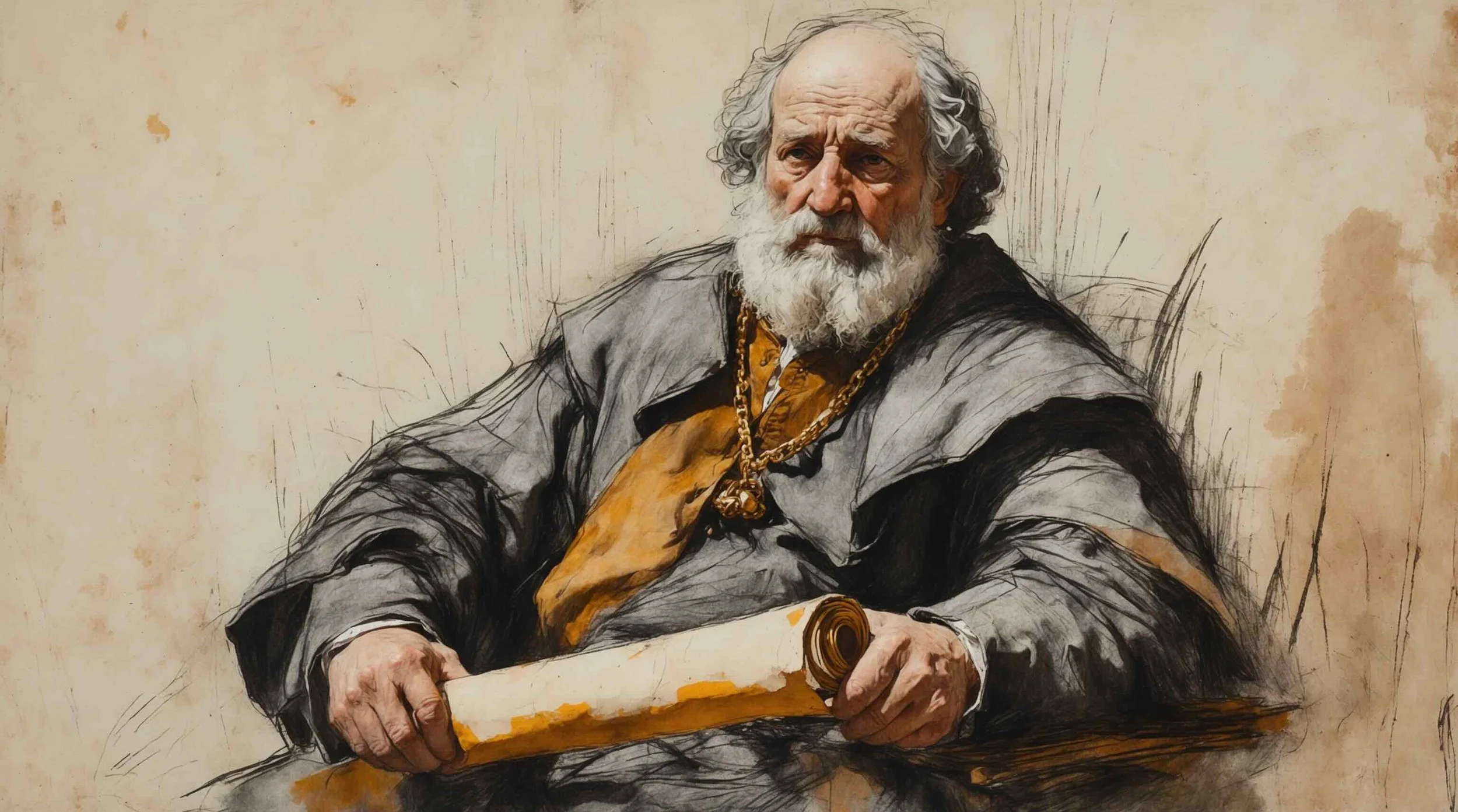
Character Profile – At a Glance
- Role: A rich gentleman of Padua and the father of Katharina and Bianca. He rules that his younger daughter may not marry until the elder has a husband.
- Key Traits: Fond, fussy, well-meaning and easily fooled. He loves his daughters and thinks of their marriages as business.
- The Core Conflict: Baptista wants both daughters well married and his own house at peace. He trusts whatever a suitor tells him, so long as the money is right.
- Key Actions: Shuts Bianca away until Katharina is married (A1S1). Agrees a dowry with Petruchio and then auctions Bianca between two bidders (A2S1). Waits at the church for a late bridegroom (A3S2). Settles Bianca’s marriage with a false father (A4S4). Learns that she has married behind his back (A5S1). Pays Petruchio a second dowry (A5S2).
- Famous Quote:
"Ay, when the special thing is well obtained,
That is, her love; for that is all in all."
(Act 2, Scene 1) - The Outcome: Both daughters are married by the end, neither in the way he arranged. He is last seen astonished at Katharina’s obedience and paying for it.
Importune Me No Farther
Baptista’s first speech sets the whole play going. He walks on with his two daughters and two of Bianca’s suitors at his heels, and lays down a rule.
Original
Gentlemen, importune me no farther,
For how I firmly am resolved you know;
That is, not bestow my youngest daughter
Before I have a husband for the elder:
If either of you both love Katharina,
Because I know you well and love you well,
Leave shall you have to court her at your pleasure.
(Act 1, Scene 1)
Shakespeare Retold (Modern Verse)
Now, gentlemen, don’t pester me again,
For you all know how I’m firmly committed;
Namely, my youngest daughter can’t be married
Until her older sister finds a husband.
If either of you love my Katharina,
Because I know and love you both so well,
I will consent for you to chat her up.
The younger girl will not be given to anyone until the elder has a husband, and if either gentleman would like Katharina, he may have her. It is said in the street, in front of both daughters. One suitor replies that she ought to be carted through the town like a criminal. Baptista lets it pass. He is not a cruel man, and he has a real problem: a daughter nobody will marry, and a custom that says the elder should go first. But his way of solving it is to treat one daughter as a lock on the other. The theme of marriage and economics starts here, with a father who talks about his children as a merchant talks about stock that must be shifted in the right order.
Poor Girl, She Weeps
At home we see which daughter he prefers. He comes in to find Bianca with her hands tied and Katharina standing over her, and he does not ask what has happened.
Original
Why, how now, dame! Whence grows this insolence?
Bianca, stand aside. Poor girl! She weeps.
(Act 2, Scene 1)
Shakespeare Retold (Modern Verse)
What’s going on here, girl! What’s caused this bad form?
Bianca, step aside. Poor girl! She’s crying.
Bianca is the "poor girl"; Katharina is "dame", and a moment later a "hilding", a worthless creature. He may well be right about who started it. But Katharina’s reply, that Bianca is his "treasure" and that she herself is to be left on the shelf, is a charge he never answers. He turns to the audience instead and asks whether any gentleman was ever so afflicted. It is the complaint of a man who thinks his daughter’s unhappiness is something that is happening to him.
A Merchant's Part
Within the same scene Baptista disposes of both his daughters. Petruchio asks what dowry comes with Katharina, is told twenty thousand crowns and half the estate, and is ready to draw up the papers. Baptista, to his credit, makes one condition: the girl must agree. When Petruchio returns from the wooing and announces that she has, while Katharina is saying loudly that she has not, her father has to choose whom to believe.
Original
I know not what to say: but give me your hands;
God send you joy, Petruchio! 'tis a match.
(Act 2, Scene 1)
Shakespeare Retold (Modern Verse)
I don’t know what to say: give me your hands;
God bring you joy, Petruchio! It’s a match.
"I know not what to say" is honest. Then he says it anyway: it is a match. Having got one daughter off his hands in ten minutes, he turns at once to the other, and the two remaining suitors are invited to bid.
Original
Content you, gentlemen: I will compound this strife:
'Tis deeds must win the prize; and he of both
That can assure my daughter greatest dower
Shall have my Bianca's love.
(Act 2, Scene 1)
Shakespeare Retold (Modern Verse)
Calm down now, gentlemen: I’ll settle this.
The prize is won through action; and the person
Who guarantees my daughter the most wealth
Shall have my Bianca’s love.
"Deeds" here means title-deeds as much as actions, and "love" means the girl. Old Gremio offers his house, his plate and his dairy herd. Tranio, dressed as his master, tops every offer with ships and estates that do not exist. Baptista knocks his daughter down to the higher bidder, subject to a father’s guarantee. He does not ask Bianca. The theme of class and status is plain in the scene: what settles a marriage in Padua is property, and a confident young man in good clothes is believed.
Another Dowry to Another Daughter
From here on Baptista is the man things happen to. He is kept waiting at the church by one son-in-law and has his feast abandoned. He negotiates Bianca’s marriage with a stranger who is pretending to be a rich man from Pisa, and is charmed by him.
Original
Sir, pardon me in what I have to say:
Your plainness and your shortness please me well.
(Act 4, Scene 4)
Shakespeare Retold (Modern Verse)
Sir, pardon me for what I have to say:
Your openness and brevity both please me.
He likes the man’s "plainness". The man is a passing schoolmaster hired to play the part. While Baptista goes off to sign the contracts, his daughter is being married round the corner to her Latin tutor. He finds out in the street, forgives everyone within a page, and sits down to the wedding feast, where one surprise is left. He is sure that Katharina is still what she always was, and says so. Then she walks in when her husband calls her.
Original
The wager thou hast won; and I will add
Unto their losses twenty thousand crowns;
Another dowry to another daughter,
For she is changed, as she had never been.
(Act 5, Scene 2)
Shakespeare Retold (Modern Verse)
You’ve won the bet; and I will add to it
Some twenty thousand crowns onto their losses;
A different dowry for a different daughter,
For she has changed to one she’s never been.
Twenty thousand crowns more, "another dowry to another daughter", because she is so changed that she seems a different person. It is a generous thing to say and a revealing one. The daughter he could not manage all her life has been made obedient in a few days by another man, and Baptista’s response is to pay for the improvement.
"At the marriage of Bianca, the arrival of the real father, perhaps, produces more perplexity than pleasure."
— Samuel Johnson, The Plays of William Shakespeare, 1765
Key Quotes
Quote 1
For shame, thou hilding of a devilish spirit,
Why dost thou wrong her that did ne'er wrong thee?
When did she cross thee with a bitter word?
(Act 2, Scene 1)
Shakespeare Retold (Modern Verse)
Shame on you, wretch, you devil-hearted girl,
Why wrong her when she’s never done you wrong?
When has she hurt you with some nasty words?
Quote Analysis: Baptista to Katharina, after finding Bianca tied up. A "hilding" is a good-for-nothing, and "devilish" is the word the suitors use of her too. The questions are fair ones: Bianca has done her sister no open wrong. But notice that he asks them and does not wait for the answers. He has decided who is at fault before anyone has spoken, and Katharina’s reply, that Bianca’s very silence mocks her, is lost on him.
Faith, gentlemen, now I play a merchant's part,
And venture madly on a desperate mart.
(Act 2, Scene 1)
Shakespeare Retold (Modern Verse)
I’ve acted like a merchant to procure
A deal that seems absurdly insecure.
Quote Analysis: Baptista on having just agreed to marry Katharina to Petruchio. He calls himself a merchant making a risky deal in a doubtful market, and the next speaker carries on the image by calling Katharina a commodity. It is said as a joke, and it is the most accurate thing he says about himself. In his mind a daughter’s marriage is a venture, with a price, a risk and a return.
Go, girl; I cannot blame thee now to weep;
For such an injury would vex a very saint,
Much more a shrew of thy impatient humour.
(Act 3, Scene 2)
Shakespeare Retold (Modern Verse)
Go, girl; I cannot blame you now for crying,
For such an insult would offend a saint,
And let alone an anxious shrew like you.
Quote Analysis: Baptista to Katharina on her wedding morning, when the bridegroom has not appeared and she has left the stage in tears. It is the one time he sides with her, and even here the sympathy has a barb. Such treatment would vex a saint, he says, "much more a shrew". He comforts his daughter and calls her a shrew in the same breath, which is roughly how he has always treated her.
Now, in good sadness, son Petruchio,
I think thou hast the veriest shrew of all.
(Act 5, Scene 2)
Shakespeare Retold (Modern Verse)
Now, in all seriousness, Petruchio,
I think your wife’s the most shrew-like of all.
Quote Analysis: Baptista at the feast, just before the wager. "In good sadness" means in all seriousness. Asked to back his own daughter, he tells her husband to his face that he has married the worst shrew of the three. It shows how fixed his opinion of Katharina is, and it sets up the surprise that follows. Minutes later he is swearing by his "holidame" in amazement and reaching for his purse.
Key Takeaways
- The Rule: Baptista's decree that Bianca cannot marry before Katharina sets both plots of the play in motion.
- The Favourite: He openly prefers his younger daughter, and Katharina's anger is partly his doing.
- The Merchant: He settles one daughter on the first man to ask and offers the other to the highest bidder.
- The Dupe: He is deceived by a false tutor, a false suitor and a false father, and never suspects any of them.
Study Questions and Analysis
Is Baptista a good father?
He is a kind one by his own lights, and a poor judge of his children. The best thing to be said for him is that he tries, briefly, to protect Katharina from a marriage she does not want. When Petruchio proposes, Baptista insists that her love must be won first, and warns him what to expect.
Well mayst thou woo, and happy be thy speed!
But be thou armed for some unhappy words.
(Act 2, Scene 1)
Shakespeare Retold (Modern Verse)
Then go and woo her, and good luck to you!
But be prepared to hear some criticism.
"Happy be thy speed" is sincere: he would like the match to succeed. But "be thou armed" tells the suitor that the bride is an enemy to be faced. He then leaves the two alone, and when he comes back he accepts Petruchio’s word against his daughter’s own.
Critics have rarely given him much attention, and when they do it is usually as a type. Karen Newman, in her "Modern Perspective" essay for the Folger edition, describes an England in which "public and domestic authority" was "vested in men", and lists fathers first among them. Baptista is that authority in its mildest form: he never threatens, and he hands his daughters over all the same. The Folger editors, Barbara Mowat and Paul Werstine, note that he "denies all men the opportunity openly to court Bianca", which is the act of a careful father and also the cause of every deception that follows. Set beside Shakespeare’s other comic fathers he comes off fairly well. He does not threaten a daughter with death or a convent for refusing a husband, and he forgives an elopement in minutes. What he lacks is curiosity. He never asks why Katharina is angry or what Bianca wants, and both daughters end by marrying in ways he did not plan. Stage tradition makes him a fussy old man, more foolish than harsh, and the text supports that. The theme of gender and patriarchy does not need a tyrant to work. It needs only a father who assumes that arranging his daughters’ lives is his job.
Why must Katharina be married before Bianca?
Baptista gives no reason beyond his own resolve, but everyone on stage understands it. An elder daughter was expected to marry first, and a younger sister’s wedding left her publicly passed over. There is also a plainer motive: Bianca is the bait. As long as she cannot be had, her suitors have a reason to find Katharina a husband. One of them makes his view of that task clear.
To cart her rather: she's too rough for me.
(Gremio, Act 1, Scene 1)
Shakespeare Retold (Modern Verse)
Slut-shame her, more like: she’s too rough for me.
Baptista has said "court"; Gremio answers "cart". The pun is a nasty one. Carting was a real punishment, in which a woman judged a scold or a whore was drawn through the streets to be jeered at. The suitor says this in front of Katharina and her father, and Baptista does not object.
Karen Newman, in her "Modern Perspective" essay for the Folger edition, uses this line to show how close the comedy stands to actual practice. She describes the public humiliations that Elizabethan communities used on unruly women, "the ducking stool" and "carting", and comments that "Anxiety about changing social relations prompted the labeling of old behaviors in new ways that made criminals of women whose actions threatened patriarchal authority." The play’s first scene, on this reading, shows a father allowing his daughter to be spoken of as a public nuisance. The situation itself is older than the play. In 1966 the folklorist Jan Harold Brunvand argued that the taming story came to Shakespeare from oral tradition, and Newman notes that the folk tales typically begin with "a father with two daughters, one curst" and "spurned, the other mild and sought after". Baptista’s rule, then, is partly a storyteller’s device: it ties the two daughters together so that the shrew must be dealt with before the romance can proceed. Within the story it has a human cost. Katharina hears herself named as the obstacle to her sister’s happiness, and Bianca is confined for something she has not done. The theme of marriage and economics begins with a rule that makes each sister the other’s punishment.
Does Baptista prefer Bianca to Katharina?
Yes, and he does not hide it. Having announced that Bianca must be shut away, he softens the blow for her at once.
And let it not displease thee, good Bianca,
For I will love thee ne'er the less, my girl.
(Act 1, Scene 1)
Shakespeare Retold (Modern Verse)
And do not be upset by this, Bianca,
For I won’t love you any less, my girl.
"Good Bianca", "my girl": the tenderness is real. Katharina is standing beside her and gets no such word. A few lines later he tells her she may stay outside, because he has "more to commune with Bianca". The elder daughter is left in the street with the men who have just insulted her.
Katharina’s own account of the household comes in A2S1, when she tells him that Bianca is his "treasure" and that she must "dance bare-foot" at her sister’s wedding. Readers who want to explain her temper usually start there. Harold Goddard, in The Meaning of Shakespeare (1951), thought her bad behaviour the natural result of her upbringing and insisted that "Kate’s shrewishness is superficial, not ingrained or congenital". If that is so, a good share of the blame is Baptista’s. The contrary view is that he is simply responding to how each girl behaves: one is gentle with him and one is not, and a father may be forgiven for finding the gentle one easier to love. The play gives some support to both. Bianca’s gentleness, as the later scenes show, is partly a performance for his benefit, and he is taken in by it as completely as her suitors are. Karen Newman, in her "Modern Perspective" essay for the Folger edition, remarks that Bianca "shows herself less docile than she seems", and her father is the last to find out. His reward for favouring her is to be deceived by her. The theme of illusion vs reality reaches into the family: Baptista has misjudged both his daughters, the difficult one and the easy one.
Does Baptista sell his daughters?
He would call it providing for them. But the language of the bidding scene is the language of a sale, and he conducts it himself. When Tranio, posing as a rich heir, has outbid old Gremio, Baptista gives his ruling.
I must confess your offer is the best;
And, let your father make her the assurance,
She is your own; else, you must pardon me,
If you should die before him, where's her dower?
(Act 2, Scene 1)
Shakespeare Retold (Modern Verse)
I must admit your offer is the best;
And if your father reaffirms your offer,
Then she is yours; but, sorry, I must say this,
That if you die before him, what’s she left with?
"Offer", "assurance", "dower": he is thinking like a lawyer. His worry is a sound one. If the young man dies before his father, Bianca could be left with nothing, so he wants the father’s signature. This is prudence on his daughter’s behalf. It is also the only question he asks about the man she is to live with.
How harshly to judge this depends on how much history one allows for. Among propertied families in Shakespeare’s England, marriage settlements were negotiated in just this way, and a father who failed to secure a jointure for his daughter would have been thought careless. Karen Newman, in her "Modern Perspective" essay for the Folger edition, reminds us that the family was then "the basic unit of production as well as consumption", so that a marriage was unavoidably a matter of money. The Folger editors, Barbara Mowat and Paul Werstine, describe the play as offering "strikingly different models" of choosing a mate, and add that "Some of these models may still seem attractive to us, some not." Baptista’s is one of the models. George Bernard Shaw, in the Saturday Review in 1897, thought the play’s honesty about money its great merit, a piece of "realistic comedy" in a form that usually pretends such things do not happen. Modern productions tend to play the auction for laughs with an edge, the old man’s head turning from bidder to bidder. Baptista himself gives the game away earlier in the scene, when he calls his dealing over Katharina "a merchant’s part". The theme of marriage and economics is seldom stated more openly than by this father, who means no harm at all.
How is Baptista deceived over Bianca’s marriage?
Three times over. The Latin tutor he hires is Lucentio, a suitor. The suitor he accepts is Tranio, a servant. The father who guarantees the dower is a stranger persuaded to play the part. Baptista believes all three, and learns the truth only when Bianca arrives already married.
But do you hear, sir? Have you married my daughter without asking my good will?
(Act 5, Scene 1)
Shakespeare Retold (Modern Verse)
But do you hear this, sir? Have you married my daughter without my prior agreement?
It is a small, plaintive question. The man who made the rule about his daughters’ marriages has just discovered that the rule was got round under his own roof. His "good will" was never asked, because the lovers knew they could do without it.
The trick belongs to a very old kind of comedy. Karen Newman, in her "Modern Perspective" essay for the Folger edition, traces the Bianca plot to George Gascoigne’s Supposes (1566), a translation of an Italian play in the Roman manner, and explains that in this tradition "the opposition is often her father" and the plot turns on a deception that "allows the lovers to be united". The father in such a play exists to be fooled. Shakespeare keeps the outline and makes the fooling triple. Samuel Johnson, in his edition of 1765, admired how well the two plots of the play are joined but found this part overdone: "At the marriage of Bianca, the arrival of the real father, perhaps, produces more perplexity than pleasure." Later critics have seen more purpose in it. Baptista is deceived because he judges by clothes and confidence. A servant in a fine cloak is a gentleman to him, and a schoolmaster with the right name is a merchant prince. In that he is no different from Padua at large, and the play has shown us in its opening scenes, with the tinker Christopher Sly dressed up as a lord, how little it takes. The theme of disguise and deception makes Baptista its chief victim, and he is so mildly punished that the comedy hardly pauses.
What does the ending show about Baptista?
That he never understood his elder daughter. At the feast he bets, in effect, against her, and when the wives are sent for he is as confident as anyone that she will not come. This is what he says when she does.
Now, by my holidame, here comes Katharina!
(Act 5, Scene 2)
Shakespeare Retold (Modern Verse)
Now, by the Virgin Mary, here’s Katharina!
"Holidame" is a mild oath, by all that is holy. The line is pure surprise. The father who has lived with Katharina all her life is more amazed than anyone in the room.
What he makes of it is told by what he does: he gives Petruchio a second dowry, "for she is changed, as she had never been". On the simplest reading this is a happy father rewarding a miracle. Read more coldly, it is a man paying a bonus to the contractor who fixed his problem. Either way it confirms that Baptista thinks the taming a success, and critics who doubt the taming have noticed that the people most convinced by Katharina’s speech are the men who know her least. Karen Newman, in her "Modern Perspective" essay for the Folger edition, observes that at the play’s close "Bianca and the widow refuse to do their husbands’ bidding at the very moment Kate has ostensibly learned to obey." The word "ostensibly" keeps the question open, and Baptista is exactly the kind of watcher who would not think to ask it. There is a neat symmetry in his position. He began the play with one difficult daughter and one easy one, and he ends it believing the same thing with the names changed round. He was wrong the first time. The theme of illusion vs reality leaves him where it found him, a fond father taking his daughters at face value.