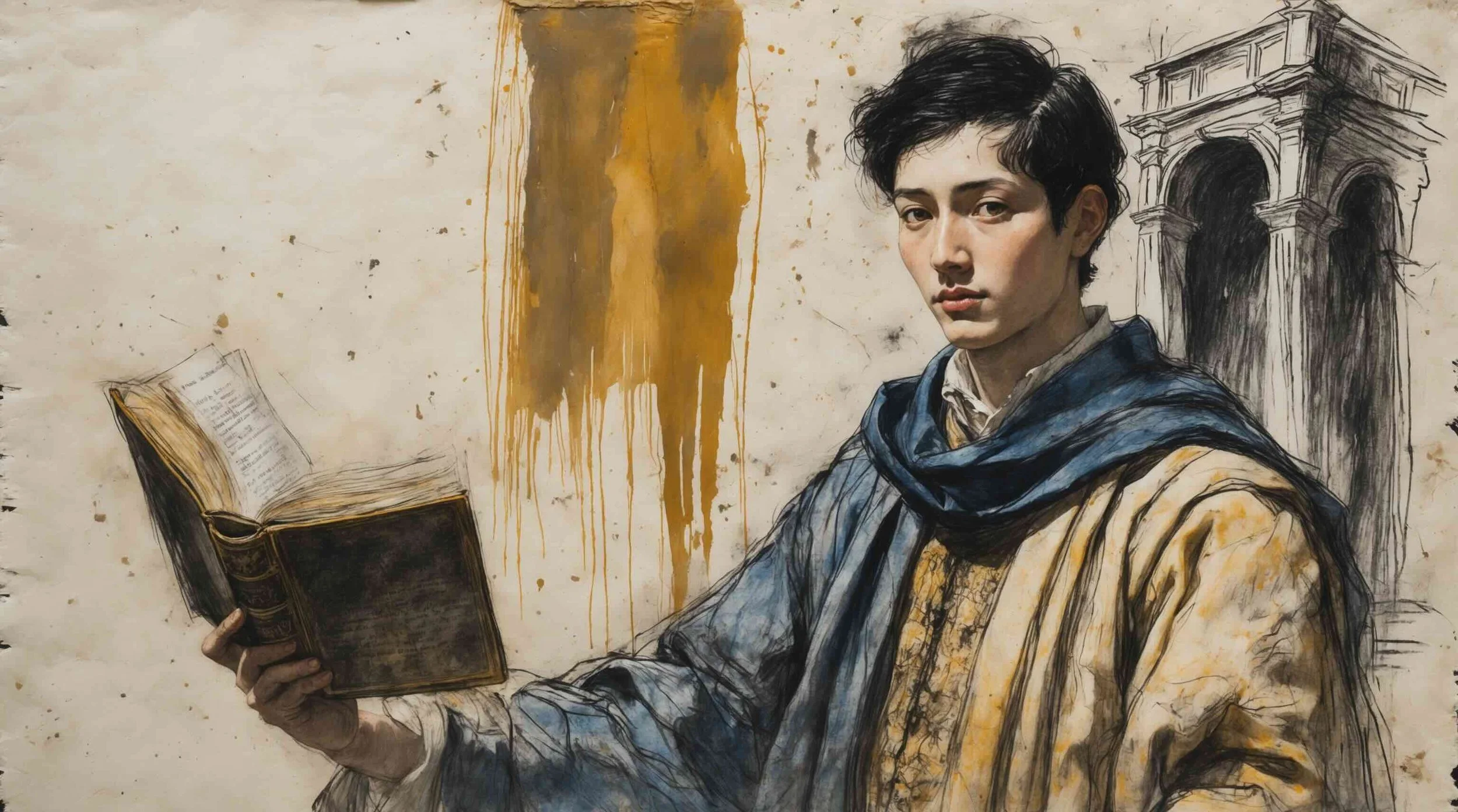
Character Profile – At a Glance
- Role: A rich young gentleman from Pisa, son of Vincentio, who comes to Padua to study. He falls in love with Bianca at first sight and woos her disguised as a Latin tutor called Cambio.
- Key Traits: Romantic, impulsive, bookish and trusting. He speaks in the language of love poetry and leaves the planning to his servant.
- The Core Conflict: Lucentio wants Bianca, but her father keeps her from all suitors. To reach her he must give up his name, his clothes and his rank, and deceive two fathers.
- Key Actions: Arrives in Padua to study and falls for Bianca (A1S1). Swaps identities with his servant Tranio (A1S1). Courts Bianca under cover of a Latin lesson (A3S1). Marries her in secret (A4S4, A5S1). Confesses to both fathers (A5S1). Loses the wager on his wife’s obedience (A5S2).
- Famous Quote:
"Tranio, I burn, I pine, I perish, Tranio,
If I achieve not this young modest girl."
(Act 1, Scene 1) - The Outcome: He wins the bride he wanted and loses a hundred crowns on her at his own wedding feast. The romantic lover ends the play as the husband who was wrong about his wife.
Nursery of Arts
The play proper opens with Lucentio, and for a scene he looks like its hero. He is young, rich and newly arrived, with his father’s blessing and a faithful servant, and he has a plan.
Original
Tranio, since for the great desire I had
To see fair Padua, nursery of arts,
I am arrived for fruitful Lombardy,
The pleasant garden of great Italy...
(Act 1, Scene 1)
Shakespeare Retold (Modern Verse)
Tranio, since I’ve always longed to see
The gorgeous Padua, home of the arts,
I’ve stopped here on my way to Lombardy,
The pleasant garden of great Italy...
Padua was famous for its university, and he has come to study virtue and philosophy. The speech is formal and a little pleased with itself, the voice of a well-brought-up young man who has read a good deal and done very little. Tranio gently suggests that he need not be too strict about it, and should mix some poetry and music with his Aristotle. Within a hundred lines the question is settled. A family walks down the street arguing, and Lucentio’s studies are over before they have begun. The theme of education and transformation starts as a joke at his expense: he came to Padua for a schooling and gets one, though not from books.
Love in Idleness
Lucentio falls in love by looking. He stands aside and watches Baptista with his daughters, hears the elder one rage, and notices that the younger says almost nothing. When the street clears he turns to his servant, amazed at himself.
Original
O Tranio, till I found it to be true,
I never thought it possible or likely;
But see, while idly I stood looking on,
I found the effect of love in idleness...
(Act 1, Scene 1)
Shakespeare Retold (Modern Verse)
Until I found it happening to me,
I never thought it possible or likely;
But look at me, as I stood watching on,
Aloof, I felt the sudden pangs of love.
"Love in idleness" is a pun. It is what happens to idle people, and it is also a name for the pansy, a flower that folk belief connected with sudden love. He has seen Bianca for a few minutes and heard her speak four lines. From this he builds a goddess: she is Minerva for wisdom, the daughter of Agenor for beauty, her breath perfumes the air. He has taken in nothing of the quarrel, and Tranio has to remind him of the practical point, that the lady is locked up until her sister is married. Lucentio is in love in the way that young men in poems are in love, completely, at once and without evidence. The play treats him kindly for it, and then shows him what he missed.
Cambio
The plan is Tranio’s as much as his. Bianca may see only tutors, so Lucentio will become one, and Tranio will put on his master’s clothes and play Lucentio in public. A gentleman turns himself into a hired schoolmaster with a new name, Cambio, to get near a girl. In the lesson scene he finally has his chance, and declares himself between the words of a Latin verse.
Original
'Hic ibat,' as I told you before, 'Simois,' I am Lucentio', 'hic est,' son unto Vincentio of Pisa, 'Sigeia tellus,' disguised thus to get your love; 'Hic steterat,' and that Lucentio that comes a-wooing, 'Priami,' is my man Tranio, 'regia,' bearing my port, 'celsa senis,' that we might beguile the old pantaloon.
(Act 3, Scene 1)
Shakespeare Retold (Modern Verse)
‘Hic ibat,’ as I told you before; ‘Simois’ means ‘I am Lucentio’; ‘hic est’ means ‘son of Vincentio from Pisa’; ‘Sigeia tellus’ means ‘disguised like this to win your love’; ‘Hic steterat’ means ‘and that Lucentio that came here to chat you up’; ‘Priami’ means ‘is actually my servant Tranio’; ‘regia’ means ‘pretending to be me’; ‘celsa senis’ means ‘so that we can trick the old fool Gremio.’
The Latin is from Ovid and is about the fall of Troy. The English tucked inside it says who he is, why he is there, and that his servant is courting her in his name to fool her old suitor. It is a clever device and a slightly comic one, since he is offering a woman his real identity while standing in front of her under a false one. Bianca answers that she does not know him and does not trust him. He has to earn it, and he does: by A4S2 they are kissing over the books. The theme of disguise and deception is at its lightest with Lucentio. He lies to everyone in Padua for love, and the play never suggests he should feel bad about it.
Love Wrought These Miracles
While Tranio handles the fathers, Lucentio slips off to church with Bianca. They return as man and wife to find the street in uproar: his real father has arrived, found a stranger using his name and a servant in his son’s clothes, and is about to be arrested. Lucentio kneels and owns up.
Original
Love wrought these miracles. Bianca's love
Made me exchange my state with Tranio,
While he did bear my countenance in the town...
(Act 5, Scene 1)
Shakespeare Retold (Modern Verse)
Love brought about these miracles. Bianca’s love
Made me exchange my role with Tranio,
While he pretended he was me in town...
It is the excuse of every young lover in comedy, and it works. Both fathers grumble and forgive. Lucentio has got everything he wanted by the end of A5S1, which leaves the play one scene in which to show him what he has got. At the feast he bets twenty crowns, then a hundred, that his new wife will come when he sends for her. She will not. When Katharina brings her in and he complains of the cost, Bianca tells him he was a fool to bet.
Original
I would your duty were as foolish too:
The wisdom of your duty, fair Bianca,
Hath cost me an hundred crowns since supper-time.
(Act 5, Scene 2)
Shakespeare Retold (Modern Verse)
I wish your duty was as foolish too:
Because your lack of duty, fair Bianca,
Has cost me a hundred crowns since suppertime.
The man who compared her to the goddess of wisdom now calls her wisdom expensive. It is a mild quarrel, and nobody is hurt. But it is the first time Lucentio has spoken to Bianca as a real person, and he does it in the tone of a disappointed customer.
"Lucentio’s courtship of and marriage to Bianca are prompted by his idealized love of an apparently ideal woman."
— Barbara Mowat and Paul Werstine, The Taming of the Shrew, Folger Shakespeare Library
Key Quotes
Quote 1
O yes, I saw sweet beauty in her face,
Such as the daughter of Agenor had,
That made great Jove to humble him to her hand.
When with his knees he kissed the Cretan strand.
(Act 1, Scene 1)
Shakespeare Retold (Modern Verse)
Oh yes, I saw the beauty in her face,
Who, like Europa – who was Agenor’s daughter –
Made Jove, the king of gods, besotted, freeze,
And, on the beach in Crete, fall to his knees.
Quote Analysis: Lucentio on Bianca, moments after first seeing her. The "daughter of Agenor" is Europa, the princess whom Jove loved so much that he came down to earth to carry her off. It is a schoolroom comparison, straight out of Ovid, and it shows how his mind works. He reaches for a book to describe a girl. There is also a small irony in the choice. In the myth the god disguises himself to get near the woman, and that is exactly what Lucentio is about to do.
Preposterous ass, that never read so far
To know the cause why music was ordained!
(Act 3, Scene 1)
Shakespeare Retold (Modern Verse)
You silly ass, you’ve never strived to learn
Why music was created in the first place!
Quote Analysis: Lucentio, as the tutor Cambio, to his rival Hortensio, who is posing as the music teacher. They are arguing over who gets to teach Bianca first. "Preposterous" means back to front: music, he says, was made to refresh the mind after study, so the philosophy lesson must come before the lute. It is a real argument and a perfectly silly one, since neither man cares about the curriculum. The line shows a livelier, ruder Lucentio than the dreamer of A1S1.
Here's Lucentio,
Right son to the right Vincentio;
That have by marriage made thy daughter mine,
While counterfeit supposes bleared thine eyne.
(Act 5, Scene 1)
Shakespeare Retold (Modern Verse)
Lucentio’s here.
The real son of real Vincentio;
By marriage I have made your daughter mine,
While our pretences fooled you, by design.
Quote Analysis: Lucentio revealing himself to Baptista. "Right son to the right Vincentio" sorts out the false Lucentio and the false Vincentio in a single phrase. "Counterfeit supposes" means false appearances, and the word nods to Supposes, the older English comedy from which this plot is taken. The speech is the moment the disguises come off. It is also Lucentio telling his new father-in-law that he has married his daughter while the old man was looking the other way.
HORTENSIO: Now, go thy ways; thou hast tamed a curst shrew.
LUCENTIO: 'Tis a wonder, by your leave, she will be tamed so.
(Act 5, Scene 2)
Shakespeare Retold (Modern Verse)
HORTENSIO: Well, off you go; you’ve tamed an angry shrew.
LUCENTIO: It is amazing she was tamed by you.
Quote Analysis: The last two lines of the play. Hortensio states the plain conclusion: Petruchio has tamed a shrew. Lucentio gets the final word, and it is a doubtful one. "’Tis a wonder" can mean that he is impressed. It can also mean that he does not quite believe it, or cannot see why she would allow it. Giving the closing line to a man who has just lost a bet on his own wife is a sly touch, and the note of puzzlement is what the audience takes home.
Key Takeaways
- The Romantic Lover: Lucentio falls in love at first sight and talks about Bianca in the language of poems and myths.
- Cambio: He gives up his rank and name to become a tutor, and wins Bianca in a Latin lesson.
- The Foil: His sweet, secret courtship is set against Petruchio's loud and public one, and the play asks which makes the better marriage.
- The Loser: At the wager he finds that the wife he idealised will not come when he calls.
Study Questions and Analysis
Why has Lucentio come to Padua?
To study. He announces a course of virtue and philosophy, and his servant answers with some of the most sensible advice in the play.
No profit grows where is no pleasure ta'en:
In brief, sir, study what you most affect.
(Tranio, Act 1, Scene 1)
Shakespeare Retold (Modern Verse)
There’s nothing to be gained when there’s no pleasure,
So, therefore, study what you most enjoy.
"Affect" means like. Study what you enjoy, says Tranio, because nothing is learnt without pleasure. He has just urged his master not to be so devoted to Aristotle that he gives up Ovid, the poet of love. Lucentio agrees that this is well advised, and promptly puts it into practice by abandoning his books for the first pretty face in the street.
William Hazlitt, in Characters of Shakespear’s Plays (1817), singled the lines out: "Nothing, however, can be better than the advice which Tranio gives his master for the prosecution of his studies". Hazlitt also grumbled that the play has "a little too much about music-masters and masters of philosophy", and the two remarks belong together. Learning is one of the play’s running subjects. Lucentio comes to a university town and becomes a schoolmaster; Hortensio becomes a music teacher; Petruchio is said to run a "taming-school". Karen Newman, in her "Modern Perspective" essay for the Folger edition, connects this to the humanist writers of the period, who treated the forming of a wife as a kind of education and recommended "persuasion, not brutality". On that view the scholar from Pisa and the tamer from Verona are both teachers, with very different methods and pupils. The opening speech also places Lucentio socially. He is the son of a merchant "of great traffic through the world", sent abroad to finish himself with his father’s money and his own servants, and it is that money which Baptista will later be so pleased to hear about. The theme of education and transformation begins with a young man who thinks learning comes from lectures and is about to be taught otherwise.
Is Lucentio really in love with Bianca?
He is certainly in love with what he has seen of her, which is not much. When Tranio tries to bring him back to the facts of the case, this is the reply he gets.
Tranio, I saw her coral lips to move
And with her breath she did perfume the air:
Sacred and sweet was all I saw in her.
(Act 1, Scene 1)
Shakespeare Retold (Modern Verse)
I saw her ruby lips begin to move
And as she breathed, she filled the air with perfume:
And all I saw in her was quite majestic.
Coral lips, perfumed breath, "sacred and sweet": it is the standard language of the love sonnets that were in fashion when the play was written. Lucentio describes Bianca as a poet of the 1590s would describe any mistress. Tranio’s response is to tell him to wake up.
Critics have long seen that the play sets this kind of love beside Petruchio’s and invites a comparison. Barbara Mowat and Paul Werstine, introducing the Folger edition, write that Lucentio’s courtship is "prompted by his idealized love of an apparently ideal woman", and that he speaks of her "as if she were a goddess come to earth". The key word is "apparently". He loves a silent girl for her silence, and he never tests the picture against the person. William Hazlitt (1817) simply enjoyed the verse, calling this description of his mistress "elegant". George Bernard Shaw, in the Saturday Review in 1897, had no patience with stage lovers of this sort and declared that "Petruchio is worth fifty Orlandos as a human study"; Lucentio is of the Orlando kind. It would be unfair to call his feeling false. He risks his father’s anger for it and gives up his rank to serve as a tutor. But it is a feeling about an image, and the image is one Bianca knows how to supply. The last scene is the correction. The theme of illusion vs reality gives the romantic lover a real wife and lets him find out the difference in public.
Why does Lucentio disguise himself as Cambio?
Because Bianca’s father has shut her away from suitors and will admit only teachers. Lucentio is still sighing when his servant works out what he must be thinking.
You will be schoolmaster
And undertake the teaching of the maid:
That's your device.
(Tranio, Act 1, Scene 1)
Shakespeare Retold (Modern Verse)
You’re going to be the tutor
And you will undertake to teach the maid.
That’s your plan too, right?
The "device" is to enter the house as a tutor. The difficulty is that someone must still be Lucentio in Padua, keeping his house and receiving his countrymen, so master and man exchange clothes on the spot. The servant becomes the gentleman. The gentleman takes a name that means "exchange".
The whole business is borrowed. Karen Newman, in her "Modern Perspective" essay for the Folger edition, explains that the Bianca plot comes from George Gascoigne’s Supposes (1566), an English version of an Italian comedy that itself imitated the Roman stage, and that Shakespeare softened it. In the older plays the young man is usually after a mistress; here the dramatist blends in "the romance tradition of the chaste lover (like Lucentio) who wishes only for marriage from the start". So the disguise is a comic convention, but it also carries a point about rank. Barbara Mowat and Paul Werstine, the Folger editors, put it this way: Lucentio "spontaneously throws off his social status as a gentleman in order to disguise himself as a lowly tutor". He does so without a moment’s hesitation, and his servant puts on a gentleman’s status just as easily. For Newman this is one of the ways the play works "to undermine notions of an essential self or a fixed identity": if a hat and cloak can make a master, mastery is not much more than a hat and cloak. Lucentio does not think about any of this. He wants to be in a room with Bianca. The theme of class and status is carried by a young man who treats his own rank as a costume he can hang up for a week.
How does Lucentio compare with Petruchio?
They are opposites, and the play is built on the contrast. Petruchio woos in public, for money, with insults, a woman who says she hates him. Lucentio woos in secret, for love, with compliments, a woman who seems to be all sweetness. Here is Lucentio at the height of his success, with Bianca on his arm and his rival giving up in disgust.
While you, sweet dear, prove mistress of my heart!
(Act 4, Scene 2)
Shakespeare Retold (Modern Verse)
While you will be the mistress of my heart!
He has just promised to practise "the Art to Love", meaning Ovid’s poem on seduction, and she has hoped he will prove a master of it. It is graceful, bookish flirting. Nothing could be further from a husband throwing roast mutton at his servants.
Which of the two is the better lover is a question the play asks through its structure, and critics answer it according to what they make of the ending. Barbara Mowat and Paul Werstine, in the Folger edition, describe the two courtships as "strikingly different models" of choosing a mate, one idealising and one "notably free of idealism", and leave the choice open. George Bernard Shaw (1897) preferred Petruchio as "an honest and masterly picture of a real man", which implies that Lucentio is the unreal one. Germaine Greer, in The Female Eunuch (1970), argued along similar lines that Petruchio at least knows the woman he marries, having the sense "to know what he wants and how to get it". The case for Lucentio is that he never starves anyone. His marriage begins with the woman’s free choice and involves no taming at all. If Bianca answers back at the end, a modern reader may think that a healthier sign than Katharina’s forty lines on obedience. The play gives Petruchio the victory in the wager. It does not follow that it gives him the argument. The theme of marriage and economics puts a love match and a money match side by side and declines to say which is which by the end.
Why does Lucentio marry Bianca in secret?
Because the open route depends on a lie that cannot last. Tranio, as "Lucentio", has won Baptista’s consent by promising a fortune and producing a false father. Sooner or later the real one will appear. Biondello brings word that a priest is waiting at Saint Luke’s church, and urges his master to take the girl there while the old men are busy. Lucentio hesitates for one line.
I may, and will, if she be so contented...
(Act 4, Scene 4)
Shakespeare Retold (Modern Verse)
I may, and will, if she would like to do that...
"If she be so contented" is to his credit. Even now he makes it depend on her. Then he talks himself into it: she will be pleased, so why should he doubt? He goes, and the next time we see the pair they are married.
The stolen marriage is the standard ending of the kind of comedy Shakespeare was adapting. Karen Newman, in her "Modern Perspective" essay for the Folger edition, describes the pattern, in which a trick "usually involving money and perpetrated by a servant or slave" unites the lovers against the wishes of an older generation. What is unusual is how much trouble it causes on the way. Lucentio’s real father arrives at the worst possible moment and is called a madman and an impostor at his own son’s door. Samuel Johnson, in his edition of 1765, praised the way the two plots of the play are joined but thought this stretch laboured: "At the marriage of Bianca, the arrival of the real father, perhaps, produces more perplexity than pleasure." William Hazlitt (1817) was fonder of it, and quoted with delight Biondello’s encouragement to the bridegroom about the girl who was married in an afternoon while fetching parsley to stuff a rabbit. Lucentio himself is absent for most of the uproar. He leaves the scheming to his servants and turns up at the end to kneel and be forgiven, which is very much the part of the young lover in this tradition: the trouble is taken by other people. The theme of disguise and deception lets him off lightly, and saves its lesson for the wedding feast.
What does Lucentio lose at the end of the play?
A hundred crowns, and his illusions about his wife. He opens the last scene as the happy host, sure that every difficulty is behind him.
At last, though long, our jarring notes agree:
And time it is, when raging war is done,
To smile at scapes and perils overblown.
(Act 5, Scene 2)
Shakespeare Retold (Modern Verse)
At last we have resolved our disagreements:
And now’s the time, now our disputes are over,
To laugh at all our close calls in the past.
The "jarring notes" are a musical image, fitting for a man who won his bride in a quarrel with a lute-player. Everything is in tune, he thinks. The scene then proceeds to show that he has spoken too soon. The widow and Katharina exchange insults, Bianca makes a bawdy joke and walks out, and the men are left to bet on their wives.
Lucentio names the stake, twenty crowns, and when Petruchio scoffs that he would bet as much on his hound, raises it to a hundred without a qualm. He sends first. Bianca replies that she is busy and cannot come. It is hard not to feel that he has earned the result. He chose a wife for looking obedient, and assumed that the look would hold. Karen Newman, in her "Modern Perspective" essay for the Folger edition, observes that "if in the end one shrew is tamed, two more reveal themselves", and Lucentio is the husband of one of them. Critics differ on how sorry to be for him. In the older, moralising view he is the dupe who married a pretty face and will repent of it. In the modern view he has merely learnt that he married a person, and Bianca’s refusal to perform for a wager is a small thing to hold against her. The play gives him the very last line, a remark that it is a wonder Katharina "will be tamed so", and it is fitting that the closing doubt should come from him. He has just had a lesson in how far a husband can know what his wife will do. The theme of illusion vs reality ends with the lover who saw a goddess in the street looking, puzzled, at two real women.