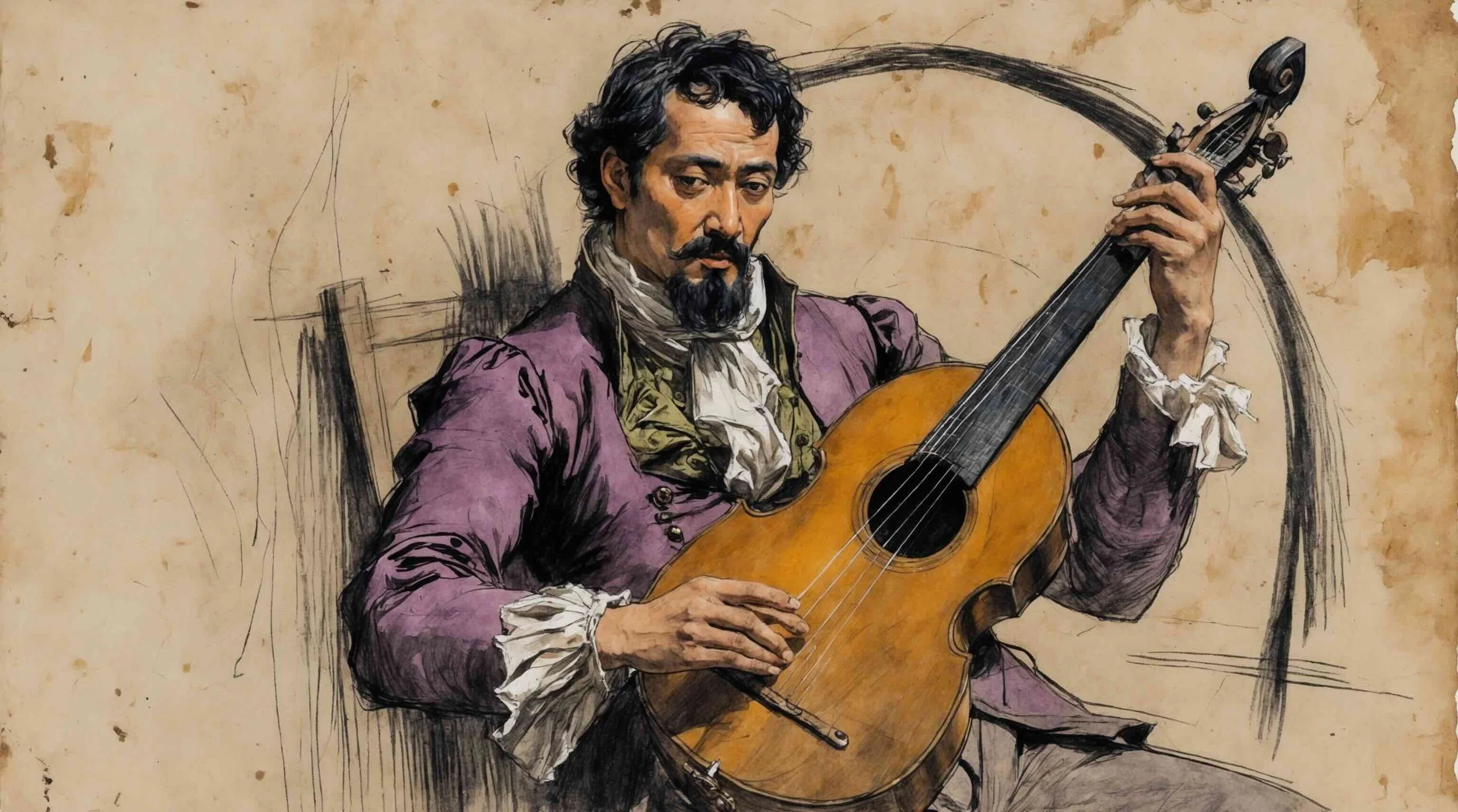
Character Profile – At a Glance
- Role: A gentleman of Padua, friend to Petruchio and suitor to Bianca. He woos her disguised as a music teacher called Litio, loses her and marries a rich widow.
- Key Traits: Sociable, cautious and easily discouraged. A follower who borrows other men’s plans and never quite makes them work.
- The Core Conflict: Hortensio wants Bianca but cannot reach her until Katharina is married. He needs a bolder man to clear the way, and then finds he has cleared it for someone else.
- Key Actions: Agrees with his rival to find Katharina a husband (A1S1). Sends Petruchio to woo her (A1S2). Has a lute broken over his head (A2S1). Courts Bianca as a music teacher and is turned down (A3S1). Gives her up and chooses a widow (A4S2). Watches the taming at Petruchio’s house (A4S3, A4S5). Loses the wager on his wife (A5S2).
- Famous Quote:
"Kindness in women, not their beauteous looks,
Shall win my love: and so I take my leave,
In resolution as I swore before."
(Act 4, Scene 2) - The Outcome: Married to a wealthy widow who will not come when he calls. He ends the play a hundred crowns poorer, admiring his friend’s success.
Good Fellows in the World
Hortensio is one of two men trailing after Bianca when the play begins, and he joins in the general abuse of her sister. When Baptista declares that the younger girl is off the market until the elder is married, the two rivals are left standing in the street. It is Hortensio who sees what must be done.
Original
Tush, Gremio, though it pass your patience and mine to endure her loud alarums, why, man, there be good fellows in the world, an a man could light on them, would take her with all faults, and money enough.
(Act 1, Scene 1)
Shakespeare Retold (Modern Verse)
Give over, Gremio, although it would exceed the patience of us both to endure all her shouting, why, there are good men in the world – if only we could see them – who’d suffer all her faults, if there was enough money in it.
There must be a man somewhere who will take Katharina "with all faults, and money enough". It is said lightly, in prose, between two men who a moment ago were enemies. They shake on it: they will find her a husband together and go back to competing afterwards. Hortensio is not a villain. He is a practical man in a town where daughters come with prices, and he has spotted that the obstacle to his own courtship can be removed with someone else’s greed. The theme of marriage and economics gets its plot from this handshake.
Come Roundly
The someone else arrives in the very next scene. Petruchio is an old friend, newly rich and looking for a wife, and Hortensio cannot resist. He mentions that he knows of a lady, wealthy, young and beautiful. Then, being an honest sort, he feels he ought to mention the rest.
Original
Her only fault, and that is faults enough,
Is that she is intolerable curst
And shrewd and froward, so beyond all measure
That, were my state far worser than it is,
I would not wed her for a mine of gold.
(Act 1, Scene 2)
Shakespeare Retold (Modern Verse)
Her only fault, and it’s a massive fault,
Is that she is intolerably rude,
A nag and disobedient, so much so
That, even if I was worse off than now,
I would not wed her for a mine of gold.
"Intolerable curst" is strong language, and he means it as a warning. He would not marry her for a gold mine. Petruchio is delighted, and from that moment Hortensio is carried along by a force he has set going and cannot control. He does at once see how to turn it to use. Petruchio shall do him a favour in return, and present him at Baptista’s house dressed as a music master, so that he can court Bianca in private. It is a neat plan. It is also, as things turn out, exactly the plan that a quicker rival has just had.
Litio and the Lute
Hortensio’s career as "Litio" the musician is brief and painful. He is sent in to give Katharina a lesson first, and returns a minute later with his head through the instrument.
Original
I did but tell her she mistook her frets,
And bowed her hand to teach her fingering;
When, with a most impatient devilish spirit,
'Frets, call you these?' quoth she; 'I'll fume with them:'
And, with that word, she struck me on the head,
And through the instrument my pate made way...
(Act 2, Scene 1)
Shakespeare Retold (Modern Verse)
I merely told her she had got the frets wrong,
And moved her fingers, teaching her the frets;
But then, with the impatience of a devil,
She said, ‘You call these frets? I’ll give you frets:’
And, with that word, she hit me on the head
So hard my head went through the instrument...
He had only corrected her fingering, and she broke the lute over his head, leaving him standing "as on a pillory" with his face looking through the strings. It is the best piece of slapstick in the play, and it happens off stage; all we get is his aggrieved account. With Bianca he does no better. In the lesson scene he is told to go and tune his instrument while the Latin tutor has his turn, and when at last he offers his love, written out as a musical scale, she tells him she prefers the old way of learning it. Hortensio is not stupid. He notices that the other tutor "looks as though he were in love". He simply cannot do anything about it. The theme of disguise and deception gives him the same trick as Lucentio and none of the luck.
Kindness in Women
What Hortensio does about losing is his one moment of dignity, or of pique, depending on how it is played. Spying on Bianca with a companion he takes to be his rival Lucentio, he watches her kiss her Latin tutor. He throws off his disguise and swears her off.
Original
See, how they kiss and court! Signior Lucentio,
Here is my hand, and here I firmly vow
Never to woo her no more, but do forswear her...
(Act 4, Scene 2)
Shakespeare Retold (Modern Verse)
Look how they kiss and cuddle! Sir Lucentio,
Please take my hand and I will firmly swear
Never to woo her, and I do renounce her...
He is giving his hand to Tranio, a servant in borrowed clothes who is working for the man doing the kissing. Hortensio never finds this out. He leaves congratulating himself on his resolve, and announces that he will marry a rich widow who has loved him as long as he has loved Bianca. From now on, he says, kindness and not beauty shall win his love. It is a sensible thing to say and a very quick recovery. He has swapped one woman with money for another within a dozen lines.
The Taming-School
Before he marries, Hortensio goes to see how it is done. Tranio reports that he has gone to "the taming-school", where Petruchio is the master, and we next find him at Petruchio’s country house, watching Katharina being kept from her dinner. He is uneasy at first and tells his friend he is to blame. By the road back to Padua he is a convert.
Original
Well, Petruchio, this has put me in heart.
Have to my widow! And if she be froward,
Then hast thou taught Hortensio to be untoward.
(Act 4, Scene 5)
Shakespeare Retold (Modern Verse)
Well, Petruchio, I feel encouraged.
I’ll see my widow! And if she’s a shrew,
Then, as you’ve taught me, I’ll be stubborn too.
If his widow proves "froward", difficult, he will be "untoward" in return, as Petruchio has taught him. He has seen a method and thinks he can copy it. The last scene tests him. His widow is sharp-tongued from her first line, she refuses to come when he sends for her, and he loses his bet with the rest. Hortensio has studied under the best teacher in Padua and learnt only the confidence. His last line tells Petruchio that he has "tamed a curst shrew", in the voice of a man who would like to know the secret.
"In some parts of this play there is a little too much about music-masters and masters of philosophy."
— William Hazlitt, Characters of Shakespear’s Plays, 1817
Key Quotes
Quote 1
Now shall my friend Petruchio do me grace,
And offer me disguised in sober robes
To old Baptista as a schoolmaster
Well seen in music, to instruct Bianca...
(Act 1, Scene 2)
Shakespeare Retold (Modern Verse)
So now my friend Petruchio will help me,
Presenting me dressed up in humble clothes
To old Baptista as a tutor who
Is good for teaching music to Bianca.
Quote Analysis: Hortensio’s plan, told to Petruchio. "Do me grace" means do me a favour. He will go to Baptista’s house "disguised in sober robes", presented as a schoolmaster "well seen in music", so that he may court Bianca unsuspected. The plan shows his character: it is careful, indirect, and depends on a friend to carry it through. He does not know that Lucentio has hit on the same idea a scene earlier, and will be a better actor.
But I have cause to pry into this pedant:
Methinks he looks as though he were in love:
Yet if thy thoughts, Bianca, be so humble
To cast thy wandering eyes on every stale,
Seize thee that list: if once I find thee ranging,
Hortensio will be quit with thee by changing.
(Act 3, Scene 1)
Shakespeare Retold (Modern Verse)
But I’ve a cause to spy upon this bookworm:
I think he looks as though he is in love.
But if, Bianca, you’re so open-minded
To fall for every foolish man you see,
Then go ahead: for if you sleep about,
I’ll quit the race and seek another out.
Quote Analysis: Hortensio alone on stage at the end of the lesson scene. He suspects the Latin tutor, rightly. Then comes the turn that defines him: if Bianca is so "humble" as to cast her eyes on every "stale", meaning a decoy or a low fellow, then anyone may have her, and he will be "quit" by changing to another woman. He is jealous, and he deals with it by deciding she is not worth having. It is the reaction of a man protecting his pride.
Would all the world but he had quite forsworn!
For me, that I may surely keep mine oath,
I will be married to a wealthy widow...
(Act 4, Scene 2)
Shakespeare Retold (Modern Verse)
If only every man but him reject her!
To make sure that I firmly keep my oath,
I will be married to a wealthy widow...
Quote Analysis: Hortensio’s parting vow. He wishes the whole world would give Bianca up, except the tutor she has chosen, and to keep his own oath he will marry within three days. The widow appears from nowhere: we have never heard of her, and she has, conveniently, loved him all along. The lines are brisk and businesslike. Romance, for Hortensio, was always partly a matter of fortune, and he moves his suit from a rich man’s daughter to a rich man’s widow without missing a beat.
Say as he says, or we shall never go.
(Act 4, Scene 5)
Shakespeare Retold (Modern Verse)
Agree with him, or we will never go there.
Quote Analysis: Hortensio to Katharina on the road, when Petruchio has stopped the journey until she agrees that the sun is the moon. It is plain, weary advice, and it is the push that changes the play. He is not on her side or on Petruchio’s; he wants to get to Padua. But the line states the bargain more plainly than either of the principals does. Agree with him, and you will get what you want.
Key Takeaways
- The Plotter: Hortensio's idea of finding Katharina a husband sets the taming plot going.
- Litio: His disguise as a music teacher wins him a broken lute and a polite refusal.
- The Quick Recovery: Rejected by Bianca, he swears off her and marries a wealthy widow within days.
- The Failed Pupil: He studies Petruchio's methods at the taming-school and still loses the wager.
Study Questions and Analysis
What kind of suitor is Hortensio?
A sincere one, as far as we can tell, who talks about love in terms of property. This is how he explains his situation to Petruchio.
For in Baptista's keep my treasure is:
He hath the jewel of my life in hold,
His youngest daughter, beautiful Bianca...
(Act 1, Scene 2)
Shakespeare Retold (Modern Verse)
Because Baptista keeps what I desire:
He holds on to what I most want in life,
His youngest daughter, beautiful Bianca...
Bianca is his "treasure" and the "jewel" of his life, and she is held in her father’s "keep", the strongest tower of a castle. The image is of a knight outside a fortress. It is also the language of a man describing valuables under lock and key, and in Padua the two are not far apart.
Hortensio is partly a creature of plot. Karen Newman, in her "Modern Perspective" essay for the Folger edition, points out that Shakespeare found the Bianca story in an older comedy and enlarged it: he "adds a rival for Bianca’s hand (Hortensio) to enhance the romantic plot by allowing her a choice between possible husbands". On that account Hortensio is there to be the man she does not choose, and to make her choosing visible. He does the job well. He is of good family and has known Bianca longer than Lucentio has, and nothing is wrong with him beyond a certain flatness. Bianca prefers the stranger who talks about Ovid. Scholars have long noticed loose ends in the part. He is missing from the scene where Bianca’s suitors bid for her, where his place as rival is taken by Tranio, and his visit to Petruchio’s house is not well prepared. Some editors have concluded that the role was altered at some stage. On stage the joins seldom show, because the character is consistent in one respect: he is always a step behind. He finds Katharina a husband and Lucentio profits. He adopts a disguise and a better one is already in the house. The theme of marriage and economics uses him as its ordinary man, neither a fortune-hunter like Petruchio nor a dreamer like Lucentio, and the least successful of the three.
Why does Hortensio send Petruchio to woo Katharina?
To get her out of the way. Until Katharina is married nobody may court Bianca, and Hortensio has agreed with his rival to find the elder sister a husband. When a friend turns up saying he wants a rich wife, Hortensio begins as a joke.
Petruchio, shall I then come roundly to thee
And wish thee to a shrewd ill-favoured wife?
(Act 1, Scene 2)
Shakespeare Retold (Modern Verse)
Petruchio, shall I speak plainly to you,
And offer you a nagging, ugly wife?
To "come roundly" is to speak plainly, and "shrewd" here means shrewish. He adds that she is rich, and then backs away: Petruchio is too much his friend to be wished on her. It is too late. Petruchio has heard the word "rich".
There is a small moral comedy in the scene. Hortensio is using his friend, and knows it, and salves his conscience by telling the truth about the lady. Barbara Mowat and Paul Werstine, in their introduction to the Folger edition, note that the arrangement soon becomes a paid one: Petruchio "takes money from all Bianca’s suitors for wooing her older sister". The suitors agree to bear the costs of his courtship, so that a man is in effect hired to marry Katharina. George Bernard Shaw, in the Saturday Review in 1897, thought these opening scenes the truest in the play, a picture of a man "hurrying off to strike the bargain before somebody else picks it up". Hortensio is the broker of that bargain. It never crosses his mind to ask what the marriage will be like for Katharina, any more than it crosses her father’s. Later critics have used him as evidence of how ordinary such thinking is in the play’s world. He is no worse than his neighbours. He wants to marry one sister, and he arranges the sale of the other to make it possible. The theme of gender and patriarchy does not rest on Petruchio alone. It needs the decent, friendly men who set him on.
What is the point of the broken lute?
It gives us Katharina’s violence at second hand, and it shows us how Petruchio takes the news. Hortensio staggers in to say that the lady will never make a musician but may make a soldier. Her intended husband is charmed.
Now, by the world, it is a lusty wench;
I love her ten times more than e'er I did...
(Petruchio, Act 2, Scene 1)
Shakespeare Retold (Modern Verse)
She sounds like she’s a feisty piece of work;
And now I love her ten times more than ever...
"Lusty" means spirited, full of life. Where Hortensio sees a danger, Petruchio sees a woman worth having, and longs "to have some chat with her". The difference between the two men is all there. One has had a lute broken on his head and wants no more of her. The other hears of it and likes her ten times better.
The episode is usually treated as pure farce, and it is very funny. It also does some quiet work. It is the only real evidence in the first half of the play that Katharina is physically dangerous, as opposed to merely rude, and it is given to us as a story told by the victim, so that we laugh at him and do not have to watch her do it. William Hazlitt, in Characters of Shakespear’s Plays (1817), complained that the play has "a little too much about music-masters and masters of philosophy", but the music master earns his place here. His account includes Katharina’s pun on "frets", the ridges on a lute and a word for anger: she will "fume" with them, she says. Even in a rage she is witty. Karen Newman, in her "Modern Perspective" essay for the Folger edition, describes Katharina’s "self-confidence and independence" as what the men of the play cannot bear, and Hortensio with the lute round his neck is the picture of a man who tried to instruct her. It matters, too, that he was correcting her. He told her she had her fingers wrong. Throughout the play Katharina’s temper flares when she is told what to do. The theme of education and transformation begins with a lesson that ends in splinters, and with a second teacher waiting who will go about it differently.
Why does Hortensio give up Bianca?
Because he sees her kissing another man, and because his pride will not let him compete with a hired tutor. Having sworn never to woo her again, he states his new principle.
Kindness in women, not their beauteous looks,
Shall win my love: and so I take my leave,
In resolution as I swore before.
(Act 4, Scene 2)
Shakespeare Retold (Modern Verse)
The kindness of a woman, not her beauty,
Will win my love. And so I’m going to leave you,
Committed to the oath I swore before.
It sounds like wisdom gained. He has pursued a beautiful face and been made a fool of; now he will look for a kind heart. The widow, he has just told us, has loved him as long as he has loved "this proud disdainful haggard". A haggard is a wild hawk, and it is the same word Petruchio uses for Katharina. Hortensio applies it to the supposedly gentle sister.
That is the interesting part. Hortensio is the first man in the play to say aloud that Bianca is not what she seems. Karen Newman, in her "Modern Perspective" essay for the Folger edition, traces the same discovery across the play, noting that in her dealings with her disguised tutors Bianca "shows herself less docile than she seems". He has learnt it the hard way. Whether he has learnt anything else is doubtful. His fine sentence about kindness is followed at once by the news that his new love is wealthy, and he has swapped brides in under three days. Critics are divided on whether to read him as shallow or merely sensible. In the world Barbara Mowat and Paul Werstine describe, where the play sets out "strikingly different models" of finding a mate, Hortensio’s is the most common and the least examined: he marries the woman who is available and has money. There is a sting in the tail. The widow he chooses for her kindness turns out, at the feast, to have a tongue as sharp as Katharina’s ever was. He had the right principle and picked the wrong woman, or more likely never knew either woman at all. The theme of illusion vs reality catches him twice, once with a mild girl who was not mild and once with a kind widow who was not kind.
What does Hortensio learn at Petruchio’s house?
Less than he thinks. He arrives as an observer, and his first reaction to what he sees is the natural one. When Petruchio snatches away a cap that Katharina wants, Hortensio objects.
Signior Petruchio, fie! You are to blame.
(Act 4, Scene 3)
Shakespeare Retold (Modern Verse)
This is your fault, Petruchio; shame on you!
For a moment he is on her side. It does not last. Petruchio takes him into the secret, asking him in an aside to eat up the meat so that Katharina shall have less, and to see the tailor paid behind her back. Hortensio goes along with both. By the time they set out for Padua he is urging her to give in, and when she does he declares the field won.
His function in these scenes is to be our representative: a reasonably kind man who is first shocked, then amused, then persuaded. How we judge that journey depends on how we judge the taming. For readers in the tradition of William Hazlitt (1817), who thought Petruchio "a character which most husbands ought to study", Hortensio is the husband doing the studying, and the joke is only that he is a poor student. For modern critics the scenes are more troubling. Karen Newman, in her "Modern Perspective" essay for the Folger edition, lists what he is watching: "starvation, sleep deprivation, and verbal bullying, all administered with the utmost courtesy and pretended kindness". Hortensio sees a hungry woman refused food and concludes that this "has put me in heart". The phrase "taming-school" itself comes from Tranio, who reports that Petruchio teaches "tricks eleven and twenty long, to tame a shrew and charm her chattering tongue". The play then makes fun of the idea that such tricks can be taught. Hortensio goes home, marries his widow, and at the feast hears Petruchio announce to the table that he fears her. He copied the manner and missed whatever it was that made it work. The theme of power and control suggests through him that Petruchio’s success is not a method at all, and cannot be passed on.
Is the Widow Hortensio’s punishment?
The last scene rather suggests so. She speaks only a handful of lines, and most of them are barbs. When Katharina obeys her husband by stamping on her own cap, the Widow says what she thinks of such obedience.
Lord, let me never have a cause to sigh,
Till I be brought to such a silly pass!
(Widow, Act 5, Scene 2)
Shakespeare Retold (Modern Verse)
Please let me never have the need to sigh
By being brought to such a wretched state!
A "silly pass" is a foolish state of affairs. She will never be brought to it. Earlier in the scene she has told the company that Petruchio, being troubled with a shrew, measures her husband’s sorrow by his own, which is a neat way of calling Katharina a shrew and Hortensio miserable at once. When Hortensio sends for her in the wager, she sends back that he must be joking, and that he may come to her.
The Widow has no name and no history. She exists to make a third at the wager and to complete the play’s reversal. Karen Newman, in her "Modern Perspective" essay for the Folger edition, puts it in a sentence: "if in the end one shrew is tamed, two more reveal themselves: Bianca and the widow refuse to do their husbands’ bidding at the very moment Kate has ostensibly learned to obey." Newman calls what the two women show "independence". A widow in Shakespeare’s England was, in law, among the freest of women, with control of her own money, and this one has plainly no intention of giving it up to a husband who went to school to learn how to manage her. An older reading takes the scene as simple comic justice: Hortensio helped arrange a shrew for his friend and has ended up with one himself. Petruchio rubs it in with his parting line, that the other two are "sped", done for. There is a third way to see it. Hortensio is the only one of the husbands who is told in public that he fears his wife, and he does not deny it. He may be the most realistic married man on the stage. The theme of gender and patriarchy leaves him where most of the men in the audience were assumed to be, with a wife who has her own opinions and a friend who claims to know better.