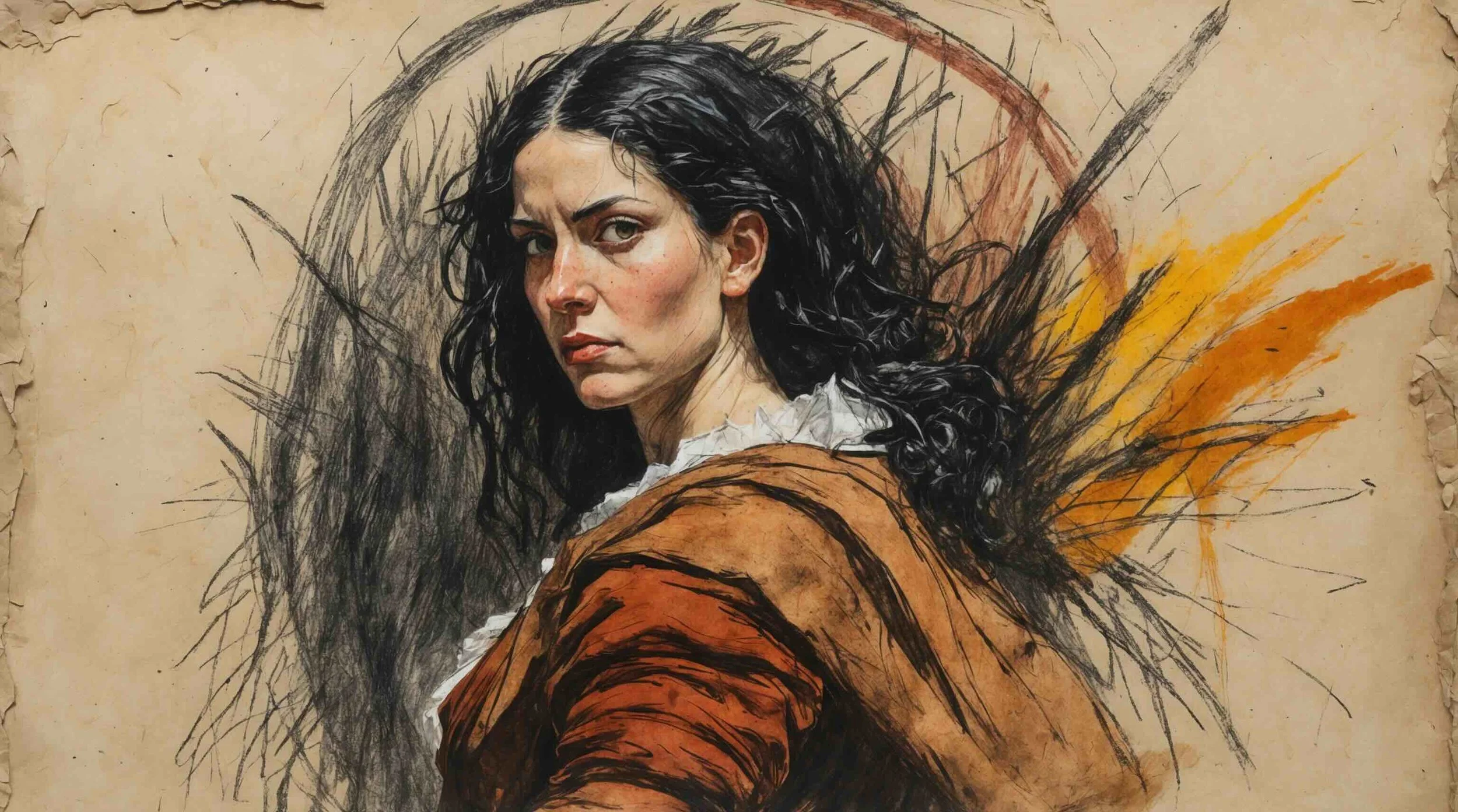
Character Profile – At a Glance
- Role: The elder daughter of Baptista, a rich gentleman of Padua, and the "shrew" of the title. Her father will not let her sister Bianca marry until she does.
- Key Traits: Quick, angry, clever and lonely. She says what she thinks in a town that wants its women quiet. By the end she is the best speaker in the play.
- The Core Conflict: Katharina will not act the mild, silent daughter that Padua rewards. Petruchio marries her for her dowry and sets out to break her will. She must decide what to give up and what to keep.
- Key Actions: Refuses to be shown off to Bianca’s suitors (A1S1). Ties up her sister and trades insults with Petruchio (A2S1). Is married against her will and carried off (A3S2). Is starved of food and sleep (A4S1, A4S3). Agrees that the sun is the moon (A4S5). Wins her husband’s bet with a speech on obedience (A5S2).
- Famous Quote:
"If I be waspish, best beware my sting."
(Act 2, Scene 1) - The Outcome: She comes when called, lectures the other wives on duty and leaves for bed with Petruchio. Whether she is tamed, acting or in on the joke is the question the play leaves open.
No Mates for You
The first thing Katharina does is object to being put on display. Her father has just told two suitors, in the public street, that neither may court Bianca until the elder sister is off his hands, and that either of them is welcome to try her instead. One suitor says she should be carted through the streets like a criminal. Katharina turns to her father.
Original
I pray you, sir, is it your will
To make a stale of me amongst these mates?
(Act 1, Scene 1)
Shakespeare Retold (Modern Verse)
I ask you, sir, do you intend
To make me look a whore amongst your mates?
It is a fair question. A "stale" is a laughing-stock, and also a prostitute, and she has just been offered round like goods nobody wants. The men answer by calling her a devil. What we see in the scene is a woman being insulted and answering back; what Padua sees is a shrew. The gap between those two views is where the whole play lives, and the theme of gender and patriarchy begins with it.
Notice, too, who is watching. Lucentio, newly arrived, looks at the two sisters and falls in love with the one who says almost nothing. Silence is what this town calls beauty. Katharina has a great deal to say, and nobody in Padua has ever wanted to hear it.
She Is Your Treasure
We next see Katharina at home, and for a moment she is exactly what the men say she is. She has tied her sister’s hands and is demanding to know which suitor Bianca likes best. When Bianca will not say, Katharina hits her. Their father arrives, comforts the younger girl and scolds the elder, and Katharina’s answer tells us where the anger comes from.
Original
What, will you not suffer me? Nay, now I see
She is your treasure, she must have a husband;
I must dance bare-foot on her wedding day
And for your love to her lead apes in hell.
Talk not to me: I will go sit and weep
Till I can find occasion of revenge.
(Act 2, Scene 1)
Shakespeare Retold (Modern Verse)
What, won’t you tolerate me? No, I see now
That she’s your treasure, and she must be married;
I’ll be humiliated when she’s married
And as you love her, I’ll be made a fool.
Don’t talk to me: I’ll sit around and cry
Until I’ve found a way to wreak revenge.
This is the only time in the play that Katharina talks about weeping, and it is the nearest she comes to explaining herself. Bianca is the treasure. Bianca will have the husband. The elder sister will dance barefoot at the wedding, the old custom for an unmarried older sister, and lead apes in hell, the proverbial fate of old maids. The rage is real, but so is the hurt underneath it. She is not angry because she hates the idea of marriage. She is angry because she has been told, all her life, that she is the daughter nobody will choose.
Kate the Curst
Then somebody chooses her, and it is no compliment. Petruchio has come to Padua to marry money, and he has settled the dowry with her father before he has set eyes on her. Their first meeting is the fastest scene in the play: a duel of puns in which, for the first time, Katharina meets someone who can keep up. She tells him to leave. He calls her a wasp. She warns him about her sting, and he offers to pull it out.
She loses, though not for want of wit. Petruchio simply tells her father that she has agreed, that she hangs about his neck in private, and that they have settled between them she will go on being rude in company. Katharina has no reply to a man who will not hear the word no. On the wedding day he arrives late, dressed like a scarecrow, and she says what the match looks like from where she stands.
Original
No shame but mine: I must, forsooth, be forced
To give my hand opposed against my heart
Unto a mad-brain rudesby full of spleen;
Who wooed in haste and means to wed at leisure.
(Act 3, Scene 2)
Shakespeare Retold (Modern Verse)
The only shame is mine: for I am forced
To marry someone that I do not love,
Who is an idiot, rude and offensive,
Who wooed me quickly, but will wed at his pace.
"To give my hand opposed against my heart" is the plainest statement in the play of what is being done to her. The theme of marriage and economics is at its coldest here: the bargain was struck between two men, and the bride is told about it afterwards. After the ceremony she asks to stay for her own wedding dinner. She is refused, called his goods and his chattels, and carried off.
The Sun and the Moon
At Petruchio’s house Katharina is kept from food and sleep, always in the name of love. The meat is burnt, so she must not eat it. The bed is badly made, so she must not lie in it. She has never had to beg in her life, and now she begs a servant for a meal. When a tailor brings the gown she was promised and her husband tears it to pieces, she makes her last open stand, and it is one of the best speeches she has: her tongue will tell the anger of her heart, or her heart will break.
The change comes on the road back to Padua. Petruchio remarks how brightly the moon is shining. It is the middle of the day, and Katharina says so. He turns the horses round. They will not go another step until the sun is the moon.
Original
Then, God be blessed, it is the blessed sun:
But sun it is not, when you say it is not;
And the moon changes even as your mind.
What you will have it named, even that it is;
And so it shall be so for Katharina.
(Act 4, Scene 5)
Shakespeare Retold (Modern Verse)
Then, praise the Lord, it is the blessed sun;
But it won’t be the sun if you say it’s not;
The moon will change as well if your mind changes.
Whatever you will call it, that will be it;
And it will be the same for Katharina.
This is the hinge of the play, and it can be read two ways. Either a hungry, exhausted woman has finally been broken, or a clever one has seen the rules of the game and decided to play it better than he does. The speech itself leans towards the second. "The moon changes even as your mind" is a joke at his expense: he is as changeable as the moon, and a little mad. A few lines later she greets an old man as a "young budding virgin" and plainly enjoys it. The theme of power and control turns in this scene from a fight into something closer to a performance for two.
Thy Husband Is Thy Lord
The last scene is a wedding feast and a bet. Three new husbands wager on whose wife will come when she is sent for. Bianca sends word that she is busy. The Widow tells her husband to come to her. Katharina comes, fetches the other two, and at Petruchio’s request tells them what a wife owes her husband. It is the longest speech in the play, and it is hers.
Original
Fie, fie! Unknit that threatening unkind brow,
And dart not scornful glances from those eyes,
To wound thy lord, thy king, thy governor:
It blots thy beauty as frosts do bite the meads,
Confounds thy fame as whirlwinds shake fair buds,
And in no sense is meet or amiable.
A woman moved is like a fountain troubled,
Muddy, ill-seeming, thick, bereft of beauty...
(Act 5, Scene 2)
Shakespeare Retold (Modern Verse)
Now, stop that! Drop your threatening, unkind frown,
And stop the daggers from your scorning eyes
That hurt your lord, your king and governor.
It blights your beauty, like frost blights a meadow,
And hurts your stature like wind shakes fine flowers,
And no way is it suitable or friendly.
An angry woman’s like a churning fountain,
All muddy, unappealing, thick, unsightly...
She goes on for more than forty lines: a husband is a lord, a king, a governor; he works by sea and land while his wife lies warm at home; a wife who fights him is a rebel. Nothing in the text tells us how to take it. It may be a broken spirit reciting its lesson, or a wife who has learnt to say what is wanted and keep her thoughts, or a woman happily showing off a new partnership in front of the people who used to pity her. What is certain is that the woman nobody in Padua would listen to has the whole room silent, and that her husband’s only answer is delight.
"In short, Kate’s speaking as she does contradicts the very sentiments she affirms."
— Karen Newman, A Modern Perspective: The Taming of the Shrew, Folger Shakespeare Library
Key Quotes
Quote 1
PETRUCHIO: Come, come, you wasp; i' faith, you are too angry.
KATHARINA: If I be waspish, best beware my sting.
PETRUCHIO: My remedy is then, to pluck it out.
KATHARINA: Ay, if the fool could find it where it lies.
(Act 2, Scene 1)
Shakespeare Retold (Modern Verse)
PETRUCHIO: Come on, you little wasp; you are too angry.
KATHARINA: If I’m a wasp, you best beware my sting.
PETRUCHIO: If I am stung, I’ll simply pull it out.
KATHARINA: Yes, if a fool like you could find the sting.
Quote Analysis: The heart of the wooing scene. Each of them takes the other’s word and turns it: he calls her a wasp, she owns the sting, he offers to pluck it out, she calls him a fool who could not find it. The lines are shared out evenly and run at the same speed, which is the point. For the first time someone is answering Katharina in her own style and not flinching. The insults are also the nearest thing to courtship that either of them gets.
Why, sir, I trust I may have leave to speak;
And speak I will; I am no child, no babe:
Your betters have endured me say my mind,
And if you cannot, best you stop your ears.
My tongue will tell the anger of my heart,
Or else my heart concealing it will break,
And rather than it shall, I will be free
Even to the uttermost, as I please, in words.
(Act 4, Scene 3)
Shakespeare Retold (Modern Verse)
Well, sir, I hope that I’m allowed to speak;
For speak I will, for I am not a child.
And better men have heard me speak my mind,
And if you cannot listen, block your ears up.
My tongue must tell the anger in my heart,
For, if I don’t, I know my heart will break,
And rather than it break, I will be free
To speak my mind, no matter what occurs.
Quote Analysis: Katharina to Petruchio, over a cap he will not let her have. It is her clearest account of why she talks as she does. Speech is not bad temper for her. It is a safety valve: if she cannot say what she feels, her heart will break. "I am no child, no babe" is a claim to be treated as an adult, and "I will be free" is the boldest phrase she is given. Petruchio pretends she has said something else and carries on. It is the last time she argues with him head-on.
Thy husband is thy lord, thy life, thy keeper,
Thy head, thy sovereign; one that cares for thee,
And for thy maintenance commits his body
To painful labour both by sea and land,
To watch the night in storms, the day in cold,
Whilst thou liest warm at home, secure and safe;
And craves no other tribute at thy hands
But love, fair looks and true obedience...
(Act 5, Scene 2)
Shakespeare Retold (Modern Verse)
Your husband is your lord, your life, your keeper,
Your head, your king, the one who cares for you,
And, so that he can care for you, commits
To working hard both on the sea and land,
To keep watch on the stormy nights and cold days,
Whilst you stay warm at home, safe and secure;
And asks for nothing else from you except
Your love, your looks and your obedience...
Quote Analysis: The core of the last speech. A husband is piled up with titles, "lord", "life", "keeper", "head", "sovereign", and the marriage is described as a fair exchange: he risks his body in storms and cold, and asks only love, fair looks and obedience in return. It is worth setting this picture beside the husband we have watched. Petruchio has not been to sea. He married her for her father’s money. Whether Katharina is describing her marriage, an ideal one, or what the room wants to hear is the question every production must answer.
Come, come, you froward and unable worms!
My mind hath been as big as one of yours,
My heart as great, my reason haply more,
To bandy word for word and frown for frown;
But now I see our lances are but straws,
Our strength as weak, our weakness past compare,
That seeming to be most which we indeed least are.
Then vail your stomachs, for it is no boot,
And place your hands below your husband's foot:
In token of which duty, if he please,
My hand is ready; may it do him ease.
(Act 5, Scene 2)
Shakespeare Retold (Modern Verse)
Come on, you stubborn, good-for-nothing worms!
My mind has been as arrogant as yours,
My courage just as great, my logic better,
To argue word for word and frown for frown;
But now I know our swords are made of straw,
Our strengths as weak as straw, and we’re pathetic,
By thinking that we’re great when we are not.
So wind your necks in, for it does no good,
And be submissive, doing what you should:
To show obedience, if he desires,
I’m here to do whatever he requires.
Quote Analysis: The close of the speech, and the hardest part of it. Katharina admits she was once as proud as the wives she is scolding, with a mind "as big" and a heart "as great", and says that women’s weapons are only straws. Then she offers to put her hand under her husband’s foot. The verse closes in neat rhyming couplets, which gives the ending the feel of a set piece. Petruchio does not take up the offer. He asks for a kiss instead.
Key Takeaways
- The Shrew: Padua calls Katharina a devil, but what we see on stage is a woman who is insulted and answers back.
- The Unloved Daughter: Her anger has a cause: her father prefers Bianca and treats his elder daughter as a problem to be got rid of.
- The Sun and the Moon: On the road she stops fighting Petruchio's words and starts playing with them, and the taming becomes a game for two.
- The Last Speech: Her sermon on obedience can be played as defeat, as irony or as partnership, and the text supports all three.
Study Questions and Analysis
Is Katharina really a shrew?
By the standards of Padua, yes. By what she does in front of us in the first scene, hardly. She asks her father one sharp question and threatens a suitor with a stool, and this is what she gets back.
Mates, maid! How mean you that? No mates for you,
Unless you were of gentler, milder mould.
(Hortensio, Act 1, Scene 1)
Shakespeare Retold (Modern Verse)
You call us mates! You what? We would not mate you
Unless you were a kinder, warmer person.
Hortensio is supposed to be a gentleman, and he is speaking to a lady in the street. The word "shrew" in Shakespeare’s England meant a scolding woman, one who would not hold her tongue, and it was a serious charge. Katharina’s offence in A1S1 is to speak at all. In A2S1 she does worse: she ties up her sister, strikes her, and breaks a lute over her music teacher’s head. The play gives her a real temper as well as a real grievance.
Critics divide over which of the two matters more. Karen Newman, in her "Modern Perspective" essay for the Folger edition, sets her against the "tripartite ideal" of chastity, silence and obedience that was preached at Elizabethan women, and writes that Katharina "refuses to abide by these Renaissance ideals of womanly submission"; on this reading the shrew is a creation of the men who use the word. Newman points to the suitor’s threat to "cart" her as a trace of the real public punishments handed out to scolds. Harold Goddard, in The Meaning of Shakespeare (1951), made the gentler case that her bad temper is a response to her treatment at home, arguing that "Kate’s shrewishness is superficial, not ingrained or congenital". William Hazlitt, in Characters of Shakespear’s Plays (1817), took the older view that she is simply wilful, and that the play shows "how self-will is only to be got the better of by stronger will". The text will carry all three. What it will not carry is the idea that she is the only difficult person in Padua. The theme of gender and patriarchy asks who gets to decide what counts as a fault.
Why does Katharina tie up her sister?
Because she wants an answer that Bianca will not give. The scene opens with the younger sister bound and the elder questioning her.
Of all thy suitors, here I charge thee, tell
Whom thou lovest best: see thou dissemble not.
(Act 2, Scene 1)
Shakespeare Retold (Modern Verse)
Of all the men who woo you, you must tell me
Which one you love the best: and do not lie.
"See thou dissemble not" is the telling phrase. Katharina thinks her sister is a hypocrite: all meekness in front of their father, and well aware of her power over the men who visit the house. She wants Bianca to admit that she enjoys being courted. Bianca offers to hand over whichever suitor her sister fancies, which is either kindness or a very neat insult, and gets slapped for it.
The scene is short, and productions use it to settle how we feel about both women. Played as bullying, it gives the taming plot its excuse. Played as a quarrel between sisters, with Bianca needling as much as she is needled, it becomes the best evidence that Katharina’s anger is jealousy, and that she wants what Bianca has. Karen Newman, in her "Modern Perspective" essay for the Folger edition, notes that in her dealings with her suitors Bianca "shows herself less docile than she seems", and that by the end of the play "if in the end one shrew is tamed, two more reveal themselves". If that is right, Katharina’s suspicion in this scene is correct, and she is the only person in the house who sees her sister clearly. Barbara Mowat and Paul Werstine, the Folger editors, describe Bianca more cautiously as "an apparently ideal woman", and the word "apparently" is doing a good deal of work. The scene ends with Katharina’s outburst that Bianca is her father’s "treasure". The theme of illusion vs reality runs through the two sisters: the mild one may not be mild, and the angry one has reasons.
Does Katharina agree to marry Petruchio?
No. The text is clear on the point, and it is easy to miss because the scene is so funny. When her father comes back in after the wooing, this is what she says to him.
Call you me daughter? Now, I promise you
You have showed a tender fatherly regard,
To wish me wed to one half lunatic;
A mad-cap ruffian and a swearing Jack,
That thinks with oaths to face the matter out.
(Act 2, Scene 1)
Shakespeare Retold (Modern Verse)
You dare to call me ‘daughter’? Now, I swear
You’ve really shown a father’s tenderness
By wanting me to wed this lunatic;
This madcap bully and a swearing fool,
Who thinks that he can force me to be married.
Petruchio’s reply is to announce the wedding for Sunday. Katharina says she will see him hanged on Sunday first. He then explains to the company that she is only pretending, that they have agreed she will stay "curst in company", and her father joins their hands. She does not speak again in the scene. Her silence has to stand for consent, because nothing else does.
Critics have read that silence in opposite ways. Barbara Mowat and Paul Werstine, introducing the Folger edition, put the facts flatly: "Assured of the money, Petruchio is ready to marry Katherine even against her will." On that account the betrothal is a transaction between men, and the comedy should not hide it. A long line of readers has preferred to think that Katharina is at least interested. Germaine Greer, in The Female Eunuch (1970), counted her lucky to have found a man "who is man enough to know what he wants and how to get it". Actors can support that reading with a look or a pause, since the wit-combat shows she enjoys the fight. But it is a reading supplied by performance. On the page, Katharina says no, is ignored, and is next seen waiting at the church for a bridegroom who is late. The theme of marriage and economics is seldom so plain: the contract is made over her head, and her father calls it a match.
Is the taming of Katharina cruel?
It is meant to be funny, and it is also, looked at steadily, a programme of hunger and sleeplessness. Katharina describes it herself.
The more my wrong, the more his spite appears:
What, did he marry me to famish me?
(Act 4, Scene 3)
Shakespeare Retold (Modern Verse)
The more I’m suffering, the more he’s angry:
What, did he wed me so I’d starve to death?
She goes on to say that beggars at her father’s door are given food, while she, who never learnt to beg, is "starved for meat, giddy for lack of sleep". What spites her most, she says, is that he does it all "under name of perfect love". That phrase is the method. Petruchio never strikes her, and never admits to being unkind. Everything is done for her own good.
Whether that makes it better or worse is the oldest argument about the play. William Hazlitt (1817) enjoyed Petruchio enormously but did not pretend the victim was comfortable: "The situation of poor Katherine, worn out by his incessant persecutions, becomes at last almost as pitiable as it is ludicrous". George Bernard Shaw, reviewing a production in the Saturday Review in 1897, thought the taming itself "quite bearable" because Petruchio’s selfishness is "untainted by wanton cruelty", and kept his anger for the last scene. Modern critics have been less easy. Karen Newman, in her "Modern Perspective" essay for the Folger edition, lists what Shakespeare put in place of the beatings found in older shrew-taming tales: "public humiliation at their wedding, starvation, sleep deprivation, and verbal bullying, all administered with the utmost courtesy and pretended kindness." She calls it "more civilized coercion", and both words count. Emily Detmer, in Shakespeare Quarterly (1997), went further and argued that the play teaches a more refined kind of domination, in which a husband controls his wife without leaving a mark. Against this stands the farce tradition, which holds that nobody in a knockabout comedy is really hurt. The play gives each side something. Katharina is never beaten. She is also never, in these scenes, allowed to eat. The theme of power and control is at its starkest in a kitchen where the meat is always sent away.
What changes for Katharina on the road to Padua?
She stops contradicting her husband and starts outdoing him. Having agreed that the sun is the moon, she is at once given a harder test: Petruchio greets an old man on the road as a young girl, and invites her to do the same.
Young budding virgin, fair and fresh and sweet,
Whither away, or where is thy abode?
Happy the parents of so fair a child;
Happier the man, whom favourable stars
Allot thee for his lovely bed-fellow!
(Act 4, Scene 5)
Shakespeare Retold (Modern Verse)
Young budding virgin, beautiful and sweet,
Where are you going, or where do you live?
How happy are the parents of this child;
But happier is the man whose stars decree
He’ll marry you and take you off to bed!
She is not asked for five lines of this. She is asked to say hello. Katharina takes the joke and runs with it, wishing the old gentleman a happy husband, and when Petruchio turns round and tells her not to be mad she apologises with a straight face: her eyes have been dazzled by the sun, or whatever it is. For the first time the two of them are on the same side of a joke, and somebody else is the puzzled party.
How much weight this scene will bear is disputed. For William Hazlitt (1817) it was simply the high point of the comedy, where Petruchio’s extravagance "reaches its most pleasant and poetical height". Later critics have made it the turning point of the marriage. One influential line of argument, set out by Marianne Novy in 1979, treats the taming as a kind of play, a game whose rules Katharina learns on the road, so that her obedience from here on is a part she chooses to act with a partner. Karen Newman, in her "Modern Perspective" essay for the Folger edition, describes the couple in similar terms, as a pair in which "Petruchio plays at antic ruffian and Kate at submissive wife". The less comfortable reading notes what comes just before: Katharina is told she will not be allowed to see her father unless she agrees, and Hortensio begs her to say whatever Petruchio wants "or we shall never go". A person who gives in to get home has not necessarily been won over. Both things can be true at once. She yields because she must, and discovers as she does it that yielding can be made into wit. The theme of education and transformation is usually about what Petruchio teaches her. In this scene she learns something he did not set out to teach.
Does Katharina mean what she says in her final speech?
Nobody knows, and the play is built so that nobody can. The speech argues that a wife owes her husband what a subject owes a king.
Such duty as the subject owes the prince
Even such a woman oweth to her husband;
And when she is froward, peevish, sullen, sour,
And not obedient to his honest will,
What is she but a foul contending rebel
And graceless traitor to her loving lord?
(Act 5, Scene 2)
Shakespeare Retold (Modern Verse)
The duty that we owe to royalty
Is equal to what women owe their husbands;
And when she’s disobedient and tetchy,
Not doing what he fairly asks of her,
Who is she but a foul, defiant rebel
And graceless traitor to her loving husband?
This was standard doctrine in Shakespeare’s England, heard from the pulpit, and an Elizabethan audience would have found nothing strange in it. The difficulty is the speaker. Four acts ago Katharina would have thrown something at anyone who said this to her.
There are, broadly, four ways of taking it. The first is that she means every word and has been tamed; this is what the title promises. George Bernard Shaw (1897) took it so and was appalled: "No man with any decency of feeling can sit it out in the company of a woman without being extremely ashamed of the lord-of-creation moral implied in the wager and the speech put into the woman’s own mouth." The second is that she means it and is right to. Germaine Greer, surprisingly to many readers of The Female Eunuch (1970), defended the speech on the grounds that "The submission of a woman like Kate is genuine and exciting because she has something to lay down, her virgin pride and individuality". The third is irony. Coppélia Kahn, in an essay of 1975, argued that Petruchio "has gained her outward compliance in the form of a public display, while her spirit remains mischievously free". The fourth, put by Robert Heilman in 1966, is that the question is too solemn for the kind of play this is, since "the whole wager scene falls essentially within the realm of farce". Karen Newman, in her "Modern Perspective" essay for the Folger edition, declines to choose and points to something all four readings must deal with: at the moment the play states most strongly that women should be silent and obedient, a woman holds the stage with "the longest speech in the play". As she puts it, "Kate’s speaking as she does contradicts the very sentiments she affirms." The actor has to decide. The theme of gender and patriarchy ends on a speech that says one thing and does another.
Why is she called both Katharina and Kate?
Because the name is one of the things she and Petruchio fight over. His very first words to her rename her.
PETRUCHIO: Good morrow, Kate; for that's your name, I hear.
KATHARINA: Well have you heard, but something hard of hearing:
They call me Katharina that do talk of me.
(Act 2, Scene 1)
Shakespeare Retold (Modern Verse)
PETRUCHIO: Good morning, Kate; for that’s your name, I hear.
KATHARINA: If that’s what you have heard, you’re hard of hearing:
For those who speak all call me Katharina.
She corrects him: people who speak of her call her Katharina. He answers with a speech that uses "Kate" eleven times in six lines, as plain Kate, bonny Kate, Kate the curst, the prettiest Kate in Christendom. It is a small act of ownership, and a clever one. "Katharina" is the formal name her father and the suitors use. "Kate" is a pet name, the sort a husband or a friend would use, and he takes it before he has any right to.
The names then track the story. Petruchio uses "Kate" more than fifty times in the play; almost nobody else uses it at all, and she never uses it of herself. When she speaks of herself it is as Katharina, in her shame on the wedding day and again on the road to Padua, at the moment she gives way about the sun and the moon: whatever he calls it, "so it shall be so for Katharina". She yields the point and keeps the name. In the last scene her father still calls her Katharina and her husband still calls her Kate, and his final line to her joins the pet name to a request: "kiss me, Kate". Actors and critics who think the marriage ends in partnership hear affection in the nickname. Those who think she has been broken hear a woman who has lost even what she is called. The play, as usual, lets both stand. The theme of power and control often comes down to words in this play, and a name is the first thing Petruchio takes.