Twelfth Night: Act 2, Scene 2 – Analysis
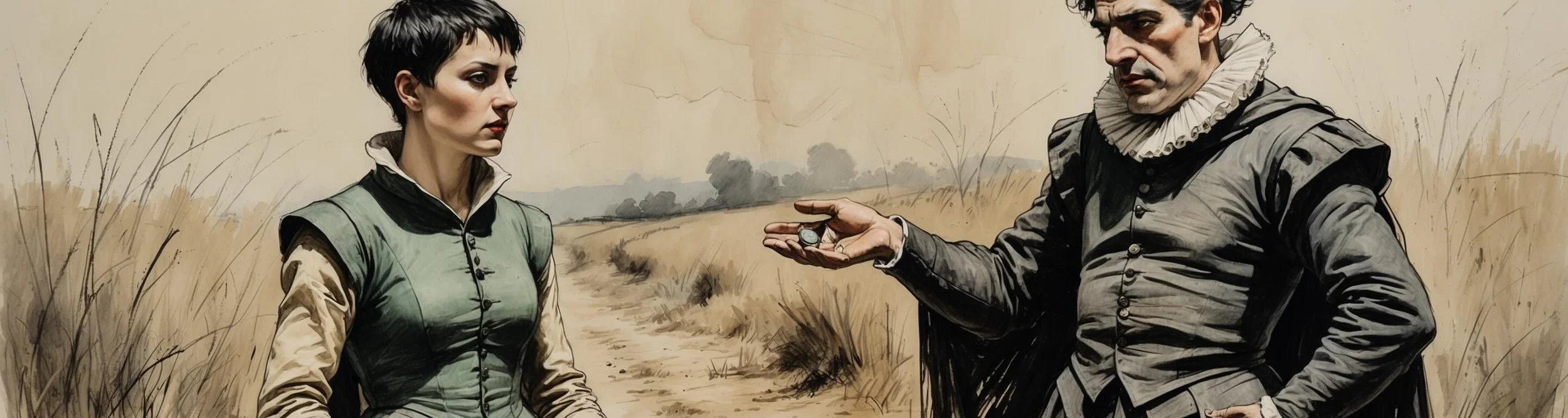
Scene Profile – At a Glance
- Location: A street near Olivia's house in Illyria.
- What Happens: Malvolio returns a ring to Viola (as Cesario) on Olivia's behalf. Alone, Viola realises that Olivia has fallen in love with her disguise, and delivers a soliloquy on the impossible knot she now finds herself in.
- Key Characters: Viola (as Cesario), Malvolio.
- Dramatic Function: The scene makes the central complication of the play explicit. Viola loves Orsino, Orsino loves Olivia, and Olivia now loves Cesario – a tangle that only time can untie.
- Famous Quote:
"I am the man: if it be so, as 'tis,
Poor lady, she were better love a dream."
(Viola, Act 2, Scene 2) - Why It Matters: In just forty lines, Shakespeare crystallises the entire love-triangle of the play. Viola's soliloquy shows how sharply she sees the situation – and how little she can do about it.
Scene Summary
Malvolio catches up with Viola in the street and, with barely concealed irritation, thrusts a ring at her. Olivia, he says, is returning it – she will have nothing to do with Orsino, and Cesario should not presume to call again. Viola is baffled: she left no ring with Olivia. Malvolio drops the ring on the ground and departs.
Left alone, Viola works out what the ring must mean: Olivia has fallen for her disguise. She is appalled and moved at once. Her soliloquy turns on the impossible triple bind – she loves Orsino, Orsino loves Olivia, and Olivia, mistakenly, loves Cesario. There is no way through this knot except time, and the scene ends with Viola walking away, unable to act.
"She Loves Me, Sure"
The ring is a message Malvolio himself does not understand, but Viola reads it in seconds. Olivia stared at her, spoke distractedly, and has now invented a pretext to make contact. The logic is transparent, and what it reveals is terrible: a woman falling for a fiction.
Original
Fortune forbid my outside have not charmed her!
She made good view of me; indeed, so much,
That sure methought her eyes had lost her tongue,
For she did speak in starts distractedly.
(Viola, Act 2, Scene 2)
Shakespeare Retold (Modern Verse)
Oh, don't say my appearance might have charmed her!
She did look at me closely, so much so
I thought at times that she was lost for words,
And when she spoke, she spoke in fits and starts.
Viola's exclamation – "Fortune forbid" – tells us she has already guessed the answer before she has finished reasoning it through. The image of Olivia losing her tongue captures a woman undone by a feeling she cannot manage. And the irony cuts deep: the person Olivia cannot speak coherently to is herself a woman, dressed as a man, suppressing her own love for Orsino.
"I Am the Man" – The Triple Knot
Having confirmed that Olivia loves her, Viola names the full catastrophe: three people locked in a chain of desire where nobody's love is returned. The lines are famous for their compression – in a handful of words Shakespeare maps the entire emotional geometry of the play.
Original
How will this fadge? My master loves her dearly;
And I, poor monster, fond as much on him;
And she, mistaken, seems to dote on me.
What will become of this? As I am man,
My state is desperate for my master's love;
As I am woman, – now alas the day! –
(Viola, Act 2, Scene 2)
Shakespeare Retold (Modern Verse)
What will occur? My master loves her dearly,
And I, both man and woman, dote on him,
And she, mistaken, seems to dote on me.
Oh, what on earth will happen? As a man,
I have no hope of my own master's love.
And as a woman – now, I rue the day! –
Viola calls herself a "poor monster" – neither fully the man she appears nor able to be the woman she is. The word is not self-pity but precise: she occupies a category the world has no name for. The soliloquy does not end in despair, however; it ends in a kind of stoic surrender. The knot is real, and time is the only force that can loosen it.
Language and Technique
- The ring as symbol: Olivia uses the ring to make contact while pretending to return what was never given. The object carries a meaning its deliverer cannot see.
- Dramatic irony: The audience knows exactly what Malvolio does not – that Viola is a woman, that no ring was left, and what Olivia's ruse means. The gap between his curt certainty and our full knowledge produces the scene's comedy.
- "Poor monster": Shakespeare uses the word carefully. Viola is not insulting herself; she is noting that disguise has placed her outside every ordinary human category, neither man nor woman in the eyes of those around her.
- The knot image: "It is too hard a knot for me to untie" gives the scene its closing image – the tangle of the plot made physical, something that can be felt as well as described.
- Soliloquy as thinking aloud: The speech is structured as real-time reasoning: a question, evidence, a conclusion, another question, and finally surrender. We watch Viola reach the truth step by step, as the audience reaches it with her.
Key Quotes from Act 2, Scene 2
Quote 1I am the man: if it be so, as 'tis,
Poor lady, she were better love a dream.
(Viola, Act 2, Scene 2)
Shakespeare Retold (Modern Verse)
I am the man she loves! If so, as is,
She would be better off loving a dream.
Disguise, I see, thou art a wickedness,
Wherein the pregnant enemy does much.
How easy is it for the proper-false
In women's waxen hearts to set their forms!
(Viola, Act 2, Scene 2)
Shakespeare Retold (Modern Verse)
I see that my disguise can be so evil,
It lets the devil do god-awful things.
How easy is it for deceptive men
To stamp their mark on women's hearts, like wax!
O time! Thou must untangle this, not I;
It is too hard a knot for me to untie!
(Viola, Act 2, Scene 2)
Shakespeare Retold (Modern Verse)
Oh time, you must untangle this, not I.
This knot's too tight for me to now untie!
Key Takeaways
- The ring is a trap: Olivia sends the ring to create contact with Viola, but the pretext is see-through and only makes the situation worse.
- Three loves, nobody satisfied: Orsino loves Olivia, Viola loves Orsino, and Olivia loves the disguised Viola. The triangle is complete and sealed.
- Viola sees clearly: Unlike Orsino or Olivia, Viola understands the full picture – which makes her position the most painful of the three.
- Disguise creates harm: Viola started her disguise as a practical convenience. Here she confronts its cost: it misleads people who have done nothing wrong.
- Time as the only solution: The scene ends in surrender – the situation is beyond human untangling and must be left to the play's unfolding.
Study Questions and Analysis
Why does Malvolio not understand what the ring means?
Malvolio's curt, self-important manner throughout the scene is the point. He is a steward carrying out a task he finds beneath him, dealing with someone he considers an impudent youth. He has no reason to look for hidden meaning in a returned ring, and his rigid, literal mind would not find it even if he looked. For him the ring is simply an object to be delivered and Cesario an irritant to be dismissed.
The scene uses Malvolio's obliviousness as a comic frame for Viola's intelligence. The same moment that he treats as a tiresome errand, she reads in seconds as a declaration of love. This contrast – between the steward's confident incomprehension and the disguised woman's instant understanding – is one of Shakespeare's sharpest pieces of characterisation in the play. It also prepares us for the later gulling plot: Malvolio's inability to read situations will be exploited at length in Act 2, Scene 5.
What does Viola mean by calling herself a "poor monster"?
The word carries more weight than it first appears. In Renaissance thought, a monster was literally something that fell outside the categories of nature – a creature that did not fit the established order. Viola, dressed as a man and serving as a love-messenger for a man she loves, genuinely does not fit any ordinary social category. She is neither the man she appears to be nor free to be the woman she is.
The self-description is precise rather than self-pitying. C. L. Barber, in Shakespeare's Festive Comedy (1959), notes that the cross-dressed heroines of Shakespeare's comedies inhabit a suspended, betwixt-and-between space that normal social life cannot accommodate; Viola's "poor monster" is an acknowledgement of that suspension. Many feminist readings have emphasised how Viola's situation exposes the rigidity of the gender categories themselves: it is not Viola who is monstrous, but a system in which she cannot speak or love as herself. The comedy will resolve the suspension, but at this moment it is entirely real.
Is the scene comic or tragic?
Both at once, which is precisely Shakespeare's comic mode. The scene's situation – a woman in male disguise being pursued by another woman – is inherently farcical in outline, and Malvolio's pompous incomprehension gives it a genuinely funny opening. But Viola's soliloquy is not comic at all: it is a lucid, quiet survey of an impossible situation, ending in a kind of resigned surrender.
Shakespeare's great comedies tend to include a character who sees through the festivity to a real cost beneath it, and Viola is that figure here. The situation will untangle – Sebastian's arrival will solve what time could not – but the scene insists we feel the knot as a knot before we watch it loosen. Northrop Frye, in A Natural Perspective (1965), described Shakespearean comedy as a movement from a blocking world toward a new society, but the blocking world must feel genuinely obstructive first. This short scene is where that obstruction becomes emotionally real.
How does this scene develop the theme of disguise and deception?
Act 2, Scene 2 is the moment when disguise stops being merely a plot device and becomes a moral problem. In Act 1 Viola adopted her male disguise as a practical response to being shipwrecked and alone; it solved an immediate problem. Here, she confronts what it costs others: Olivia has fallen genuinely in love with a fiction, through no fault of her own.
Viola's lines – "Disguise, I see, thou art a wickedness / Wherein the pregnant enemy does much" – invoke the devil and cast disguise as a moral trap. Yet the scene holds this condemnation alongside a recognition that Viola had no real alternative. The theme of disguise and deception in the play rarely presents deception as simply wicked or simply harmless; this scene is its fullest and most compressed statement.