Twelfth Night: Act 2, Scene 3 – Analysis
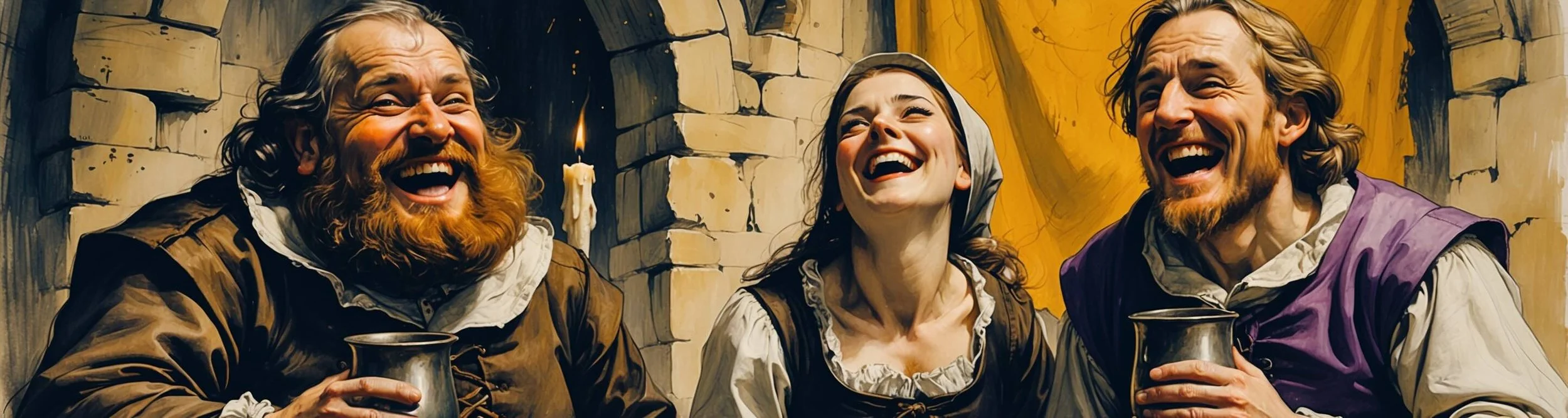
Scene Profile – At a Glance
- Location: Olivia's house, late at night.
- What Happens: Sir Toby, Sir Andrew, and Feste carouse and sing late into the night. Malvolio arrives to rebuke them. Toby's famous retort – "Dost thou think, because thou art virtuous, there shall be no more cakes and ale?" – sends him packing. Maria then proposes the forged-letter plot to trick Malvolio into thinking Olivia loves him.
- Key Characters: Sir Toby Belch, Sir Andrew Aguecheek, Feste, Malvolio, Maria.
- Dramatic Function: The scene establishes the comic counter-world of revelry against which Malvolio's puritanism will be humiliated. It plants the gulling plot that drives Act 2, Scene 5 and beyond.
- Famous Quote:
"Dost thou think, because thou art
virtuous, there shall be no more cakes and ale?"
(Sir Toby Belch, Act 2, Scene 3) - Why It Matters: This is the scene that defines the play's comic engine: the conflict between pleasure and puritanism. Malvolio's interruption of the revellers sets in motion his own downfall, while Maria's wit reveals her as the play's cleverest schemer.
Scene Summary
The scene opens past midnight. Sir Toby Belch and Sir Andrew Aguecheek are still up, attempting to justify their late hours with increasingly tortured logic – Toby claims that going to bed after midnight counts as going to bed early. They call for Feste the jester, who arrives and proves his talent at wordplay by trading nonsense with them to their enormous delight.
Sir Andrew admires Feste's singing and requests a song. Feste performs two stanzas of "O mistress mine", a lyric song about seizing love while you can – "Youth's a stuff will not endure." Toby and Andrew are delighted and urge him to more. They break into a raucous drinking catch, waking the house.
Maria enters with a warning: Olivia has sent Malvolio to deal with them. Malvolio arrives, cold and furious, demanding they show some respect for the hour, the place, and their hostess. Sir Toby responds with a song and Feste joins in, baiting the steward. Toby delivers his famous line questioning whether Malvolio's virtue gives him authority over everyone else's enjoyment. Malvolio turns on Maria, threatening to report her to Olivia, then leaves.
Maria now reveals her plan. She will write love letters in Olivia's handwriting – her script is so similar she can barely be distinguished – and drop them where Malvolio will find them. The letters will play to Malvolio's greatest weakness: his conviction that everyone who sees him must love him. Toby is delighted; the scene ends with plans made and Maria departing to draft the letter while Toby and Andrew stay up still later.
Feste's Song – Carpe Diem
Feste's "O mistress mine" is the scene's emotional centre, though it sits lightly on the rowdy night around it. The song's argument is simple and ancient: love now, because time will not wait. Its tone is gentle and slightly melancholy – a reminder that the comic festivity of Toby's world rests on time's passing.
Original
O mistress mine, where are you roaming?
O, stay and hear; your true love's coming,
That can sing both high and low:
Trip no further, pretty sweeting;
Journeys end in lovers meeting,
Every wise man's son doth know.
(Feste, Act 2, Scene 3)
Shakespeare Retold (Modern Verse)
My lover, dear, where are you roaming?
Oh listen here! Your truelove's coming,
That can sing both high and low,
Don't dance away, my little sweeting,
Journeys end in lovers meeting,
Every wise man's son does know.
The song's assurance that "journeys end in lovers meeting" has a particular resonance in a play where the main characters are separated from the people they love by disguise and circumstance. For the audience, who know more than the characters, the line feels like a promise. But Feste the fool knows better than anyone how provisional such promises are, and the second stanza turns darker.
"Youth's a Stuff Will Not Endure"
The second stanza of Feste's song strips away the lightness of the first. Love is not coming in some better future – it is "not hereafter." The song's gentle urgency becomes quietly serious: the time to love is now, not later, because later is already slipping.
Original
What is love? 'Tis not hereafter;
Present mirth hath present laughter;
What's to come is still unsure:
In delay there lies no plenty;
Then come kiss me, sweet and twenty,
Youth's a stuff will not endure.
(Feste, Act 2, Scene 3)
Shakespeare Retold (Modern Verse)
What is love? It's not tomorrow.
Humour now makes laughter follow.
What's to come is still unclear.
There is no point in wasting time
So kiss me now whilst in your prime.
We don't stay young for every year.
This carpe diem philosophy – seize the present – is the unofficial anthem of Toby's world. It is also a quiet rebuke to everyone in the play who is waiting: Orsino for Olivia, Olivia for a lost brother, Viola for a resolution she cannot engineer. The song knows something the plot must learn.
Malvolio's Interruption
The steward arrives like a cold draught through a party. His speech is precise, controlled, and furious – every clause a reproach. He cites the time, the place, Olivia's dignity, and their own. The revellers respond with exactly the opposite of what he wants: more noise, more song, more deliberate frivolity.
Original
steward? Dost thou think, because thou art
virtuous, there shall be no more cakes and ale?
(Sir Toby Belch, Act 2, Scene 3)
Shakespeare Retold (Modern Verse)
than just a servant? And, as you are good,
do you believe all others can't have fun?
Toby's retort is one of the play's great comic lines. It is not merely an insult – it is an argument: that personal virtue confers no authority over other people's pleasures. Malvolio's mistake is not that he dislikes noise; it is that he believes his own moral superiority justifies controlling everyone around him. Toby refuses that authority in a single sentence.
Maria's Plot – Malvolio's Vanity as Weapon
After Malvolio exits, Maria delivers the most precise character analysis in the scene. Her description of Malvolio as a man so convinced of his own excellence that he believes everyone who sees him must love him is more acute than anything Toby or Andrew could manage. She has identified not just a weakness but the exact mechanism through which it can be exploited.
Original
swarths: the best persuaded of himself,
so crammed, as he thinks, with excellencies, that it is
his grounds of faith that all that look on him love
him; and on that vice in him will my revenge find
notable cause to work.
(Maria, Act 2, Scene 3)
Shakespeare Retold (Modern Verse)
he holds such high opinion of himself
that, due to all his splendid qualities,
he thinks that all who see him think he's great.
And, with this vanity of his, I'll find
a way to get revenge.
Maria's plan is elegant in its economy: she does not need to invent a plausible deception. She only needs to provide Malvolio with the material for a delusion he is already primed to believe. The forged letter will work not despite his intelligence but because of his vanity. This is the sharpest comedy in the scene – a trap baited with the victim's own self-love.
Maria's Letter Scheme
Maria's explanation of the plan is prose, quick and confident – the voice of someone who has already worked it out completely. She will forge Olivia's handwriting, imitate her style, and make the letters describe Malvolio so closely that he cannot doubt they are for him. Her handwriting, she notes, is near-indistinguishable from Olivia's – a detail that is both practically useful and slightly alarming.
Original
I will drop in his way some obscure epistles of love;
wherein, by the colour of his beard, the shape
of his leg, the manner of his gait, the expressure
of his eye, forehead, and complexion, he shall find
himself most feelingly personated. I can write very
like my lady your niece: on a forgotten matter we
can hardly make distinction of our hands.
(Maria, Act 2, Scene 3)
Shakespeare Retold (Modern Verse)
I'll make him find some vague letters of love,
which – by the way they crave his coloured beard,
his leg shape and the way he walks, his eyes,
his forehead, and complexion – he'll believe
they are describing him. I write just like
my lady, who's your niece; I had forgotten,
there's hardly a distinction in our writing.
The physical detail here – beard colour, leg shape, gait – is deliberately comic. Maria is promising to write a letter so full of specific description that Malvolio will be incapable of thinking it applies to anyone else. The comedy is in the precision of the trap, and in the confidence with which Maria describes a man she has evidently studied with care.
Language and Technique
- Prose throughout: The revellers' banter and Maria's scheming are all prose – the language of the common room, not the court. Even Malvolio's rebuke, though formal, is prose. The scene's only verse is Feste's song, marking it as a different, more lyrical register.
- Song as argument: "O mistress mine" is not merely decoration. Its carpe diem philosophy – seize love now, for youth does not last – quietly frames the entire night's revelry as something valuable and time-sensitive, not merely irresponsible.
- Comic timing in Toby's retort: "Dost thou think, because thou art virtuous, there shall be no more cakes and ale?" works because it answers Malvolio's moral authority with a counter-principle. It is not mere rudeness but a genuine argument about the limits of personal virtue.
- Maria's rhetorical precision: Her description of Malvolio – "the best persuaded of himself" – is a miniature character study delivered at speed. She uses Malvolio's own characteristics as the blueprint for his trap.
- Revelry vs order: The scene stages the play's central social conflict in miniature: the world of holiday and pleasure against the world of duty and sobriety. Neither is wholly right; both claim authority.
Key Quotes from Act 2, Scene 3
Quote 1What is love? 'Tis not hereafter;
Present mirth hath present laughter;
What's to come is still unsure:
In delay there lies no plenty;
Then come kiss me, sweet and twenty,
Youth's a stuff will not endure.
(Feste, Act 2, Scene 3)
Shakespeare Retold (Modern Verse)
What is love? It's not tomorrow.
Humour now makes laughter follow.
What's to come is still unclear.
There is no point in wasting time
So kiss me now whilst in your prime.
We don't stay young for every year.
steward? Dost thou think, because thou art
virtuous, there shall be no more cakes and ale?
(Sir Toby Belch, Act 2, Scene 3)
Shakespeare Retold (Modern Verse)
than just a servant? And, as you are good,
do you believe all others can't have fun?
swarths: the best persuaded of himself,
so crammed, as he thinks, with excellencies, that it is
his grounds of faith that all that look on him love
him; and on that vice in him will my revenge find
notable cause to work.
(Maria, Act 2, Scene 3)
Shakespeare Retold (Modern Verse)
he holds such high opinion of himself
that, due to all his splendid qualities,
he thinks that all who see him think he's great.
And, with this vanity of his, I'll find
a way to get revenge.
O mistress mine, where are you roaming?
O, stay and hear; your true love's coming,
That can sing both high and low:
Trip no further, pretty sweeting;
Journeys end in lovers meeting,
Every wise man's son doth know.
(Feste, Act 2, Scene 3)
Shakespeare Retold (Modern Verse)
My lover, dear, where are you roaming?
Oh listen here! Your truelove's coming,
That can sing both high and low,
Don't dance away, my little sweeting,
Journeys end in lovers meeting,
Every wise man's son does know.
I will drop in his way some obscure epistles of love;
wherein, by the colour of his beard, the shape
of his leg, the manner of his gait, the expressure
of his eye, forehead, and complexion, he shall find
himself most feelingly personated. I can write very
like my lady your niece: on a forgotten matter we
can hardly make distinction of our hands.
(Maria, Act 2, Scene 3)
Shakespeare Retold (Modern Verse)
I'll make him find some vague letters of love,
which – by the way they crave his coloured beard,
his leg shape and the way he walks, his eyes,
his forehead, and complexion – he'll believe
they are describing him. I write just like
my lady, who's your niece; I had forgotten,
there's hardly a distinction in our writing.
Key Takeaways
- Revelry has a philosophy: Feste's song gives the late-night carousing a serious underpinning – seize joy now, because time runs out.
- Malvolio oversteps: His error is not that he wants quiet, but that he assumes his virtue gives him the right to control others. Toby's retort exposes this.
- Maria is the cleverest person in the scene: She outthinks Toby, outmanoeuvres Malvolio, and devises the plan that will carry Acts 2 and 3.
- The gulling plot is launched: Maria's forged-letter scheme, set up here, drives the play's most sustained comic sequence.
- Vanity as vulnerability: Malvolio's absolute self-belief is not a strength but a trap waiting to be sprung. Maria sees this clearly; Malvolio does not.
- Prose and verse divide the world: The revellers speak prose throughout; only Feste's song rises into verse – a musical moment that lifts briefly above the comic chaos.
Study Questions and Analysis
What is the purpose of Feste's song "O mistress mine" in the scene?
The song functions on several levels at once. On the surface it is entertainment – a jester performing for a paying audience. But its content reaches beyond the moment. The carpe diem philosophy of the second stanza ("Youth's a stuff will not endure") is not merely decorative; it articulates the principle that underlies the whole night's revelry. Toby and Andrew are not simply misbehaving: they are, in the song's terms, doing exactly what time demands.
The song also creates an ironic frame around the play's main plot. At the moment Feste sings it, Viola is unable to tell Orsino of her love; Orsino is unable to reach Olivia; Olivia is locked in a vow of mourning. All three are delaying, and the song says delay is wrong. C. L. Barber, in Shakespeare's Festive Comedy (1959), argues that festive songs in Shakespeare serve a clarifying function – they name the values the festive world embodies and the comic plot will vindicate. "O mistress mine" is exactly this: a lyric statement of the play's comic faith that love will and should be found, now, before it is too late.
Is Sir Toby Belch a sympathetic character in this scene?
Toby occupies an ambiguous position throughout the play, and this scene captures both sides of him. His comic energy is genuinely infectious; his argument with Malvolio is one of the play's great moments, and his loyalty to the night's pleasures has a kind of reckless dignity. "Dost thou think, because thou art virtuous, there shall be no more cakes and ale?" is not merely a taunt but a principle, and it is not obviously wrong.
At the same time, the scene reveals Toby's less attractive qualities. He is exploiting Sir Andrew – knowingly running down a foolish man's inheritance while keeping him dangling with false hope of winning Olivia. The line "Send for more money" late in the scene is a brief glimpse of this. Northrop Frye, in A Natural Perspective (1965), distinguishes between festive figures who genuinely embody comic release and parasitic figures who merely mimic it; Toby sits awkwardly between the two. Audiences tend to enjoy him, but Shakespeare does not let us entirely trust our enjoyment.
Why is Malvolio a puritan, and what does that mean in this play?
Maria says Malvolio is "a kind of puritan", and then immediately qualifies it: "the devil a puritan that he is", she adds – he is not genuinely devout but merely a "time-pleaser", someone who performs moral strictness for social advancement. The distinction matters. Malvolio does not object to the revels out of sincere religious conviction; he objects because they threaten the order and dignity on which his own authority depends.
The "puritan" label nonetheless connects Malvolio to a real cultural conflict in Elizabethan England. Puritans campaigned against public festivity, theatre, and "cakes and ale" style celebrations as morally corrupting. For Shakespeare's audience, the type was immediately recognisable. The comedy of Malvolio's position is that he presents himself as morally superior while being motivated by ambition and vanity. C. L. Barber's reading of the Twelfth Night revelry as a "festive comedy" working out social tensions around holiday and sobriety is most fully demonstrated here: Malvolio is the spirit of anti-festivity, and his humiliation is the play's ritual answer to that spirit.
How does this scene present Maria, and why is she important?
Maria arrives in the scene as a warning voice – "What a caterwauling do you keep here!" – but rapidly reveals herself as the scene's most acute intelligence. Her character assessment of Malvolio is delivered quickly, confidently, and accurately; she has clearly been watching him for some time. Her plan is not impulsive but thought through in detail: the letter, the handwriting, the specific physical descriptions, the hiding place for observers.
Shakespeare gives Maria an unusual combination of qualities: the social position of a servant or waiting-woman, the wit and strategising ability of a comic mastermind, and a genuine grievance against Malvolio's pomposity. Many productions have drawn attention to the power dynamics here – a woman of relatively low status devising an elaborate revenge against a man who outranks her but whom she outthinks entirely. Toby's admiring "She's a beagle, true-bred" is meant as a compliment; it also reveals how the men around her consistently underestimate her. The plan she launches here will be one of the play's most sustained and elaborate comic sequences.
What does Toby's "cakes and ale" speech tell us about the play's themes?
The line crystallises the play's central thematic conflict: the tension between revelry and its opponents. Malvolio stands for order, sobriety, propriety, and hierarchy – all genuinely important social values. Toby stands for pleasure, fellowship, music, and the rights of appetite – also genuinely important. Shakespeare refuses to adjudicate cleanly between them.
What he does adjudicate is the specific claim Malvolio makes: that his personal virtue entitles him to constrain others. Toby's retort exposes this as a confusion. Personal virtue is its own reward; it does not come with a licence to impose it on others. This is the argument that resonates beyond its comic surface. Harold Bloom, in Shakespeare: The Invention of the Human (1998), reads Malvolio as a figure who anticipates a later cultural narrowing – the triumph of the work-ethic over festivity – and finds in Toby's rebuke one of Shakespeare's most direct statements about the value of pleasure as a human right. Whether or not one accepts Bloom's broader argument, the line's longevity suggests it names something real.
How does the scene prepare us for Malvolio's humiliation in Act 2, Scene 5?
The scene does two things that make the later gulling pay off dramatically. First, it establishes Malvolio's character precisely enough that the audience understands why the letter will work – Maria's diagnosis of his vanity ("the best persuaded of himself") is the key. When we watch him find the letter in A2S5, we already know the mechanism that will make him believe it.
Second, the scene establishes the audience's sympathies before Malvolio enters A2S5. We have seen him be genuinely unpleasant – threatening Maria, dismissing the revellers, invoking Olivia's authority in a self-serving way. We have also seen Toby, Andrew, Feste, and Maria at their most entertaining. By the time Malvolio discovers the letter, we are fully positioned in the comic world against him, which is why his gulling can be played for pure delight rather than discomfort. The moral positioning of this scene is careful preparation, not accident.
Why do Sir Toby and Sir Andrew stay up so late, and what does it reveal about them?
The scene opens with Toby's tortured logic about midnight constituting an early bedtime. The joke is simple enough, but it establishes something important: Toby and Andrew's revelry is deliberate, performative, even defiant. They are not accidentally up late; they are choosing to stay up specifically because it is the kind of thing sober, responsible people do not do.
For Toby this is a kind of philosophy. He lives in Olivia's house as her uncle, with no clear purpose or occupation – his entire existence is the festive counterworld the play also embodies. For Andrew it is something sadder: he stays because Toby asks him to, and because, as the scene reveals at its end ("I was adored once too"), he is a lonely man clinging to the approximation of friendship Toby provides. The late hour is comic, but Andrew's wistful aside turns it briefly melancholy – a reminder that not everyone in Toby's world is having quite as good a time as Toby.
What is the significance of the song's claim that "journeys end in lovers meeting"?
The line is the song's most resonant phrase in the context of the whole play. Twelfth Night is structured around separations: Viola is separated from Sebastian, Orsino from Olivia, Olivia from her dead brother. The play's comic machinery works to reunite the separated, correct the misdirected, and dissolve the barriers that hold people apart. Feste's song, sung in the middle of the action, offers the assurance that this is how things work – that travel leads to arrival, and arrival leads to love.
The attribution of this knowledge to "every wise man's son" is also worth attention. It is not the wise man himself who knows it, but his heir – wisdom passed down, absorbed rather than reasoned. This sits in deliberate contrast to Malvolio, whose every action is calculated and systematic. The song claims that the deepest truths about love are things you know before you think about them, which is exactly the kind of knowledge Malvolio, for all his self-assurance, entirely lacks.