Twelfth Night: Act 4, Scene 2 – Analysis
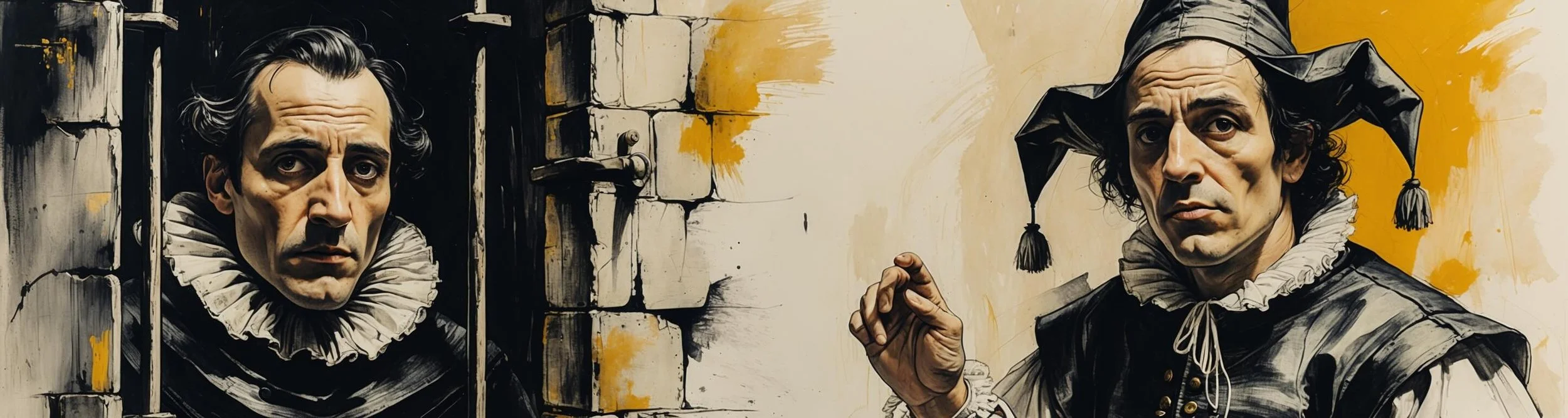
Scene Profile – At a Glance
- Location: Olivia's house – the dark room where Malvolio is imprisoned.
- What Happens: Maria disguises Feste as "Sir Topas the curate". Feste torments Malvolio in the dark by denying the room is dark and testing him on Pythagoras. Later, speaking in his own voice, Feste agrees to bring him pen and ink.
- Key Characters: Feste, Malvolio, Sir Toby Belch, Maria.
- Dramatic Function: The Malvolio subplot reaches its darkest point. His repeated plea "I am not mad" becomes the scene's refrain, and the cruelty of the prank forces the audience to reconsider how funny the joke has ever been.
- Famous Quote:
"I am not mad, Sir Topas: I say to you, this house is dark."
(Malvolio, Act 4, Scene 2) - Why It Matters: This scene marks the moment the comedy's festive cruelty tips into something uncomfortably close to real suffering. Malvolio's dignified insistence on his own sanity quietly shifts audience sympathy, preparing for the play's unresolved ending.
Scene Summary
Maria hands Feste a gown and a false beard, instructing him to impersonate a curate named Sir Topas and visit Malvolio in the darkened room where he has been locked. Feste dresses quickly and Sir Toby and Maria arrive to watch. Feste enters the performance immediately, calling out to announce his arrival as a clergyman come to minister to the lunatic.
Malvolio, hearing a voice of apparent authority, appeals urgently to Sir Topas: he is not mad, he insists; the room is genuinely dark; he has been wrongly imprisoned. Feste, maintaining his priestly persona, refuses every appeal. He tells Malvolio the room has transparent windows, that any darkness is in Malvolio's own ignorance, and tests him on the opinion of Pythagoras concerning the transmigration of souls – a deliberately absurd theological examination. Malvolio, thinking clearly, gives the correct answer but refuses to endorse Pythagoras's view; Feste uses this as proof that he remains mad and withdraws.
Sir Toby, growing nervous about the consequences for himself, tells Feste to visit Malvolio in his own voice and find a way to let him out quietly. Feste sings a fragment of an old song outside the room, and Malvolio calls out again. This time Feste drops the persona and speaks to him as himself. Malvolio, desperate but clearheaded, begs for light, pen, ink, and paper so that he can write to Olivia. Feste teases him a little longer, then agrees to help. The scene ends with Feste singing a comic exit song about the Vice figure of old morality plays, turning a dark scene back towards theatrical play-acting – though the darkness itself has not lifted.
Sir Topas Enters the Dark Room
The scene's central joke is that Feste does not need a disguise to fool Malvolio – Malvolio cannot see him, because the room is pitch dark. Maria points this out openly, and Feste's reply ("I am for all waters") is a comic admission that he can play any role in any circumstances. The disguise exists for the benefit of the conspirators watching, not for the prisoner. It is a piece of theatre within theatre, and it tells us something about Feste: he performs not only for his audience but for the pleasure of performing.
Original
What, ho, I say! Peace in this prison!
(Feste, Act 4, Scene 2)
Shakespeare Retold (Modern Verse)
What's happening here, I ask! Peace in this prison!
Feste's opening line as Sir Topas is a piece of comic bravado – commanding peace in a place where the prisoner can do nothing but appeal for help. The phrase "this prison" acknowledges what the conspirators are doing even while the priestly persona tries to deny it. Malvolio has been held without cause in genuine darkness; calling the place a prison is the most honest thing Sir Topas says, even if Feste means it as part of a joke.
"I Am Not Mad" – Malvolio's Insistence
The emotional centre of the scene is Malvolio's repeated assertion of his own sanity. He says it to Sir Topas, he says it again when Feste speaks as himself, and he says it in different words several times in between. His arguments are coherent: the room is dark; he has been locked up; the people tormenting him are the ones behaving strangely. Every test Feste applies, Malvolio passes – and is then told the correct answer proves he is mad.
Original
I am not mad, Sir Topas: I say to you, this house is dark.
(Malvolio, Act 4, Scene 2)
Shakespeare Retold (Modern Verse)
Sir Topas, I'm not mad; it's dark in here.
The simplicity of "this house is dark" is the key to the scene's tone. Malvolio is not raving; he is stating a plain observable fact. Feste's response – that there are windows, that it is not dark at all, that any darkness is ignorance – is a parody of the kind of argument that tells someone their lived experience is simply wrong. The comedy depends on the audience knowing Malvolio is right, but watching him be overruled by pure bluster dressed as authority.
Feste's Double Act – Topas and Himself
When Sir Toby begins to lose his nerve – worried that the prank has gone further than his niece will forgive – he asks Feste to visit Malvolio in his own voice and feel out the situation. Feste does so, but not before a brief song at the door that holds the scene's comic and dark registers in balance. As himself, Feste is gentler with Malvolio but no less teasing – he asks solicitously how Malvolio "fell besides his five wits", and when Malvolio insists he is as sane as Feste himself, Feste wonders aloud if that means Malvolio is mad indeed, since Feste is only a fool.
Original
Madman, thou errest: I say, there is no darkness
but ignorance; in which thou art more puzzled than
the Egyptians in their fog.
(Feste, Act 4, Scene 2)
Shakespeare Retold (Modern Verse)
Madman, you're wrong. There is no darkness here,
except your ignorance; you're more confused than
wandering Egyptians in the fog.
Feste's Sir Topas persona is a masterpiece of mock-authority. The reference to the Egyptians wandering in the biblical plague of darkness ("their fog") gives the speech a learned, clerical air – Feste is performing a version of the kind of impenetrable official language that leaves ordinary people unable to argue back. The irony is perfect: Malvolio is in real darkness, and the argument being used to deny it is borrowed from a story about divinely imposed blindness. The fool has become the most powerful figure in the scene precisely because Malvolio cannot see him at all.
The Pythagoras Test
Feste's examination of Malvolio on Pythagoras's theory of the transmigration of souls is the scene's most elaborate piece of comic cruelty. Malvolio answers correctly – he knows the theory, and he gives his own view (he thinks nobly of the soul and rejects metempsychosis) – but Feste declares that until Malvolio believes a woodcock might contain his grandmother's soul, he will not be counted sane. The test is rigged: Malvolio can only pass it by professing a belief he finds absurd.
Original
I am as well in my wits, fool, as thou art.
But as well? Then you are mad indeed,
if you be no better in your wits than a fool.
(Malvolio and Feste, Act 4, Scene 2)
Shakespeare Retold (Modern Verse)
I am as sane as you, dear fool.
As sane as me? Then you are mad indeed,
if you're no saner than a silly fool.
The exchange is a perfect comic trap. Malvolio, appealing to Feste as a fellow human being of presumably normal understanding, compares himself to the fool as a measure of ordinary sanity. Feste turns the compliment instantly: if you're only as sane as a fool, then being sane as a fool means you're still a fool. It is a logical pirouette, and it leaves Malvolio with nowhere to go. The laughter the scene draws from this moment is real, but uneasy – the cleverness belongs to the man with power, not to the man with the truth.
Language and Technique
- Prose throughout: The whole scene is in prose, which suits both the clown's licence and Malvolio's earthy, practical appeals. There is no verse comfort here – no lyric register to soften the darkness.
- Mock-clerical language: Feste's Sir Topas persona borrows the vocabulary of authority – references to Pythagoras, "the Egyptians in their fog", "the opinion of metempsychosis" – to bully Malvolio with learning he cannot challenge.
- Theatre within theatre: Feste's double act (Sir Topas then himself) turns the scene into a play within a play. He explicitly comments on his own performance ("I am for all waters"), reminding us that this is role-playing all the way down.
- Comic inversion: Every clear, rational statement Malvolio makes is twisted into evidence of madness. The scene parodies the logic of institutions that define sanity by the willingness to agree with those in charge.
- The exit song: Feste's closing song invokes the Vice figure from old morality plays – a theatrical ancestor who embodied devilish mischief. It frames what has just happened as traditional clowning, but the frame does not quite cover what the audience has witnessed.
Key Quotes from Act 4, Scene 2
Quote 1I am not mad, Sir Topas: I say to you, this house is dark.
(Malvolio, Act 4, Scene 2)
Shakespeare Retold (Modern Verse)
Sir Topas, I'm not mad; it's dark in here.
Madman, thou errest: I say, there is no darkness
but ignorance; in which thou art more puzzled than
the Egyptians in their fog.
(Feste, Act 4, Scene 2)
Shakespeare Retold (Modern Verse)
Madman, you're wrong. There is no darkness here,
except your ignorance; you're more confused than
wandering Egyptians in the fog.
Good fool, help me to some light and some paper:
(Malvolio, Act 4, Scene 2)
Shakespeare Retold (Modern Verse)
Good fool, please help me get some light and paper.
Sir Topas, never was man thus wronged:
good Sir Topas, do not think I am mad:
(Malvolio, Act 4, Scene 2)
Shakespeare Retold (Modern Verse)
Sir Topas, someone's never been so wronged.
Dearest Sir Topas, do not think I'm mad.
Key Takeaways
- The disguise is unnecessary: Feste does not need a false beard to fool Malvolio – the room is already dark. The point of the costume is performance for its own sake.
- Malvolio is entirely rational: Every argument he makes is coherent and correct. The scene's dark comedy comes from watching him be overruled by pure bluster.
- The prank has gone too far: Sir Toby begins to worry about consequences, which signals that even the plotters sense a line has been crossed.
- Feste is the play's most complex figure here: He is simultaneously the entertainer, the tormentor, and eventually the one who agrees to help Malvolio write his letter.
- The scene shifts sympathy: Audiences who have enjoyed Malvolio's humiliation in Acts 2 and 3 find it harder to laugh here. The darkness is real; the wrongness is real.
Study Questions and Analysis
Why is it significant that Feste does not need his disguise to fool Malvolio?
Maria points this out herself – Malvolio cannot see Feste at all – and Feste's reply ("I am for all waters") concedes the point cheerfully. The disguise exists not to deceive Malvolio but to please the audience of the prank: Toby and Maria want to watch a performance. This exposes one of the scene's central truths, which is that the torment of Malvolio has always been more about the entertainers' pleasure than about any practical goal.
It also places Feste's role in an interesting light. He is not a tool of justice or of revenge; he is a professional performer who has been handed a role and inhabits it fully. C. L. Barber, in Shakespeare's Festive Comedy (1959), argues that the Fool in Shakespearean comedy occupies a position outside social hierarchy, free to expose its absurdities without belonging to it. Feste's willingness to play Sir Topas – to put on the most respectable of social disguises and use it to deny a man his own senses – is the darkest expression of that freedom in the play.
How does the Pythagoras test work as both comedy and cruelty?
As comedy, the examination is pure absurdism: a court jester dressed as a priest asking a steward in a dark room whether grandmothers can live in birds. The gap between the solemnity of the form (a theological disputation) and the nonsense of the content is the joke. Malvolio's earnest, correct answer – he knows the theory but rejects it – makes the comedy sharper, because it shows him being reasonable in an unreasonable situation.
As cruelty, it functions as a rigged test. Feste has defined sanity as the willingness to endorse a doctrine Malvolio finds absurd; the only way to pass is to say something Malvolio believes to be false. Many productions emphasise this dimension by playing Malvolio's answers with dignified patience rather than agitation. Harold Bloom, in Shakespeare: The Invention of the Human (1998), notes that Malvolio's tragedy – if it is a tragedy – lies precisely in the fact that he is always right when it matters least: he correctly identifies the darkness, correctly handles the theology, correctly claims his sanity, and is overruled at every point by people who hold the keys.
Does this scene ask the audience to feel sorry for Malvolio?
It certainly makes it harder not to. The key movement is from the physical comedy of a costumed fool speaking through a door to the repeated, simple claim "I am not mad" – a claim that is simply and plainly true. There is also the quiet dignity of Malvolio's appeal for pen and paper: he is not asking for rescue or revenge, just for the means to communicate. That modesty of request, from a man we have seen as pompous and self-important, makes the scene uncomfortable in ways that earlier scenes were not.
Critical opinion has shifted considerably on this question. In productions from the nineteenth century onwards, the dark-room scene has increasingly been played as genuinely distressing rather than farcical. C. L. Barber (1959) placed Malvolio's exclusion within the festive logic of the comedy – he is expelled because he cannot participate in holiday. But many later readings, including those of feminist and post-colonial critics, have argued that the expulsion of Malvolio says something uncomfortable about who the festive community decides to exclude and on what grounds. The scene does not resolve this: it simply leaves the laughter with a chill underneath it.
What is the significance of Feste's exit song at the end of the scene?
Feste's closing song invokes the Vice – the comic devil-figure of medieval English morality plays, who entertained audiences with anarchic mischief before being vanquished at the end. By likening himself to this figure, Feste steps back from the events of the scene and reframes them as traditional theatrical play-acting. It is a way of saying: this is the kind of thing clowns have always done; do not take it too seriously.
But the reframing is itself a kind of trick. The Vice was eventually cast out of the morality play; the form ended in judgement and order restored. Feste's song does not promise that. It ends on "Adieu, good man devil" – a phrase that refuses to choose between comedy and threat. The darkness in Malvolio's room has not lifted, and the song's jaunty rhythm does not quite cover the sound of a man still calling out from behind a locked door. Many productions let the song trail off into silence before the scene ends, leaving the audience to sit with both the laughter and the discomfort.
Why does Sir Toby want to end the prank at this point?
Toby is "so far in offence" with his niece, as he puts it, that he cannot safely continue. His own recklessness – the duel plot against Cesario, the street brawl with Sebastian – has damaged his standing with Olivia, and prolonging the imprisonment of her steward risks making his position in the household untenable.
This is a significant moment structurally, because it shows the prank unravelling not through justice or Malvolio's own resistance but through the conspirators' self-interest. Toby is not moved by compassion – he wants to "be well rid of this knavery" for his own sake. The fact that Malvolio's release is being arranged for the wrong reasons – convenience rather than conscience – prepares the audience for the play's ending, in which Malvolio is released and confronted with the truth but receives no apology. The comedy offers no proper accounting for what has been done to him, and Toby's cold pragmatism here is the first signal of that absence.
How does Feste's role in this scene compare to his role elsewhere in the play?
Throughout the play, Feste operates as the character who sees most clearly and speaks most freely – licensed by his role as fool to say things no one else can. In earlier scenes he demonstrates Olivia's foolishness to herself, challenges Malvolio's contempt for clowning, and sings with genuine melancholy about the passage of time. He is the play's most intelligent commentator.
In this scene, that intelligence is turned to a darker use. He deploys his verbal agility not to illuminate but to confuse, not to speak truth but to deny it to someone who is telling the truth. Harold Bloom (1998) suggests that Feste alone among Shakespeare's fools might be genuinely motivated by something like malice toward Malvolio – a personal grievance underlying the professional performance. Whether that reading is right, the scene certainly shows that the same qualities that make Feste the play's wisest speaker – his quickness, his authority, his gift for reframing reality – can be weaponised. His freedom from hierarchy cuts both ways.
Is the Sir Topas scene more prose or verse, and why does that matter?
The entire scene is in prose – there is not a line of verse in it. This is deliberate. Prose in Shakespeare is the register of comedy, of everyday speech, and of those outside the charmed circle of poetic elevation. By keeping the scene entirely in prose, Shakespeare places Malvolio's suffering in the mundane, unbeautified register of ordinary life – there is no lyric distance to make the darkness aesthetic.
The contrast with the scenes around it is sharp. Act 4, Scene 1 ends with Sebastian's verse soliloquy about dreaming; Act 4, Scene 3 opens with another verse soliloquy from Sebastian about wonder and reason. The Sir Topas scene, sandwiched between two moments of lyrical elevation, remains stubbornly earthbound. The darkness in the room – literal and figurative – does not get the grace of verse. It is just a man in the dark, speaking plainly, being refused.