Twelfth Night: Act 4, Scene 1 – Analysis
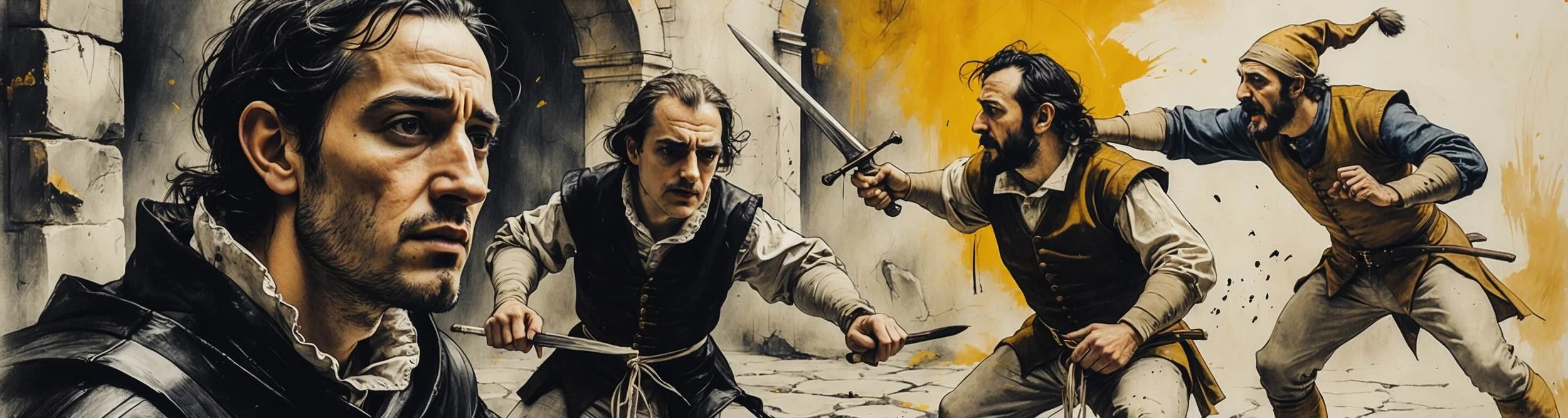
Scene Profile – At a Glance
- Location: Outside Olivia's house.
- What Happens: Feste mistakes Sebastian for Cesario. Sir Andrew attacks Sebastian, who fights back fiercely. Olivia arrives, dismisses Toby and Andrew, and takes the baffled Sebastian home with her.
- Key Characters: Sebastian, Feste, Sir Andrew Aguecheek, Sir Toby Belch, Olivia.
- Dramatic Function: The comedy of errors reaches its physical peak as the twin confusion turns violent. Sebastian's unexpected fight marks him apart from Viola, and Olivia's rescue sets up the secret betrothal in the next scene.
- Famous Quote:
"Or I am mad, or else this is a dream:
Let fancy still my sense in Lethe steep;
If it be thus to dream, still let me sleep!"
(Sebastian, Act 4, Scene 1) - Why It Matters: It is the hinge scene of Act 4. Sebastian's arrival on Olivia's doorstep sets the twins' worlds colliding in public, and Olivia's swift rescue of someone she believes is Cesario propels the play towards its resolution.
Scene Summary
Feste encounters Sebastian outside Olivia's house and, taking him for Cesario, tries to deliver a message. Sebastian has no idea what Feste is talking about and tells him, with increasing irritation, to get lost. Feste finds this bewildering – his lady sent him for this very man, he insists – and the exchange becomes a comic battle of mutual incomprehension.
Things turn violent when Sir Andrew, Sir Toby, and Fabian arrive. Andrew, thinking Sebastian is the Cesario he has been primed to fight, punches him. Unlike Viola, who shrank from a duel in Act 3, Sebastian punches back – hard, and repeatedly. Toby tries to separate them by force. The scuffle is halted only when Olivia sweeps in, sends the men packing with a furious rebuke, and turns with apologetic tenderness to the man she believes is Cesario. Sebastian, astonished to be rescued by a beautiful woman who clearly adores him, can only conclude he is either dreaming or mad. He follows her indoors willingly.
The Wrong Man Takes the Right Blow
The scene's comedy depends entirely on mistaken identity colliding with real violence. Sir Andrew has been talked into challenging Cesario as a duellist, and now he finds his quarry at last – except it is not Cesario at all. Sebastian has none of Viola's careful diplomacy or cultivated restraint, and he does not hesitate for a second. His response to being punched by a stranger is immediate: he punches back, and keeps going. The audience, who know both twins, can measure the gap at once: this is not the man Andrew thought he was hitting.
Original
Are all the people mad?
(Sebastian, Act 4, Scene 1)
Shakespeare Retold (Modern Verse)
Is everybody crazy here?
Sebastian's bewildered question lands as a genuine one. He has arrived in Illyria to find no one he knows, has been pestered by a stranger with a message he did not send for, and has now been punched in the street for no apparent reason. From his side of the confusion, the whole city seems deranged. The comedy is that from everyone else's side, perfectly logical plans are unfolding – all aimed at the wrong twin.
Olivia's Intervention
Olivia's entrance transforms the scene. She arrives to find the man she believes is Cesario in the middle of a street brawl, and her fury is immediate. She drives Toby and Andrew away with a sharpness that surprises even Toby, calling him an "ungracious wretch" fit for barbarous caves. The force of her feeling – equal parts anger at the men and protective tenderness toward Sebastian – reveals how deeply she has invested in this figure she took for Cesario.
Original
Will it be ever thus? Ungracious wretch,
Fit for the mountains and the barbarous caves,
Where manners ne'er were preached! Out of my sight!
(Olivia, Act 4, Scene 1)
Shakespeare Retold (Modern Verse)
Will you always be like this? Boorish lout,
You should be in a barbarous mountain cave
Where no one teaches manners! Out of here!
There is real heat in Olivia's language here. "Barbarous caves" and "manners ne'er were preached" place Toby outside civilised society altogether; she is not merely annoyed, she is ashamed of him. Then, almost in the same breath, she turns to Sebastian with the gentleness of someone coaxing a nervous animal. She calls him "dear Cesario" and tells him she has been frightened for him. Sebastian, entirely wrong-footed, says nothing – he simply watches a stranger express devoted concern for his safety.
Sebastian's Wonder
The scene closes on Sebastian's brief, dazzled soliloquy. He is trying to account for what is happening to him – a fool delivering messages, a stranger attacking him without provocation, and now a beautiful woman bundling him tenderly indoors – and he can find no rational explanation. His options are madness or dreaming, and he finds he does not much mind which it is.
Original
Or I am mad, or else this is a dream:
Let fancy still my sense in Lethe steep;
If it be thus to dream, still let me sleep!
(Sebastian, Act 4, Scene 1)
Shakespeare Retold (Modern Verse)
I'm either mad, or else this is a dream.
If it's a fairytale, it's one to keep;
If it's a dream, I want to stay asleep!
The lines echo the confusion Viola felt when she first arrived in Illyria – but where Viola's bewilderment came from grief and danger, Sebastian's comes from sudden, inexplicable good fortune. He is being drawn by a beautiful, adoring stranger into her home, and his instinct is not to resist but to surrender to the implausible happiness of it. This willingness to accept the dream is what allows the scene's impossible comedy to tip into something warmer.
Language and Technique
- Verse vs prose: Feste and the knights speak prose – the register of comic confusion – while Olivia's rebuke and Sebastian's soliloquy shift into verse, marking the scene's emotional turn.
- Sebastian's short line: "Are all the people mad?" is metrically incomplete, a single fragment that captures the stutter of disbelief better than any long speech could.
- Lethe imagery: Sebastian invokes the river of forgetfulness from classical myth, wishing the dream would drown his rational mind so he can simply enjoy it.
- Olivia's "barbarous caves": The phrase sets up a vivid contrast between civilised love (her house, her tenderness) and the crude violence she is banishing from it.
- Dramatic irony: The audience's superior knowledge – knowing Sebastian is not Cesario – turns every line of Olivia's affection into comedy and pathos at the same time.
Key Quotes from Act 4, Scene 1
Quote 1He started one poor heart of mine in thee.
(Olivia, Act 4, Scene 1)
Shakespeare Retold (Modern Verse)
He scared my heart, the one that you just stole.
Or I am mad, or else this is a dream:
Let fancy still my sense in Lethe steep;
If it be thus to dream, still let me sleep!
(Sebastian, Act 4, Scene 1)
Shakespeare Retold (Modern Verse)
I'm either mad, or else this is a dream.
If it's a fairytale, it's one to keep;
If it's a dream, I want to stay asleep!
Will it be ever thus? Ungracious wretch,
Fit for the mountains and the barbarous caves,
Where manners ne'er were preached! Out of my sight!
(Olivia, Act 4, Scene 1)
Shakespeare Retold (Modern Verse)
Will you always be like this? Boorish lout,
You should be in a barbarous mountain cave
Where no one teaches manners! Out of here!
Key Takeaways
- Sebastian and Viola contrast in action: Where Viola shrank from a fight, Sebastian throws himself in. The twins share a face but not a temperament.
- Mistaken identity turns physical: The confusion built through Acts 2 and 3 becomes real violence here, with blows landing on the wrong person.
- Olivia reveals her true feelings: Her fury at Toby and tenderness toward Sebastian show how seriously she has fallen for the figure she believes is Cesario.
- Sebastian chooses the dream: His soliloquy shows a man willing to surrender to happiness rather than interrogate it, setting up his quick consent to the betrothal.
- The pace matters: Fast movement from farce to tenderness to wonder mirrors the speed at which the confusion is about to resolve into marriage.
Study Questions and Analysis
How does Sebastian's reaction to the fight differ from how Viola behaved in a similar situation?
In Act 3, Scene 4, Viola was challenged to a duel by Sir Andrew and was visibly frightened, relying on Antonio's intervention to escape. Sebastian, by contrast, trades blows immediately and with evident enjoyment – he hits back once, twice, three times, and his only bewilderment is that anyone in this city would start a fight at all.
The contrast is important for the plot: it confirms that Sebastian and Viola are distinct people beneath identical faces, and it ensures that when Olivia chooses Sebastian she is choosing someone genuinely different from the Cesario she had imagined. Northrop Frye, in A Natural Perspective (1965), notes that Shakespearean comedy regularly uses the twin or look-alike not simply as a device for confusion but as a means of exploring what identity consists of when appearance is stripped away. Sebastian's readiness to fight is a mark of selfhood that no disguise could replicate – an identity that persists beneath the surface similarity the plot depends on.
What is the significance of Olivia calling Toby an "ungracious wretch" fit for "barbarous caves"?
The violence of her language places Toby outside the social order she inhabits – not merely bad-mannered but pre-civilised, belonging in wild places where no one has ever heard of a code of behaviour. This is remarkable given that Toby is her kinsman and has been living under her roof throughout the play.
It marks a turning point in Olivia's relationship with the revellers. She has tolerated their antics while her attention was elsewhere; now that someone she loves has been endangered by those same antics, her patience collapses entirely. The rebuke also serves a structural function: it banishes the comic subplot characters from the stage so that the play can move into a more intimate register – Olivia alone with the man she loves, about to take him home and, in the next scene, to a private chapel. Many productions make this moment a decisive break: after this speech, Toby and Andrew's foolery ceases to be something Olivia merely ignores and becomes something she actively refuses.
Why does Sebastian choose to follow Olivia rather than question what is happening?
Sebastian's logic is straightforward: he faces two options – madness or dreaming – and since neither is something he can argue himself out of, the practical choice is to enjoy whatever is happening. His soliloquy is not a statement of confusion so much as a decision to surrender to good fortune.
This willingness is essential for the play's resolution. A more suspicious character would demand explanations and break the comic spell; Sebastian's openness allows the plot to move quickly towards the betrothal. C. L. Barber, in Shakespeare's Festive Comedy (1959), argues that release into the implausible is central to festive comedy: the rules of ordinary life are briefly suspended, and the characters who thrive are those who accept rather than resist the suspension. Sebastian is the play's clearest example of this festive openness – where Malvolio demands the world make sense on his terms, Sebastian simply goes along with the dream.
How does the scene use dramatic irony?
Every line Olivia speaks to Sebastian is shadowed by the audience's knowledge that she is addressing the wrong person. When she calls him "dear Cesario", soothes him, tells him Toby has frightened the heart he has stolen – each phrase is simultaneously a declaration of love for someone she believes she knows and a declaration to a stranger who has no idea what she is talking about. The comedy and the pathos co-exist in exactly the same words.
Shakespeare sustains the dramatic irony by keeping each character's logic internally consistent. Feste is doing his job; Andrew is doing what Toby told him; Olivia is expressing genuine feeling. None of them is being foolish within their own frame of reference – the absurdity arises entirely from the audience's superior vantage point. This is the mechanism of the twin-confusion plot throughout the play, and it reaches its peak here precisely because the stakes are now highest: real violence has occurred, and real love is being declared, all to the wrong person.