Class and Ambition
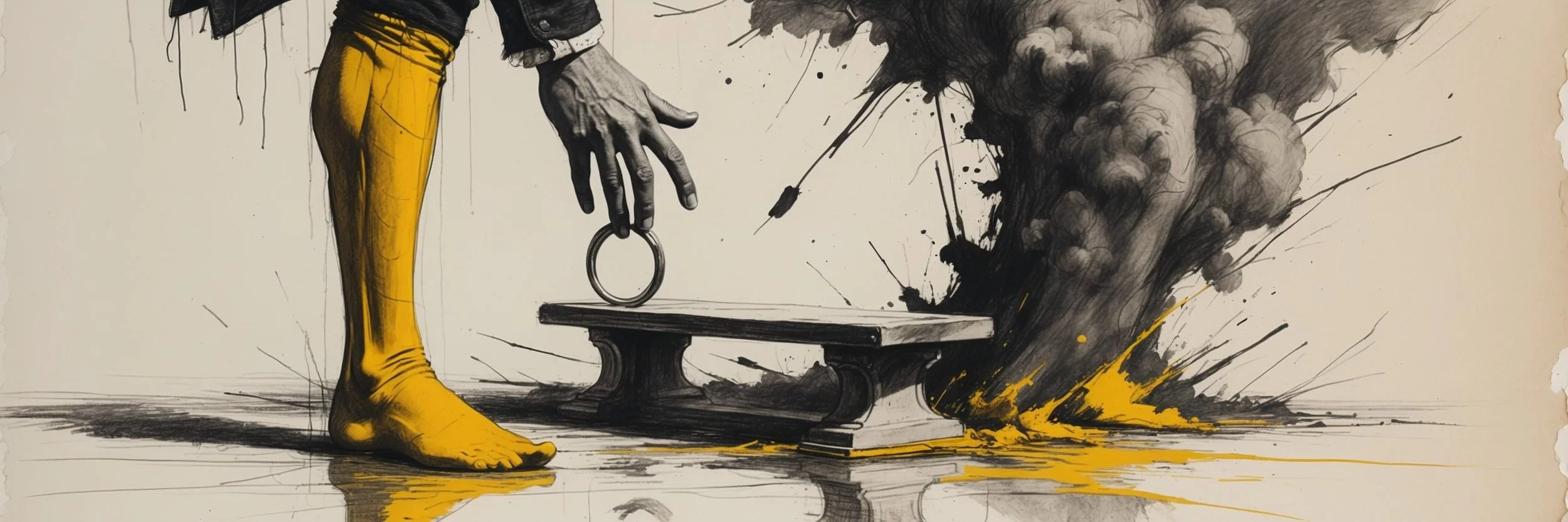
Theme Profile – At a Glance
- Focus: A steward dreams of becoming a count, a maid marries a knight, and a shipwrecked gentleman weds a countess – Illyria's social ladder, climbed and policed.
- Key Characters: Malvolio, Maria, Sir Toby, Olivia, Sebastian.
- The Core Tension: The play punishes Malvolio's social ambition savagely – while rewarding Maria's and Sebastian's identical climbs without comment.
- Key Manifestations: "To be Count Malvolio" (Act 2, Scene 5); the letter's promises (Act 2, Scene 5); Maria's design and reward (Act 2, Scene 3); the steward's last exit (Act 5, Scene 1).
- Famous Quote:
"To be Count Malvolio!"
(Act 2, Scene 5) - The Outcome: The ladder holds for those who climb it quietly. The one man who said the dream aloud leaves the play swearing revenge on everyone who heard him.
Count Malvolio
Before any letter exists, the play shows the dream already running. Alone in the garden – watched by hidden gentlemen – Olivia's steward is rehearsing a life.
Original
To be Count Malvolio!
(Act 2, Scene 5)
Shakespeare Retold (Modern Verse)
Imagine this: I’m Count Malvolio.
Four words, and a social order shivers. The fantasy that follows is meticulously furnished – the velvet gown, the day-bed, the officers summoned, Sir Toby curtsying to his former victim – because Malvolio's ambition is not romantic but administrative: Olivia herself barely features in the dream, except as the instrument of rank. What makes the eavesdroppers murderous is not the absurdity but the plausibility: he cites precedent ("the lady of the Strachy married the yeoman of the wardrobe"), and the play never says the precedent is false. The watching knights are gentlemen by birth living as parasites; the dreaming steward is a working man one marriage from out-ranking them. The box-tree scene is the class war of the play staged as comedy – and the laughter from inside the box-tree has the unmistakable note of men defending a border.
The Letter's Ladder
Maria's forged letter succeeds because it speaks the one dialect of hope a man like Malvolio can believe: greatness as something that can arrive, like an inheritance, from above.
Original
Thy Fates open their hands; let thy blood and spirit embrace them; and, to inure thyself to what thou art like to be, cast thy humble slough and appear fresh.
(Act 2, Scene 5)
Shakespeare Retold (Modern Verse)
Good fortune shines on you; embrace it with your mind and body, And so, prepare for who you will become, discarding all your lowly ways; be strong.
"Cast thy humble slough" – shed the servant's skin like a snake – is the letter's true cruelty, because it names what social climbing requires in Illyria: not effort but moulting, the disposal of the self that served. Malvolio obeys to the letter, and the play makes the moult visible as costume: yellow stockings, cross-garters, the smile – class aspiration worn as fancy dress, instantly legible to everyone as transgression. The trap works because the letter's sociology is accurate: rank in this play really is a matter of garments, names and others' consent. Maria has not lied to Malvolio about how the ladder works. She has simply withdrawn the consent at the top while he was climbing – which is, the play quietly notes, how the ladder disciplines all its climbers.
The Architect from Below
The letter's author is the play's most successful social climber – and the contrast with her victim is the theme's sharpest instrument. Maria, Olivia's gentlewoman, sketches Malvolio for her conspirators with a professional's precision.
Original
The devil a puritan that he is, or any thing constantly, but a time-pleaser; an affectioned ass...
(Act 2, Scene 3)
Shakespeare Retold (Modern Verse)
He is about as moral as the devil, and says just what you want to hear; that dumb ass...
Her indictment – no principle, only time-serving; self-love fed on imagined excellencies – is the servant class's verdict on its own policeman, and it doubles as her targeting data: a man "best persuaded of himself" will believe any letter that agrees with him. But watch what Maria does with the same ladder Malvolio dreams of. She forges her mistress's hand (a sackable, possibly criminal intimacy with rank), delights a knight with her wit, and is married into the gentry by Act 5 – Toby's prize "gull-catcher", wed, as Fabian reports, "in recompense" for the device. Her climb succeeds where Malvolio's fails for one reason the play makes no effort to hide: she ascends through the approved channel – marriage upward by a woman, brokered in laughter, flattering the order it enters – while he aspired through the forbidden one: a male servant supplanting his betters. The ladder was never closed. It was selectively enforced.
The Whirligig's Bill
The theme's final scene is an accounting. The trick is exposed, the wedding feast assembles – and the steward stands in front of the laughing class with one question.
Original
I'll be revenged on the whole pack of you.
(Act 5, Scene 1)
Shakespeare Retold (Modern Verse)
I’ll get revenge on every one of you!
"The whole pack" is exact: not individuals but the set of them – mistress, duke, knights, fool, the entire confederation of rank and licence that watched, laughed, or failed to intervene. The exit line refuses every comic settlement on offer: Olivia's sympathy, Fabian's plea that the device be laughed over, the general amnesty of the weddings. Malvolio is the one figure the festive machine cannot digest, and the play honours the indigestibility – his grievance is read into the record, his abuse acknowledged, his pursuit ordered ("entreat him to a peace") and left visibly unfinished. The man who dreamed of rising above the pack leaves it with the only power Illyria cannot revoke: the refusal to be reconciled. Comedy closes over the gap – and the gap, famously, stays.
"Malvolio is not essentially ludicrous. He becomes comic but by accident. He is cold, austere, repelling; but dignified, consistent, and, for what appears, rather of an over-stretched morality."
— Charles Lamb, On Some of the Old Actors, 1822
Key Quotes on Class and Ambition
Quote 1
Why have you suffered me to be imprisoned,
Kept in a dark house, visited by the priest,
And made the most notorious geck and gull
That e'er invention played on? Tell me why.
(Act 5, Scene 1)
Shakespeare Retold (Modern Verse)
Why did you let me suffer in the jail,
Kept in the dark with visits by a priest,
And made me be the world’s worst idiot
Who’s fallen for a trick? Do tell me why!
Quote Analysis: Malvolio's indictment, addressed to his mistress, is built like a steward's report: itemised, accurate, and ending in the one question the comedy cannot answer – why. The honest reply ("for laughing at us; for being you") would convict the household, so Olivia answers a different question, about handwriting. The speech's dignity is its class content: a servant formally demanding cause from the rank that injured him – the social order's machinery (imprisonment, the priest, public shaming) turned on a man whose actual offence was believing the order might promote him.
'Tis but fortune; all is fortune.
(Act 2, Scene 5)
Shakespeare Retold (Modern Verse)
It is just luck, sheer luck.
Quote Analysis: The first words of the box-tree scene are Malvolio's social theory in miniature, and it is the theory of a man with no other hope. Birth he cannot change and merit goes unrewarded – but fortune deals new hands, and Maria once said Olivia fancied his complexion. The creed explains his perfect vulnerability to the letter: a document signed, in effect, by Fortune herself. It also quietly indicts the play's world, where the creed is true – Sebastian will shortly be handed a countess by pure shipwreck. Malvolio's error was not believing in luck. It was believing luck was available to stewards.
Be opposite with a kinsman, surly with servants...
(Act 2, Scene 5)
Shakespeare Retold (Modern Verse)
Debate a gentleman, demean your servants.
Quote Analysis: The letter's behavioural instructions are a forged etiquette manual for the newly great – and their satire cuts upward. Maria's parody works because it is observation: rudeness to kinsmen and surliness to servants is how rank behaves in Illyria; Sir Toby treats everyone beneath him as furniture, and no letter was needed. Malvolio performing haughtiness reads as madness; gentlemen performing it daily reads as breeding. The instruction exposes class manners as a script that anyone could play – the unforgivable thing being, precisely, that anyone might.
Oh, you are sick of self-love, Malvolio, and taste with a distempered appetite.
(Act 1, Scene 5)
Shakespeare Retold (Modern Verse)
You are so vain, Malvolio, you’re tainted by poisoned taste.
Quote Analysis: Olivia's diagnosis, delivered in the play's first act, is the seed of everything: self-love as a sickness that corrupts judgement. The play endorses her – Malvolio's vanity is what the letter will feed on – but the speech's context complicates the comfort. She is defending her fool's licensed mockery against her steward's humourless censure: rank gently instructing the help to be laughed at gracefully. Malvolio's self-love is real; so is the fact that the household's sport requires his kind to absorb its jokes. The diagnosis is correct, and it is also the first stone.
Key Takeaways
- The Dream Precedes the Letter: "Count Malvolio" exists before Maria writes a word. The trick supplies evidence for an ambition already fully furnished.
- The Ladder Is Selectively Enforced: Maria climbs by wit and marriage and is rewarded; Sebastian climbs by shipwreck and is blessed; the steward who aspires aloud is jailed in the dark.
- Class Is Costume: Yellow stockings read as lunacy on a steward; daily surliness reads as breeding on a knight. The letter's etiquette satire cuts upward.
- The Unreconciled Exit: Malvolio's "whole pack of you" refuses the comic amnesty – and the play lets the refusal stand as its last word on the social order.
Study Questions and Analysis
Is Malvolio ambitious – or just a conscientious servant?
Both descriptions are true, and the play needs both. The conscientious servant is real: Malvolio runs a great house in mourning, polices its nights, returns its rings, carries its messages – every appearance he makes before the letter is an act of duty performed with grim competence. Charles Lamb, in his 1822 essay "On Some of the Old Actors", built the character's defence on exactly this: Malvolio is "dignified, consistent, and, for what appears, rather of an over-stretched morality" – a man whose real fault is being the only adult in a house full of holiday.
But the play plants the ambition before any provocation: the daydream of "Count Malvolio", the velvet gown and the day-bed, is running before he finds the letter, and Maria's profile of him – "the best persuaded of himself" – is offered as known fact. The ambition, moreover, has a specific shape: not wealth or office but rank, the conversion of duty's authority into birth's. His fantasy dwells longest on disciplining Sir Toby – ambition as the dream of out-ranking one's tormentors.
The theme needs the doubleness because it is the play's actual subject: the question is not whether Malvolio dreams above his station (he does) but why that dream, in him, is criminal, while around him Maria angles for a knight, Sir Toby sponges rank he never earns, and a shipwrecked stranger marries the countess within a day of arriving. The conscientious servant makes the punishment unjust; the ambitious steward makes it explicable. Shakespeare, characteristically, supplies the laughter and the case against it in the same figure.
What exactly does the forged letter promise him?
Everything except a fact. Read coldly, Maria's letter asserts almost nothing: an unnamed writer loves someone she may not name; the beloved is identified only by a riddle of four letters; the rest is conditional instruction – if you accept, wear, smile, be surly. Its one direct promise is the postscript's, and even that is a bargain with terms.
If not, let me see thee a servant still.
(Act 2, Scene 5)
Shakespeare Retold (Modern Verse)
But if you don’t, just stay a humble servant.
The threat is the promise's shadow, and it is the letter's masterstroke: decline the greatness, and remain a servant still – the words aimed precisely at the wound. Everything else Malvolio supplies himself: the identification of the beloved, the certainty, the gown-and-day-bed future. The letter is a mirror with a single instruction etched on it, and the instruction is "climb".
What it promises, in the theme's terms, is the thing Illyria genuinely distributes but never to him: arbitrary elevation. The play is full of greatness "thrust upon" people – Sebastian's countess, Viola's dukedom, Maria's knight – all delivered by fortune to those who never asked aloud. The letter offers Malvolio a counterfeit of the play's own plot, and he is mocked for believing in it while the genuine article operates all around him. Marjorie Garber (2004) notes the cruelty of the symmetry: the letter's lie is indistinguishable in form from the play's truths. Malvolio's gullibility, examined closely, is simply faith that the comedy everyone else is living in might include him.
Why is Maria's social climb rewarded while Malvolio's is punished?
Because hers obeys the unwritten rules that his violates, and the play is candid enough to let the double standard show. Tabulate the two climbs. Maria: a waiting-gentlewoman who forges her mistress's hand – an offence against rank far more concrete than anything Malvolio does – and rises by delighting a knight into marriage. Malvolio: a steward who forges nothing, breaks no law, and rises only in imagination – and is imprisoned in the dark for it. The asymmetry is the theme's data.
The rules her climb obeys are legible. First, channel: a woman marrying upward confirms the order – the man remains the elevator – while a male servant marrying his mistress would invert it; the period's anxieties about the second were real and sharp. Second, style: Maria ascends through laughter, making herself the gentry's entertainer and ally; Malvolio aspires through censure, having made himself the policeman of their pleasures – the climber who flatters the club is admitted, the one who would reform it is expelled. Third, discretion: Maria never says her hope aloud; the play's mortal sin, for servants, is Malvolio's soliloquy – ambition spoken.
John Manningham's 1601 diary already read the play this way, relishing the "good practice" of gulling the presumptuous steward: the first audience took the policing as the entertainment. Modern readings, after Lamb (1822), tend to hear the policing as the subject. Both are right about the same scenes: the play stages the border-control of class as superb comedy, and keeps the receipts – Maria's wedding "in recompense" and Malvolio's dark house are the same justice, distributed by status.
What does Sir Toby's position reveal about rank in Illyria?
That rank, once conferred, is unconditional – the play's quietest and most cynical class lesson. Sir Toby produces nothing, contributes nothing, and costs everyone: he drinks Olivia's cellar dry while she mourns, gulls Sir Andrew out of two thousand ducats on the false prospect of his niece, engineers a duel between two innocents for sport, and escalates the Malvolio device past every limit. By any behavioural measure he is the most destructive person in the play. He ends it married, at home, and untouched.
The contrast with Malvolio is the theme's hinge, and the play stages it directly in the kitchen scene: the steward, speaking for order, his lady's instructions and two o'clock in the morning, against the knight, speaking for cakes and ale and his own blood – "Art any more than a steward?" The question is the entire class system in six words: not are you right but what are you – and it ends the argument, because in Illyria it is unanswerable. Toby's consequence for a play's worth of parasitism is a bloodied head from Sebastian and a marriage to the cleverest woman in the house; Malvolio's consequence for being conscientiously insufferable is public diagnosis, imprisonment and exorcism.
Charles Lamb (1822) caught the asymmetry from the victim's side: Malvolio's morality is "misplaced in Illyria" – the island runs on licence, and rank is the licence's name. What Toby reveals is the system's foundation: gentility in this play is not conduct, taste or even money (he has none); it is an inherited immunity – and the comedy's festive warmth, the play lets us notice, is largely the glow of that immunity enjoying itself.
Does Sebastian's marriage to Olivia expose a double standard?
Completely – and the play seems to build the exposure deliberately. Set the two cases side by side. Malvolio dreams that his lady might marry below her: he is lectured by the plot, mocked by the household, imprisoned, and exorcised. Sebastian actually marries the same lady – a stranger she has known for minutes, with no estate in evidence, swept to the priest on the strength of a face – and the play blesses the union without one syllable of social anxiety. The difference cannot be desert: Sebastian has done nothing but arrive. The play even supplies the certificate the steward was denied: when Orsino asks, the marriage is confirmed as right and noble – "right noble is his blood".
That phrase is the answer, and the theme's bleakest finding. Sebastian's climb is invisible because, by blood, it is not a climb: a gentleman marrying a countess crosses distance but no boundary; a steward marrying her would cross the one line Illyria actually defends. Rank in the play is not a gradient but a membrane – porous in any direction for the gently born, sealed absolutely from below. Malvolio's precedent ("the lady of the Strachy married the yeoman of the wardrobe") is never refuted, just never repeated.
What the double standard exposes is the play's class settlement at the close: every marriage – Orsino's, Olivia's, Toby's – moves wealth and rank around inside the gentry or pulls deserving outsiders (Viola, Sebastian: well-born castaways; Maria: a gentlewoman) into it. Nothing rises from genuine below. The festive ending redistributes everything except the one thing Malvolio asked for – which is why he alone cannot attend it.
What does "some are born great" actually claim about greatness?
The letter's famous triad – some are born great, some achieve greatness, and some have greatness thrust upon 'em – is a complete, miniature sociology, and its comedy is that every clause is calibrated to its reader. Born great is the aristocratic theory: rank as nature, Olivia's and Orsino's case, the thing Malvolio cannot claim. Achieve greatness is the meritocrat's theory: rank as wages, the steward's secret hope and his life's actual method. Thrust upon is the fairy-tale theory: rank as gift, requiring nothing but readiness – and it is, of course, the clause Malvolio chooses, because it is the only one with a door he can walk through.
The play then runs the triad as an experiment on its whole cast, and the results are mischievous. Nobody in Twelfth Night achieves greatness – effort is the one route the plot never rewards. The born-great keep their greatness effortlessly through every confusion. And greatness genuinely is thrust upon people on all sides – Viola, Sebastian, Maria – but only upon those who never solicited it; the thrusting, it turns out, has a strict admissions policy. The letter's lie was not its sociology but its addressee.
There is a final irony in the phrase's afterlife. Feste quotes the triad back at the end, and the words Malvolio read as prophecy return as taunt – "some have greatness thrown upon them" in the fool's mocking reprise – the same sentence serving elevation and humiliation. Marjorie Garber (2004) observes how the play keeps demonstrating that texts have no fixed rank of their own: meaning, like greatness, is conferred by position. The triad is true in Illyria. It was simply never going to be true for the man holding the letter.
Is Malvolio's final exit tragic?
"Tragic" overshoots a man whose injuries are a lost afternoon, a dark room and a wounded ego – but the exit is something comedy is not supposed to contain, and the play knows it. Consider what the final scene does for everyone else: errors dissolved, twins restored, marriages stacked three deep, even Antonio granted wonder if not a partner. Against that machinery of settlement, Malvolio is brought on, allowed his full indictment – the prison, the priest, the "notorious geck and gull" – given Olivia's acknowledgement and Fabian's confession, and offered the standard comic exchange: your humiliation for our goodwill, all debts cancelled by laughter. He is the only character in Shakespeare's comedies to look at that bargain, in the middle of the wedding party, and refuse it to the room's face.
The refusal is what gives the exit its weight. "I'll be revenged on the whole pack of you" reasserts, at the last possible moment, everything the play's festivity asked him to surrender: his injury is real, his dignity is not negotiable, and their laughter does not convert into his consent. Olivia's verdict ("notoriously abused") and Orsino's unfinished order to "entreat him to a peace" leave the account formally open – the play's one unpaid debt, carried past the curtain.
Charles Lamb (1822) made the case that the character's "over-stretched morality" deserved better than his world gave him; the stage has increasingly agreed, playing the exit as a wound the comedy bears. Perhaps the exactest word is not tragic but unforgiving – in both directions. Malvolio will not forgive the pack; the play, gently but firmly, declines to pretend that festivity is the same thing as justice. The revels end; the steward's question – "tell me why" – is the one piece of Illyria still standing when the music starts.