Henry V: Act 1, Prologue – Analysis
Scene Profile – At a Glance
- Location: A bare stage. The Chorus speaks directly to the audience before the play begins.
- What Happens: The Chorus wishes for powers the theatre does not have, apologises for the bare stage, and asks the audience to imagine the armies, ships and battlefields to come.
- Key Characters: The Chorus, alone.
- Dramatic Function: The frame for the whole play. It sets the deal every scene depends on: the stage supplies the words, and the audience supplies the world.
- Famous Quote:
"O for a Muse of fire, that would ascend
The brightest heaven of invention..."
(the Chorus, Act 1, Prologue) - Why It Matters: No other Shakespeare play opens like this. Before we meet a single character, we are told the story is too big for the theatre – and made partners in staging it.
Scene Summary
A single figure, the Chorus, walks onto an empty stage and speaks straight to the audience. It wishes aloud for "a Muse of fire" – for a stage as big as a kingdom, real princes for actors, and real monarchs watching – so that King Harry could appear in his true warlike glory. Since none of that is possible, the Chorus apologises: how can one small theatre hold the fields of France, or the helmets that frightened the air at Agincourt?
The answer is the audience. The Chorus asks us to piece out the theatre's imperfections with our thoughts – to see a thousand soldiers in each actor, to imagine the horses, and to let the play leap across years and seas. Finally the speaker introduces himself as the Chorus to this history and asks us to hear the play gently and judge it kindly.
A Muse of Fire
The opening is a wish list, and every item on it is impossible. A Muse of fire, a kingdom-sized stage, princes as actors: the Chorus begins by imagining the perfect production this play will never have, with Harry himself as the god of war and famine, sword and fire straining at the leash like hunting dogs.
Original
Then should the warlike Harry, like himself,
Assume the port of Mars; and at his heels,
Leashed in like hounds, should famine, sword and fire
Crouch for employment.
(the Chorus, Act 1, Prologue)
Shakespeare Retold (Modern Verse)
Then Harry seems the real army general,
Appearing like the god of war, commanding
Starvation, swords and fire – like tied-up dogs –
To get to work.
The image is thrilling and carefully double-edged. This is the heroic Henry of legend – Mars in person – but look at what kneels at his heels waiting for work: starvation, violence and burning. The very first picture the play paints of its hero yokes his glory to the suffering his war will cause, and it does so in the play's opening seconds. The doubleness that runs through everything Henry does is planted here, before he has spoken a word.
The Wooden O
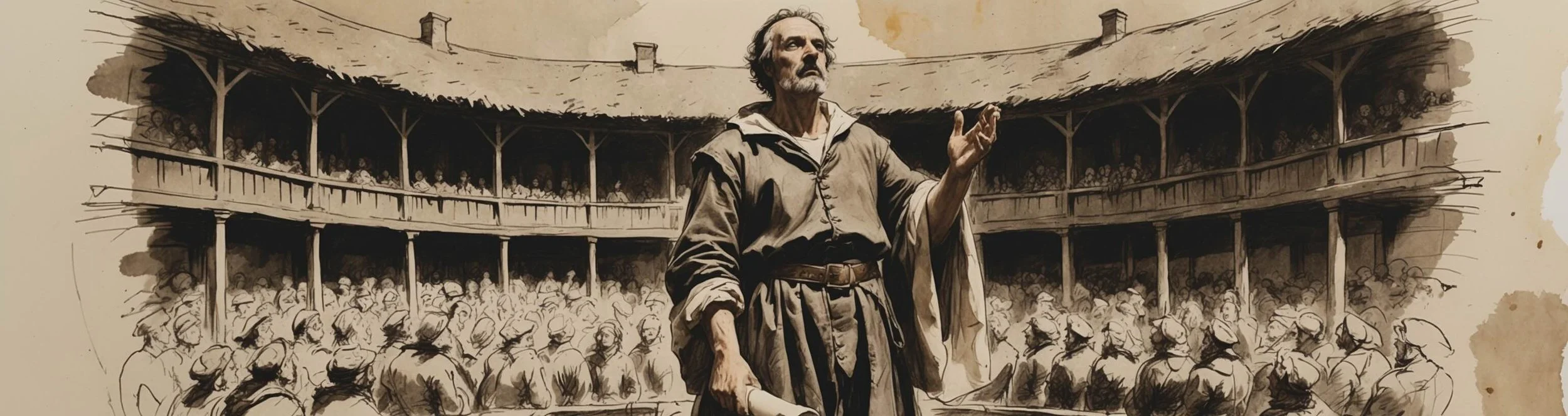
Then the apology – which is really the play's founding bargain. The Chorus gestures at the actual building around the audience and asks whether such a space can possibly contain the story.
Original
So great an object: can this cockpit hold
The vasty fields of France? Or may we cram
Within this wooden O the very casques
That did affright the air at Agincourt?
(the Chorus, Act 1, Prologue)
Shakespeare Retold (Modern Verse)
So great a story. Can this theatre seem
To be the sprawling fields of France? Can we fit
Within this wood rotunda, all the helmets
That filled the air of Agincourt with terror?
The "wooden O" is the theatre itself – almost certainly the brand-new Globe of 1599 – and the question is honest: it cannot hold Agincourt. So the Chorus turns the audience into the missing machinery. We are asked to divide one man into a thousand, to make "imaginary puissance", to see horses printing their hoofs in the earth. Imagination is not a decoration here; it is the engine the play runs on. And the request quietly introduces the play's deepest subject – because building great things out of confident words is exactly what King Henry will spend five acts doing to his army, his enemies and his bride.
Language and Technique
- Direct address: The Chorus speaks straight to us and calls us "gentles all" – there is no pretence that this is not a theatre.
- Impossible wishes: The opening lines are built on "O for..." – a string of wishes the theatre cannot grant, which makes the audience feel the gap the play must cross.
- The "O" wordplay: The theatre is a "wooden O", and the actors mere "ciphers" (zeros) – yet zeros placed after a number multiply it. Small things standing for huge ones is the whole trick of the speech.
- Commands to the audience: Piece out, divide, make, think, suppose: the verbs are instructions. The audience is given a job, not just a welcome.
- Animal imagery: War appears as hounds – famine, sword and fire "leashed in" at Harry’s heels – power held back and waiting to be released.
Key Quotes from Act 1, Prologue
Quote 1
Original
Piece out our imperfections with your thoughts;
Into a thousand parts divide one man,
And make imaginary puissance...
(the Chorus, Act 1, Prologue)
Shakespeare Retold (Modern Verse)
Outthink the limitations of our acting;
Think each man represents a thousand soldiers,
And conjure up two nations’ mighty forces....
Quote Analysis: The play's working method in three lines. The theatre's "imperfections" are admitted, and the repair is handed to the audience: our thoughts must multiply one actor into a thousand soldiers and conjure "imaginary puissance" – power that exists only in the mind. It is worth pausing on that phrase, because imagined power that works like real power is also a fair description of kingship as this play presents it. The instruction to the audience doubles as the play's first lesson in how authority is made.
Original
And let us, ciphers to this great accompt,
On your imaginary forces work.
(the Chorus, Act 1, Prologue)
Shakespeare Retold (Modern Verse)
Let all us zeros acting this great story
Have huge effect on your imagination.
Quote Analysis: The Chorus calls the actors "ciphers" – zeros – to this "great accompt" (a great sum, or a great story). The arithmetic joke is precise: a zero is worth nothing alone, but placed beside a figure it multiplies it tenfold. That is the actors' claim exactly – worthless in themselves, transformative when the audience's imagination stands beside them. Modest and boastful at once, it is the whole speech in miniature.
Original
Admit me Chorus to this history;
Who prologue-like your humble patience pray,
Gently to hear, kindly to judge, our play.
(the Chorus, Act 1, Prologue)
Shakespeare Retold (Modern Verse)
Permit me – I’m called Chorus – to narrate it;
And, like a prologue in a book, I pray
You’ll listen up and kindly judge our play.
Quote Analysis: The Prologue's closing couplet is a courteous handover: the Chorus names its own role, asks for patience, and requests gentle hearing and kind judgement. The humility is conventional – prologues often ended this way – but this Chorus will return before every act, which no other Shakespeare play does. The polite narrator introduced here becomes the play's constant official voice, and how far we should trust that voice becomes one of the play's best questions.
Key Takeaways
- The play opens with an apology: The Chorus admits the theatre cannot show this story – and turns that weakness into a partnership with the audience.
- Imagination is the engine: We are instructed to supply armies, horses and kingdoms with our thoughts.
- The hero comes pre-shadowed: The first image of Harry is Mars with famine, sword and fire at his heels – glory and destruction in one picture.
- The frame is unique: No other Shakespeare play is narrated throughout by a Chorus; the device introduced here will open every act.
Study Questions and Analysis
What does "O for a Muse of fire" actually mean?
A Muse is one of the classical goddesses of inspiration, and fire is the highest and brightest of the four elements in Renaissance thinking – the element that rises. So the Chorus is wishing for inspiration hot and bright enough to lift the play to the height of its subject: "the brightest heaven of invention". It is a poet's prayer for powers beyond the ordinary.
Original
O for a Muse of fire, that would ascend
The brightest heaven of invention...
(the Chorus, Act 1, Prologue)
Shakespeare Retold (Modern Verse)
If we can conjure burning inspiration
To fire up our creativity...
The wish structures the whole speech. If the company had a Muse of fire, a kingdom for a stage and real princes for actors, no imagination would be needed. Since it has none of those things, the audience must supply the difference. The famous opening is therefore not confidence but a confession of inadequacy – made so magnificently that it produces the very grandeur it claims to lack. That paradox, weakness performed into strength, is worth keeping hold of: it is also how the play's king operates.
What is the "wooden O"?
The playhouse itself. Elizabethan public theatres were roughly circular timber buildings with an open yard in the middle, and the Chorus's "wooden O" gestures at the actual structure the first audience was standing in – almost certainly the Globe, newly built in 1599, the year of the play. The same speech calls it "this cockpit", a pit for cock-fighting: deliberately humble names for the company's proud new home.
The self-mockery has a purpose. By shrinking the theatre – a wooden nothing, a cockpit – the Chorus makes the gap between stage and story as wide as possible, so that the audience's imagination is recruited to bridge it. And there may be a wink in it too: a brand-new playhouse opening with the nation's greatest victory story, while pretending to be embarrassed about its size, is advertising as much as apology.
What does the Prologue ask the audience to do?
Four things, in a rising sequence of instructions. First, to "piece out our imperfections with your thoughts" – to patch the production's gaps with imagination. Second, to multiply: "into a thousand parts divide one man", so each actor stands for a regiment. Third, to visualise what cannot be staged – horses "printing their proud hoofs i' the receiving earth". And fourth, to let thought do the travelling: the play will jump across years and seas, "turning the accomplishment of many years into an hour-glass", and the audience's minds must make the jumps with it.
Original
For 'tis your thoughts that now must deck our kings,
Carry them here and there; jumping o'er times,
Turning the accomplishment of many years
Into an hour-glass...
(the Chorus, Act 1, Prologue)
Shakespeare Retold (Modern Verse)
For now your fertile minds must make our kings,
Transporting them around; and skipping time,
Converting what’s occurred over the years
To merely last an hour...
The speech, in other words, is a contract. The company will provide words, and the spectators will provide the world. Every later Chorus speech renews the same deal – suppose you have seen the fleet, work your thoughts, behold the night camp – which is why the Chorus matters so much more here than in any other Shakespeare play: the whole production is openly built on licensed imagination.
Is the Chorus a character, and can we trust it?
It is best treated as a character with a point of view rather than as Shakespeare's own voice – and that makes trust the interesting question. The Prologue's Chorus seems entirely reliable: it describes the theatre honestly and asks reasonable things of us. But a pattern begins at the start of Act 2 and never stops: the Chorus announces one picture, and the scene that follows shows something else. All the youth of England on fire, followed by Eastcheap packing to steal; the sweet touch of Harry in the night, followed by the King losing an argument with his own soldiers.
Joel B. Altman, in his landmark 1991 essay Vile Participation, argued that the Chorus works on its audience – that by making us imagine the armies and share the excitement, it implicates us in the war it celebrates. On that reading the Prologue is not a neutral welcome but the first move in the play's management of our sympathies. Whether you read the Chorus as proud official narrator or as the play's most elegant unreliable witness, the habit of checking its claims against the scenes is the single most useful skill this play teaches.
Why is this Prologue so important for the rest of the play?
Because it teaches the audience how to watch everything that follows – twice over. On the surface it is a practical briefing: expect leaps of time and place, supply the spectacle yourself, forgive the theatre its limits. Every act will open with a similar briefing, so the Prologue establishes the play's unique rhythm of narration followed by scene.
Beneath that, it plants the play's central idea. A confident speaker stands before a crowd, admits that the reality falls short of the vision, and persuades the crowd to see the vision anyway – that is the Chorus with the audience, and it will shortly be King Henry with his army at Harfleur, with his frightened men before Agincourt, and with a French princess who barely speaks his language. The play about a king who wins everything through words opens with a demonstration of exactly that power, performed on us. James L. Calderwood, in Metadrama in Shakespeare’s Henriad (1979), read this whole cycle of plays as drama about its own medium – kingship practised as a performing art – and the Prologue announces that subject before the King ever appears: the first voice we hear is a performer asking us to believe in a king.