Loyalty and Betrayal
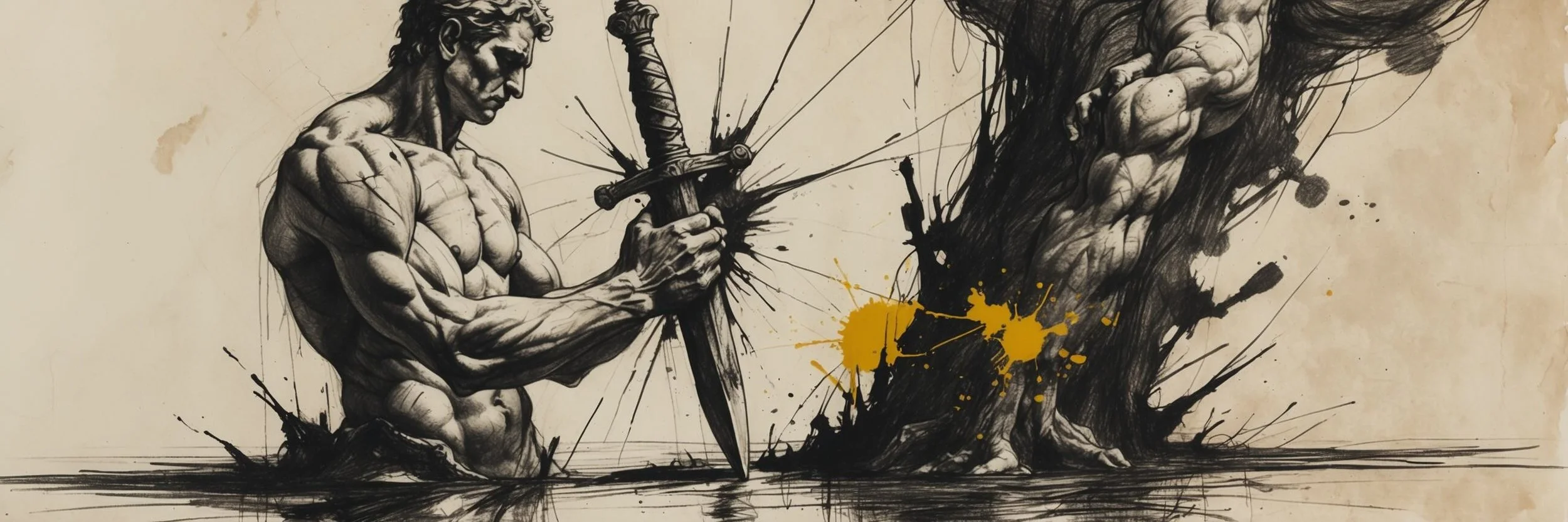
Theme Profile – At a Glance
- Focus: Every bond in the play – friendship, marriage, political alliance – is tested by the assassination. Almost none survives it.
- Key Characters: Brutus, Julius Caesar, Mark Antony, Cassius, Portia.
- The Core Tension: Brutus betrays his friend out of loyalty to Rome. The play never lets him – or us – settle whether that trade was noble or monstrous.
- Key Manifestations: Cassius's recruitment of his friend (Act 1, Scene 2); Portia's plea (Act 2, Scene 1); the assassination (Act 3, Scene 1); the quarrel at Sardis (Act 4, Scene 3); the suicides at Philippi (Act 5, Scene 5).
- Famous Quote:
"Et tu, Brute! Then fall, Caesar."
(Act 3, Scene 1) - The Outcome: The betrayers are betrayed in turn – by the crowd, by fortune, by each other – and the play's last loyalties are paid by servants and suicides.
The Friend Recruited Against the Friend
The conspiracy begins as an act of friendship turned inside out. Cassius works on Brutus in A1S2 through every register of intimacy – shared memories, mutual esteem, the language of love. Then Brutus exits, and Cassius, alone, tells the audience precisely what the friendship is for.
Original
Caesar doth bear me hard; but he loves Brutus:
If I were Brutus now and he were Cassius,
He should not humour me.
(Act 1, Scene 2)
Shakespeare Retold (Modern Verse)
Caesar does hate my guts, but he love Brutus.
If I were him and he were me, I would not
Be made to change my mind so easily.
The admission is double-edged. Cassius knows Caesar loves Brutus – that love is exactly what makes Brutus's recruitment so valuable, because the killing must look like principle, and only a man Caesar trusts can supply it. And he concedes, in the same breath, that Brutus is being "humoured" – worked on – in a way Cassius himself would never permit. The conspiracy's foundation stone is laid here: a friendship (Cassius and Brutus) used to destroy a friendship (Caesar and Brutus), by a man who admits that what he is doing to his friend is something no clear-sighted man would allow to be done to himself. The forged letters that follow complete the pattern – Brutus's love of Rome, his deepest loyalty, is counterfeited against him.
The Unkindest Cut
The assassination is staged as the breaking of a bond, not just a body. Caesar withstands the first wounds; what kills him, the play insists, is the sight of one particular face among the killers.
Original
Et tu, Brute! Then fall, Caesar.
(Act 3, Scene 1)
Shakespeare Retold (Modern Verse)
And you as well, Brutus? Then Caesar dies.
Three words of Latin, and they have outlived the play as the universal shorthand for betrayal by a friend. The grammar does the work: you too – meaning the daggers of strangers and enemies were survivable, but yours ends the question. "Then fall, Caesar" is not defeat by force; it is consent. A world in which Brutus strikes is not a world Caesar chooses to keep living in, and he stops resisting. The play sharpens the moment by everything it has shown before: Caesar's genuine affection for Brutus, Brutus's genuine anguish, and the conspirators' kneeling courtesies seconds before the blades. The most intimate gesture in the play – Brutus bending towards his friend – is the killing stroke. Loyalty does not merely fail at the Capitol; it is the weapon.
The Loyalist's Revenge
The play's most dangerous man turns out to be its most loyal. Antony, left alone with the body after shaking the killers' hands, drops the diplomatic mask and shows the audience what his loyalty to Caesar actually contains.
Original
O, pardon me, thou bleeding piece of earth,
That I am meek and gentle with these butchers!
Thou art the ruins of the noblest man
That ever lived in the tide of times.
(Act 3, Scene 1)
Shakespeare Retold (Modern Verse)
Forgive me, bleeding corpse, becoming dust,
That I am soft and gentle with these butchers.
You are the ruins of the finest man
That ever lived in all eternity.
He apologises – to a corpse – for the handshakes. The word "butchers" tells us the courtesy upstairs was theatre; the apology tells us the loyalty underneath is real, and lethal. Antony's grief is not performed, and that is exactly what makes his next move so devastating: he converts the truest feeling in the play into the play's most calculated act, the funeral oration. Loyalty and opportunism do not compete in Antony; they collaborate. Devotion to the dead friend supplies the passion, and the passion wins the crowd, and the crowd destroys the betrayers. The conspirators spared Antony because they could not imagine loyalty as a weapon. It is the same mistake Caesar made about Brutus, inverted – and it costs them Rome.
Loyalty's Last Ledger
The play's final scene hands the theme to its quietest witnesses: the servants and soldiers around Brutus at Philippi. One by one he asks them to hold his sword while he runs upon it, and one by one – Clitus, Dardanius, Volumnius – they refuse, out of love. It is Strato, finally, who consents, and Brutus's farewell draws up the strangest balance sheet in Shakespeare.
Original
My heart doth joy that yet in all my life
I found no man but he was true to me.
(Act 5, Scene 5)
Shakespeare Retold (Modern Verse)
My heart is full of joy that through my life
I only met men who were true to me.
From any other mouth the line would be unremarkable. From the man whose dagger made "Et tu, Brute" immortal, it is breathtaking – and the play declines to tell us how to take it. Read generously, Brutus is right: within his own circle, no one ever betrayed him; Cassius quarrelled but reconciled; his servants loved him to the end; even his enemies will praise him over his corpse. Read darkly, the sentence is the final proof of the self-blindness that let him kill a friend on a hypothesis – a betrayer congratulating himself on a life untouched by betrayal. Both readings are available, and the gap between them is the whole theme: in this play, loyalty is real, precious, and never once seen clearly by the person receiving it.
"Tyranny and servility are to be dealt with after their own fashion: otherwise, they will triumph over those who spare them, and finally pronounce their funeral panegyric, as Antony did that of Brutus."
— William Hazlitt, Characters of Shakespeare's Plays, 1817
Key Quotes on Loyalty and Betrayal
Quote 1
For Brutus, as you know, was Caesar's angel:
Judge, O you gods, how dearly Caesar loved him!
This was the most unkindest cut of all...
(Act 3, Scene 2)
Shakespeare Retold (Modern Verse)
You know Brutus was Caesar’s guardian angel;
Then judge, oh gods, how dearly Caesar loved him!
This cut here was the cruellest cut of all...
Quote Analysis: The double superlative – "most unkindest" – breaks grammar to make its point: ordinary language has no degree strong enough for this betrayal. Antony is at the funeral, pointing to a single rent in Caesar's cloak, and the move is rhetorically brilliant precisely because it is emotionally true. Brutus was Caesar's angel; the audience has watched the affection. By making one wound stand apart from thirty-two others, Antony teaches the crowd – and the play teaches us – that betrayal is not measured in damage but in distance: the nearer the hand, the deeper the cut.
Dwell I but in the suburbs
Of your good pleasure? If it be no more,
Portia is Brutus' harlot, not his wife.
(Act 2, Scene 1)
Shakespeare Retold (Modern Verse)
Am I peripheral
To your good life? For, if that is the case,
I’m just your prostitute, and not your wife.
Quote Analysis: Portia's image is geographic: a wife kept outside the walls of her husband's real life, lodged in its suburbs. The charge is precise – marriage, to her, is a loyalty of full disclosure, and Brutus's silence about the conspiracy is therefore a kind of infidelity. To prove her constancy she has already wounded her own thigh, out-Romaning the Romans: the conspirators bind themselves with handshakes and rhetoric; she offers blood. The play honours her claim and then breaks it – Brutus promises to tell her everything, the world intervenes, and her loyalty ends in the most violent suicide in the play, swallowing fire offstage.
A friend should bear his friend's infirmities,
But Brutus makes mine greater than they are.
(Act 4, Scene 3)
Shakespeare Retold (Modern Verse)
A friend should tolerate a friend’s weakness,
But, Brutus, you’ve accentuated mine.
Quote Analysis: Cassius's complaint in the quarrel scene is, on its face, self-serving – he is asking his friend to overlook bribery. But the line states the play's most humane idea of loyalty: friendship as the willingness to carry, rather than catalogue, each other's flaws. Brutus, at this moment, is all catalogue – icy, itemising, morally exact – and the scene lets us feel how cruelty can wear the costume of principle. That the two men climb down, reconcile, and share wine before Philippi makes this the play's one bond that survives its test – just in time for both of them to die.
This was the noblest Roman of them all:
All the conspirators save only he
Did that they did in envy of great Caesar...
(Act 5, Scene 5)
Shakespeare Retold (Modern Verse)
He was the noblest Roman of them all.
Except for him, all of the other henchmen
Did what they did to Caesar out of envy.
Quote Analysis: The play's final verdict on Brutus is delivered by the man with most cause to curse him. Antony separates Brutus from the conspiracy he led: the others struck from envy; Brutus alone struck from honest thought for the common good. It is generous, it is politically convenient – shrinking the conspiracy to one mistaken idealist flatters the new regime – and it is true to what we have seen. The eulogy completes the theme's last inversion: the loyal friend who destroyed the conspirators ends the play paying sincere tribute to the friend-betrayer, while the betrayer's own last loyalty was to the man he killed.
Key Takeaways
- Loyalty Is the Weapon: Caesar is killed by trust, not force. Only a beloved hand could get close enough, and only Brutus's blow is fatal in the way that matters.
- Two Loyalties, One Choice: Brutus frames the murder as Rome versus Caesar, friendship versus duty. The play honours the dilemma and punishes the answer.
- The Loyalist Wins: Antony's devotion to Caesar is the truest feeling in the play, and he turns it into the counter-revolution that destroys the betrayers.
- The Last Bonds Hold: When the politics has consumed everyone, what remains is Portia's blood, the servants' refusals, and Strato's steadied sword.
Study Questions and Analysis
Is Brutus a patriot or a traitor?
The question has divided readers for centuries, and the division begins inside the play itself. Antony's eulogy calls Brutus "the noblest Roman of them all"; the same Antony has just helped destroy him as a murderer. Both verdicts are sincere, and the play retires without choosing.
The case for the patriot rests on motive. Brutus alone, the play insists, acted from "a general honest thought" – no envy, no grievance, no profit. He risks everything for a constitutional principle, refuses to kill Antony because the deed must stay a sacrifice rather than a purge, and dies attended by servants who love him. The case for the traitor rests on the deed. He killed his friend – a friend who loved him – on a forecast of crimes uncommitted; whatever the motive, the act is the most intimate betrayal in Shakespeare, and the cultural tradition has weighed it accordingly. Dante, three centuries before Shakespeare, placed Brutus and Cassius in the lowest circle of the Inferno, chewed eternally in Lucifer's jaws beside Judas Iscariot – betrayal of a benefactor being, in his scheme, the worst sin a human can commit.
William Hazlitt, in his 1817 Characters of Shakespeare's Plays, read the tragedy as the failure of well-meaning men: "Those who mean well themselves think well of others, and fall a prey to their security." M. W. MacCallum's 1910 study refined the paradox – Brutus is genuinely noble and genuinely the conspiracy's ruin, because the idealism that purifies the cause also misjudges every practical question. The play's own answer may live in its structure: it is called Julius Caesar, but the tragedy it follows from orchard to suicide is Brutus's. Traitors do not usually get the tragedy named for their victim and the arc reserved for themselves.
Why is "Et tu, Brute" the moment Caesar stops fighting?
Plutarch's Caesar pulls his toga over his face when he sees Brutus among the killers; Shakespeare compresses that surrender into three words of Latin and a sentence of consent. The dramatic logic is laid out, in retrospect, by Antony at the funeral.
For when the noble Caesar saw him stab,
Ingratitude, more strong than traitors' arms,
Quite vanquished him: then burst his mighty heart...
(Act 3, Scene 2)
Shakespeare Retold (Modern Verse)
Because, when Caesar saw the stab from Brutus,
The pain from his ungratefulness hurt more,
And that’s what killed him; then his heart burst open...
Ingratitude "more strong than traitors' arms": the daggers of enemies are merely physical, but Brutus's blade carries information – that the world is not what Caesar believed, that love was not where he had placed it. "Then fall, Caesar" is therefore a decision as much as a death. The man who minutes earlier declared himself constant as the northern star chooses not to outlive the discovery.
The moment also completes the play's pattern of mirrored misjudgements. Caesar's fatal error is trusting Brutus; Brutus's fatal error is trusting the crowd, and sparing Antony; the conspirators' error is trusting the handshakes. Each man extends loyalty exactly where it will destroy him. Marjorie Garber, in her 2004 Shakespeare After All, observes how the play keeps staging acts of misplaced confidence as acts of reading – each victim misreads the people closest to him. "Et tu, Brute" is the masterstroke of that pattern: two words in which the play's most powerful man finishes reading, at last, correctly – and concludes that the text is not worth surviving.
How does the play weigh personal loyalty against political duty?
It stages the collision in one man and lets him state the exchange rate himself. Brutus's defence at the funeral is the theme's thesis sentence.
Not that I loved Caesar less, but that I loved Rome more. Had you rather Caesar were living and die all slaves, than that Caesar were dead, to live all free men?
(Act 3, Scene 2)
Shakespeare Retold (Modern Verse)
it’s not that I did not love Caesar, but that I loved Rome more. Would you prefer he lived but we all die slaves, or Caesar dead, we all live as free men?
The sentence is beautifully balanced and quietly question-begging: it assumes the very forecast – Caesar living means all slaves – that the play has kept conspicuously unproven. But its deeper interest is what it reveals about Brutus's moral arithmetic. He believes loyalties can be ranked, that the abstraction (Rome) can outbid the person (Caesar), and that a sufficiently pure motive converts betrayal into sacrifice. The play tests the proposition to destruction. Rome – the actual Rome of crowds and streets – repays his higher loyalty by burning his house within the hour; the abstraction he served turns out to have no existence apart from the fickle people in front of him.
Against Brutus's ranked loyalties the play sets Antony's unranked one: no theory, no hierarchy, just devotion to a particular dead man – and Antony wins. Coppélia Kahn, in her 1997 Roman Shakespeare: Warriors, Wounds, and Women, reads the play's Rome as a culture where male bonds carry the whole weight of politics, so that public duty and private friendship can never truly be separated – which is why Brutus's attempt to separate them with a formula satisfies no one, including, by Philippi, himself.
What does the quarrel scene reveal about loyalty under pressure?
A4S3 is the play's long study of a friendship surviving – barely – the consequences of what the friends have done. The matter is squalid: Cassius has been selling offices, and Brutus, the man who killed his friend to keep politics clean, is incandescent that the killing is being retailed for bribes. Cassius's grievance is more personal: judged, itemised, and denied the simple indulgence friends owe each other. The scene's power is that both are right, and both are intolerable.
William Hazlitt singled the scene out in 1817: "The quarrel between Brutus and Cassius is managed in a masterly way. The dramatic fluctuation of passion, the calmness of Brutus, the heat of Cassius, are admirably described; and the exclamation of Cassius on hearing of the death of Portia, which he does not learn till after the reconciliation, 'How 'scap'd I killing when I crost you so?' gives double force to all that has gone before."
Hazlitt's point about Portia is the structural key. Brutus has been carrying the news of her suicide through the entire quarrel – his iciness was grief in armour – and Cassius's horrified exclamation, when he learns it, converts the whole scene retrospectively: the bickering over bribes becomes the surface noise of two exhausted men who have lost everything but each other. The reconciliation that follows, sealed with a bowl of wine, is the only bond in the play that is tested and holds. It is also, the play notes with its usual coldness, useless: the friendship survives the night, and Philippi kills them both anyway. Loyalty, here, has no power to save – only to accompany.
What does Portia's loyalty demand – and what does it cost her?
Portia's single great scene reframes the whole theme in domestic terms. While the conspirators downstairs bind themselves with handshakes and high rhetoric, Brutus's wife asks for the only pledge the play treats as truly binding: full knowledge of her husband's mind.
Think you I am no stronger than my sex,
Being so fathered and so husbanded?
(Act 2, Scene 1)
Shakespeare Retold (Modern Verse)
Do you think I’m no stronger than all women
With Cato for a father, you my husband?
Her credentials are Roman to the bone – Cato's daughter, Brutus's wife – and her proof is Roman too: she has already given herself a "voluntary wound" in the thigh, demonstrating that she can keep pain, and therefore secrets, in silence. The gesture out-does every oath the men swear. Coppélia Kahn, in her 1997 Roman Shakespeare, reads the wound as Portia's claim to the constancy Rome genders male – she must literally cut herself into the masculine economy of trust before her husband will treat her loyalty as real.
The cost is the play's quietest indictment of its men. Brutus yields, promising her everything – then the knock at the door intervenes, and the play never shows the promised conversation. Portia next appears half-mad with the secret she evidently now carries, and her death arrives as a report from off-stage: she has swallowed fire. The loyalty that asked only to share a burden is destroyed by carrying it. In a play where men's betrayals are rewarded with orations and eulogies, the most faithful character dies unseen, between scenes, and her husband mourns her in a single stoic exchange over wine.
How do the victors treat loyalty after Caesar's death?
As a commodity – and the play shows the conversion happening in a single scene. A4S1 opens with the triumvirate trading lives: Lepidus consents to his brother's death in exchange for Antony's nephew. The bond of family, which even the conspirators never touched, is now a negotiating chip. Then Lepidus is sent on an errand, and Antony spends the rest of the scene explaining to Octavius that their partner is "a slight unmeritable man" – a beast of burden to be loaded, used, and turned out to graze. Loyalty among the new rulers is explicitly instrumental: Lepidus is owed nothing for his service; he is a tool that talks.
The irony is pointed, because this is Antony – the play's great loyalist, the man whose devotion to Caesar powered the counter-revolution. His loyalty, it emerges, was real but singular: it attached to one man, and died with its object into pure political skill. The play offers no sentimental view in which faithfulness, once proven, becomes character. Harold Bloom, in his 1998 Shakespeare: The Invention of the Human, notes how completely the play's final movement belongs to calculation – the warmth that filled the Forum scene has nowhere to live in the new Rome.
The contrast with the losing side is the theme's last word. At Philippi, Brutus's circle displays loyalty with no instrumental value at all: servants refusing to help him die, soldiers like Lucilius impersonating him to absorb his capture, Strato holding the sword and weeping. The winners use people; the losers are loved. The play declines to pretend the second fact mitigates the first – but it makes sure we see both ledgers before the lights go down.
What do the suicides at Philippi say about Roman loyalty?
They are the theme's final accounting, and each one settles a debt. Cassius, believing his messenger captured and the battle lost, has his bondman Pindarus kill him with the same sword that stabbed Caesar – freedom granted in exchange for one last service. Titinius, returning crowned with victory laurels to find his friend dead from misreading his ride, places the garland on the corpse and kills himself with Cassius's sword: loyalty to a man outlasting any loyalty to a cause. And Brutus, asking his last favour of a servant, names the killing's true addressee.
Caesar, now be still:
I killed not thee with half so good a will.
(Act 5, Scene 5)
Shakespeare Retold (Modern Verse)
Caesar, rest; I’m through.
I was just half as sure when killing you.
The couplet is a confession the living Brutus never made: he is more certain dying than he ever was killing. The suicide is framed as repayment – the betrayal returned to the betrayed, the spirit of Caesar finally allowed to "be still" because the account is settled in kind. M. W. MacCallum, in 1910, read the Roman suicide throughout the play as loyalty's last available gesture: when fortune, the republic and the cause have all collapsed, a Roman can still choose whom his death serves. Cassius dies to his error, Titinius to his friend, Portia to her marriage, Brutus to his victim. The play's politics end in cynicism – Octavius collecting the survivors "in service" like inventory – but its loyalties end paid in full, by the only currency the losers have left.