The Witches
Character Profile – At a Glance
- Role: Prophets, agents of chaos, and the physical manifestation of evil and temptation.
- Key Traits: Malicious, deceptive, otherworldly, and deeply manipulative.
- The Core Conflict: The Witches present prophecies that blur the line between fate and free will, sparking the dormant ambition within Macbeth.
- Key Actions: Deliver the initial prophecy to Macbeth and Banquo; conjure apparitions to create a false sense of security; subvert the natural order of Scotland.
- Famous Quote: "Fair is foul, and foul is fair:
Hover through the fog and filthy air."
(Act 1, Scene 1) - The Outcome: They vanish after delivering their final, fatal prophecies, leaving Macbeth to face the consequences of his tyrannical actions alone.
Agents of Chaos and Equivocation
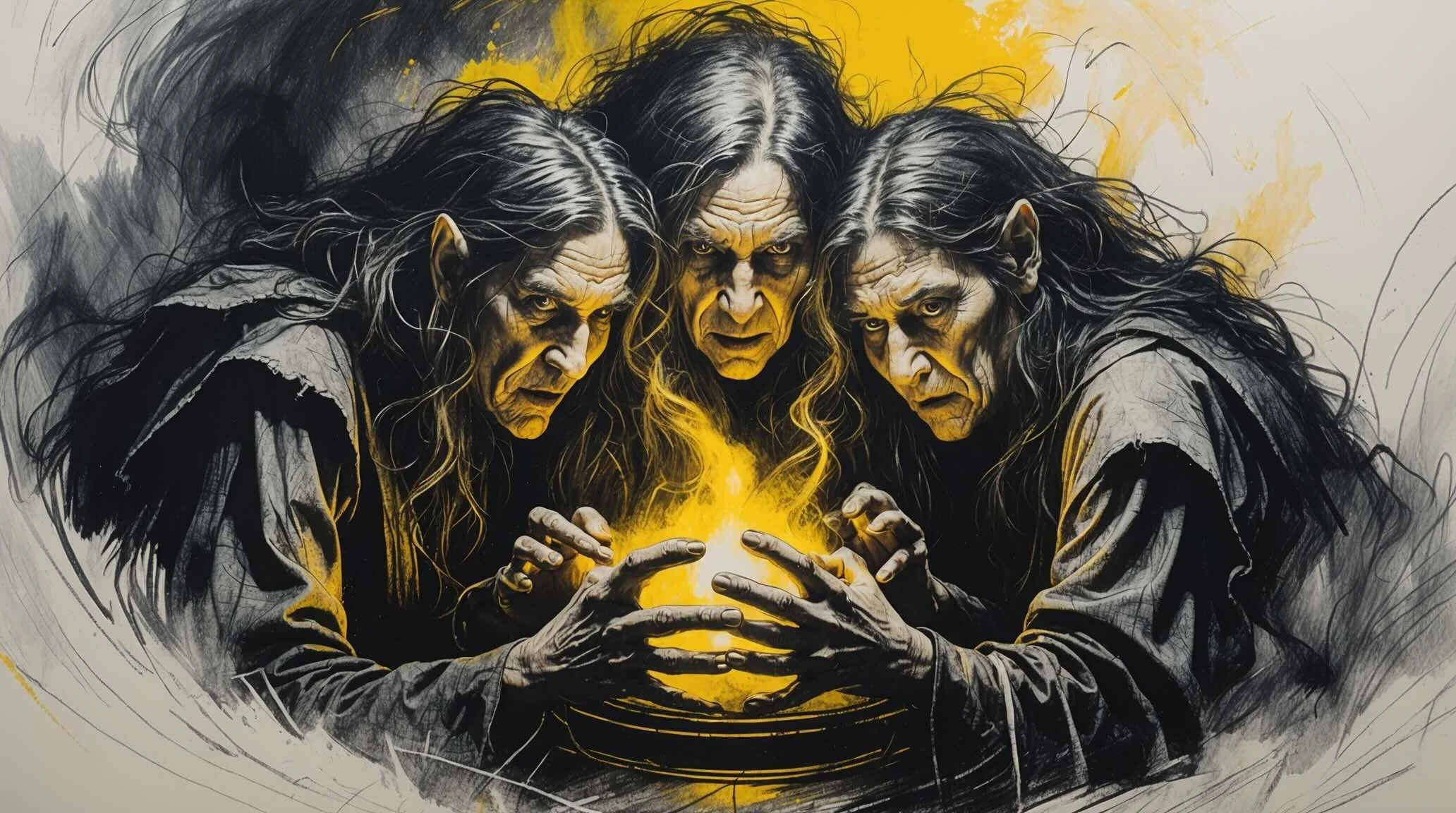
The Witches, or the Weird Sisters, are perhaps the most dangerous figures in the play, defined by their ability to manipulate the truth. They operate in the shadows of paradox, frequently speaking in riddles that blur the line between appearance and reality. By offering statements that seem inherently contradictory, they plant seeds of curiosity and doubt. They are the supreme architects of the supernatural atmosphere that chokes the play.
Original
Lesser than Macbeth, and greater.
Not so happy, yet much happier.
**Shakespeare Retold (Modern Verse)**
You will be lesser than Macbeth, but greater in the end.
You will not be as lucky, but you will be much more blessed.
This interaction with Banquo highlights their mastery of equivocation. While Macbeth is easily swayed by promises of kingship, the Witches also ensure they provoke his paranoia by suggesting a rival, enduring lineage for his closest friend.
Temptation and the Awakening of Ambition
The relationship between the Witches and Macbeth is built on a profound psychological vulnerability. The Witches do not cast a spell to force Macbeth to commit regicide; rather, they act as a catalyst for his preexisting desires. They offer him the destination but remain completely silent on the journey, leaving the bloody execution entirely to him and Lady Macbeth.
Original
All hail, Macbeth, that shalt be king hereafter!
**Shakespeare Retold (Modern Verse)**
All hail, Macbeth, who will be king in the future!
Their absolute certainty preys upon his hidden ambition. The Witches understand that the most effective way to destroy a man like Macbeth is not to fight him, but to give him exactly what he wants.
"The witches are the embodiment of the fear, the guilt, and the darkest desires of the human soul, made manifest on the barren heath."
— L.C. Knights, Some Shakespearean Themes, 1959
Key Quotes by The Witches
Quote 1
When shall we three meet again
In thunder, lightning, or in rain?
**Shakespeare Retold (Modern Verse)**
When will the three of us meet again?
In thunder, lightning, or in the rain?
Quote Analysis: The opening lines of the play immediately associate the Witches with turbulent weather and dark, uncontrollable forces. It establishes that their presence disrupts the natural order, signalling to the audience that the events to follow will be violent and unnatural.
Quote 2
Double, double toil and trouble;
Fire burn, and cauldron bubble.
**Shakespeare Retold (Modern Verse)**
Work hard and let the trouble double;
Let the fire burn and the cauldron boil.
Quote Analysis: This hypnotic, ritualistic chant showcases their malicious intent. The rhythmic intensity and trochaic tetrameter separate them from the human characters, emphasising their sheer delight in brewing chaos and orchestrating the suffering of others.
Quote 3
By the pricking of my thumbs,
Something wicked this way comes.
**Shakespeare Retold (Modern Verse)**
I can feel a tingling in my thumbs,
Which means something wicked is coming this way.
Quote Analysis: Spoken just before Macbeth arrives at their cavern, this line is a brilliant subversion. The Witches, who are the literal embodiment of evil, recognise Macbeth as a fellow "wicked" entity. It illustrates how far Macbeth has fallen; he is no longer a victim of their magic, but a monster in his own right.
Key Takeaways
- Masters of Manipulation: The Witches never command violence; they use the power of suggestion to let human nature destroy itself.
- Thematic Mirror: They introduce and embody the paradox of "Fair is foul," serving as the foundational pillar for the play's exploration of deception and inverted morality.
- Agents of Fate: Their prophecies force the audience to question whether Macbeth's downfall was predetermined by fate or a result of his own free will.
- Subversion of Nature: Everything about them—their beards, their unnatural speech rhythms, their association with violent weather—represents a complete subversion of God's natural order.
Study Questions and Analysis
What is the primary role of the Witches in Macbeth? +
The Witches serve as the catalyst for the tragic events of the play. They introduce the themes of prophecy and the supernatural, sparking Macbeth's ambition and setting him on a path of murder and tyranny. They establish the mood of moral ambiguity that permeates the text.
Do the Witches control Macbeth's actions? +
No, the Witches do not control his actions directly. They operate through suggestion and prophecy, telling him what will happen but not how to achieve it. Macbeth's own ambition and his wife's influence are what drive him to commit regicide; the Witches merely plant the seed.
Why do the Witches speak in a different rhythm to the other characters? +
Shakespeare gives the Witches dialogue in trochaic tetrameter, a metre that sounds rhythmic, chanting, and distinctively unnatural compared to the steady iambic pentameter used by the noble characters. This linguistic choice immediately categorises them as otherworldly and threatening.
What is the significance of the phrase "Fair is foul, and foul is fair"? +
This paradox is the central thematic statement of the play. It suggests that appearances are deceiving: what seems good (fair) is actually evil (foul), and vice versa. It foreshadows the treacherous behaviour of characters who hide their dark intentions behind false smiles.
How does Banquo's reaction to the Witches differ from Macbeth's? +
While Macbeth is rapt and immediately captivated by the prophecies, Banquo remains highly sceptical and cautious. He warns that the "instruments of darkness" often tell half-truths to lead men to their destruction, serving as a vital moral foil to Macbeth's rapid descent into ambition.
What role do the Apparitions play later in the text? +
In Act 4, the Witches conjure three apparitions that offer further prophecies to Macbeth, telling him to beware Macduff, that no man of woman born can harm him, and that he will not be defeated until Birnam Wood moves. These create a false sense of invincibility, which ultimately seals his tragic fate.
Are the Witches real or a psychological projection? +
While Banquo's ability to see them confirms they are physically present within the world of the play, their purpose is heavily psychological. They externalise Macbeth's inner desires and guilt, acting as a dramatic representation of the corrupting power of unchecked ambition.