Twelfth Night: Act 1, Scene 5 – Analysis
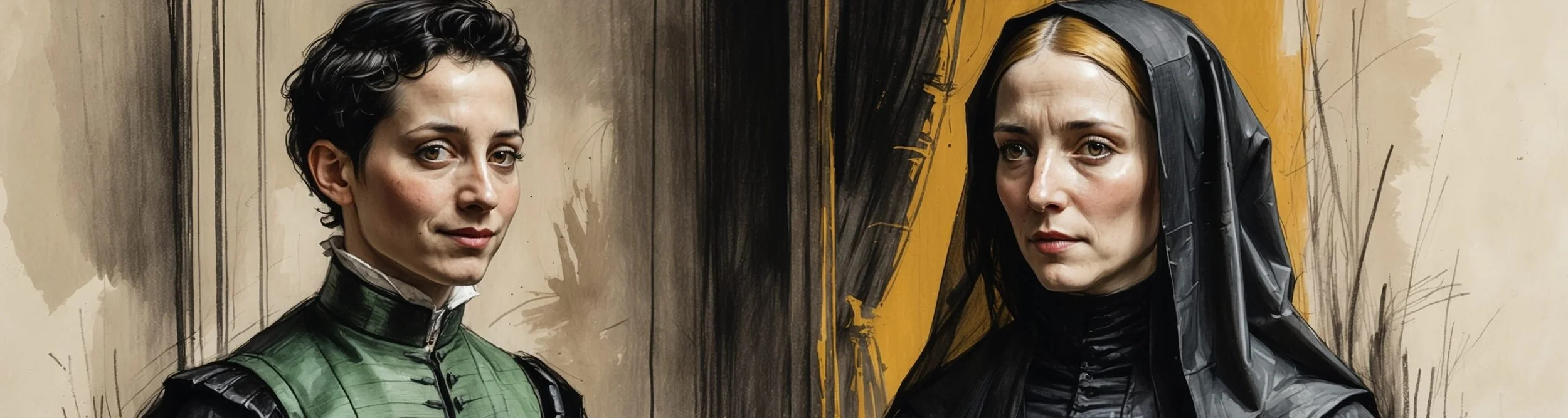
Scene Profile – At a Glance
- Location: Olivia's house in Illyria.
- What Happens: Feste teases Olivia out of her mourning and Malvolio sneers at him. A persistent young messenger arrives from Orsino, and Olivia agrees to see him. This is Cesario – Viola in disguise – who pleads Orsino's love so well that Olivia falls for the messenger instead, and sends a ring after him to lure him back.
- Key Characters: Olivia, Feste, Malvolio and Viola (disguised as Cesario), with Maria and Sir Toby Belch.
- Dramatic Function: The hinge of the plot. It introduces Olivia's household, sets Feste and Malvolio against each other, and triggers the central love-triangle by making Olivia fall for a woman in disguise.
- Famous Quote:
"Make me a willow cabin at your gate,
And call upon my soul within the house..."
(Viola, Act 1, Scene 5) - Why It Matters: The disguise that has been a survival tactic now becomes a romantic trap. Olivia's sudden love for Cesario sets the whole comic muddle in motion and pushes the play's questions about desire and identity to the front.
Scene Summary
The scene opens in Olivia's house, where Maria scolds Feste the clown for being away so long and warns him that Olivia may hang him or turn him out. Feste shrugs off the threat with jokes. When Olivia enters, still in mourning for her dead brother, she orders the fool taken away – but Feste turns the tables, proving her the real fool for grieving a brother whose soul, she says, is in heaven.
Olivia's steward Malvolio refuses to be amused and insults Feste, prompting Olivia to accuse Malvolio of being "sick of self-love". Maria announces a young man at the gate who will not be turned away. After dealing with her drunken kinsman Sir Toby, Olivia agrees to see the visitor and puts on her veil.
The visitor is Cesario – Viola in disguise – sent to woo Olivia on Orsino's behalf. Viola begins with a memorised speech of praise, jokes her way past Olivia's defences, and persuades her to lift the veil. When Olivia coolly says she can never love Orsino, Viola answers with the heartfelt "willow cabin" speech, describing how she herself would court such a lady.
The speech works far too well. Olivia, struck by the messenger rather than the message, asks about Cesario's family and all but admits she is smitten. After Viola leaves, Olivia sends Malvolio running after "him" with a ring she pretends Cesario left behind, an excuse to bring him back. Alone, she realises with alarm that she has fallen in love at first sight, and surrenders herself to fate.
"Take Away the Fool"
The scene begins not with romance but with comedy and grief tangled together. Feste returns from a mysterious absence to find Olivia in deep mourning and in no mood for jokes. When she commands her servants to "take the fool away", Feste cleverly reverses her, turning the proof of folly back onto Olivia herself.
Original
Good madonna, why mournest thou?
(Feste, Act 1, Scene 5)
Shakespeare Retold (Modern Verse)
Madonna, tell me why you are in mourning?
By a few short questions, Feste argues that if Olivia truly believes her brother's soul is in heaven, then mourning him is foolish – so she is the fool, not he. It is a joke, but a serious one. Beneath the wordplay, Feste is gently telling his grieving mistress to stop performing sorrow and rejoin the living, the same lesson the whole comedy will press upon her.
Malvolio and Self-Love
If Feste laughs Olivia towards life, Malvolio scowls at the laughter. Olivia's steward cannot bear the clown and dismisses him as a "barren rascal". Olivia's reply is one of the most important character notes in the play, naming the flaw that will eventually be Malvolio's undoing.
Original
Oh, you are sick of self-love, Malvolio, and taste with a distempered appetite. To be generous, guiltless and of free disposition, is to take those things for bird-bolts that you deem cannon-bullets: there is no slander in an allowed fool, though he do nothing but rail.
(Olivia, Act 1, Scene 5)
Shakespeare Retold (Modern Verse)
You are so vain, Malvolio, you're tainted by poisoned taste. To be more kind and generous, with open mind, just take the things he says as pops to scare the birds, not cannon fire. The words are not offensive from a fool, although he prattles on.
"Sick of self-love" is the diagnosis the whole play will test. Malvolio takes a harmless joke as a deadly insult because his pride is so easily wounded. Olivia sees it clearly here, yet she keeps him on as her trusted steward – and it is exactly this vanity that Maria and Sir Toby will later exploit to humiliate him.
The Messenger at the Gate
The mood shifts when Maria reports a young man who simply will not leave. Malvolio is sent to send him away and comes back baffled, unable to describe quite what the visitor is – not old enough for a man, not young enough for a boy. The audience already knows the answer: this is Viola, a woman dressed as a youth, and Malvolio's confusion is the first sign of how the disguise unsettles everyone who meets it.
Original
Not yet old enough for a man, nor young enough for a boy; as a squash is before 'tis a peascod, or a cooling when 'tis almost an apple: 'tis with him in standing water, between boy and man.
(Malvolio, Act 1, Scene 5)
Shakespeare Retold (Modern Verse)
Not old enough to be a man, nor young enough to be a boy; he's like a pea seed before it is a pod; a pip, no apple. He's like the turning tide, not man nor boy.
Malvolio is trying to place a stranger and cannot. His image of the unripe pea and the "standing water" between boy and man catches Viola's in-between state exactly – and points to the play's larger fascination with people who slip between fixed categories. Curious despite herself, Olivia decides to receive the visitor and calls for her veil.
Viola Woos for Orsino
Sent to plead Orsino's love, Viola begins with a rehearsed speech and a stream of teasing wit, breaking through Olivia's guard until she agrees to lift her veil. But when Olivia flatly refuses Orsino, Viola drops the script and speaks from her own heart, describing the devotion she would offer if the love were hers to give.
Original
Make me a willow cabin at your gate,
And call upon my soul within the house;
Write loyal cantons of contemned love
And sing them loud even in the dead of night...
(Viola, Act 1, Scene 5)
Shakespeare Retold (Modern Verse)
I'd make a wooden cabin at your gate
And there I'd pray that you would want my soul;
I'd write you songs of love between two people
And sing them loud into the dead of night...
This is the moment Viola stops acting. The willow is the tree of forsaken love, and the cabin she imagines building at the gate is an image of patient, hopeless devotion – the very opposite of Orsino's lazy, self-pleasing passion. She is, in effect, telling Olivia how she herself longs to love, and Olivia, hearing real feeling at last, falls not for Orsino but for the voice in front of her.
Olivia Falls in Love
The wooing backfires completely. The moment Viola leaves, Olivia drops her mourning and replays the visit in her mind, astonished at how fast her own heart has turned.
Original
Methinks I feel this youth's perfections
With an invisible and subtle stealth
To creep in at mine eyes. Well, let it be.
(Olivia, Act 1, Scene 5)
Shakespeare Retold (Modern Verse)
I feel like those perfections of that youth
Are subtly, invisibly invading
Into my eyes and mind. Well, let it be.
Olivia, who vowed to grieve a brother for seven years, is undone in a single conversation. She invents an errand – sending a ring after Cesario that he never left – just to draw him back. The woman who would not look at Orsino now cannot stop looking at Orsino's messenger. The comic engine of the play is now fully running: Orsino loves Olivia, Olivia loves "Cesario", and Cesario is a woman who secretly loves Orsino.
Language and Technique
- Prose and verse: The clowning and banter are in everyday prose; the moment real feeling arrives, in Viola's "willow cabin" speech and Olivia's confession, the language lifts into verse.
- Wordplay and proof: Feste argues by mock-logic, "proving" Olivia a fool with a chain of trick questions – comedy used to deliver a serious truth.
- The willow image: The willow is the traditional tree of rejected love, so Viola's "willow cabin" signals devotion that expects no reward.
- Disguise dramatic irony: We know Cesario is a woman, so every word of love carries a double meaning the characters cannot hear.
- Sight imagery: Olivia describes love "creeping in at mine eyes", picturing desire as something caught through looking, sudden and beyond her control.
Key Quotes from Act 1, Scene 5
Quote 1'Tis beauty truly blent, whose red and white
Nature's own sweet and cunning hand laid on:
Lady, you are the cruell'st she alive,
If you will lead these graces to the grave
And leave the world no copy.
(Viola, Act 1, Scene 5)
Shakespeare Retold (Modern Verse)
It is a blended beauty, red and white,
Made by the sweet and cunning hand of nature.
Lady, you are the cruellest person living
If you will take your beauty to the grave
Without leaving a child here of your own.
I see you what you are, you are too proud;
But, if you were the devil, you are fair.
(Viola, Act 1, Scene 5)
Shakespeare Retold (Modern Verse)
I see you as you are, and you're too proud.
But gorgeous, even if you were the devil.
If I did love you in my master's flame,
With such a suffering, such a deadly life,
In your denial I would find no sense;
I would not understand it.
(Viola, Act 1, Scene 5)
Shakespeare Retold (Modern Verse)
If I loved you with all my master's passion,
With so much suffering, like death in life,
Rejecting me would not make any sense.
I would not understand it.
Even so quickly may one catch the plague?
(Olivia, Act 1, Scene 5)
Shakespeare Retold (Modern Verse)
Can someone really fall in love that fast?
Fate, show thy force: ourselves we do not owe;
What is decreed must be, and be this so.
(Olivia, Act 1, Scene 5)
Shakespeare Retold (Modern Verse)
Fate, show your strength! You choose my destiny,
And what you choose for me to be will be.
Key Takeaways
- The plot's hinge: Olivia's love for the disguised Viola launches the play's central love-triangle.
- Feste's serious joke: The clown "proves" Olivia a fool to coax her out of excessive mourning and back into life.
- Malvolio diagnosed: Olivia names her steward as "sick of self-love", the flaw that will lead to his downfall.
- Honesty wins: Viola's plain, heartfelt wooing succeeds where Orsino's flowery devotion always failed.
- Love as accident: Olivia falls at first sight, comparing it to catching the plague, and surrenders herself to fate.
Study Questions and Analysis
How does Feste prove Olivia is the real fool?
Feste uses mock-logic, the comic version of a formal argument. He asks Olivia why she is mourning; she answers that her brother is dead. He then asks where she believes her brother's soul to be, and she says heaven. Feste springs the trap: if her brother is happily in heaven, then weeping for him is foolish, so the true fool is Olivia, not the clown she wanted removed.
The joke is light, but its purpose is serious. Like the licensed fools throughout Shakespeare, Feste is allowed to say what others cannot. Olivia herself defends this freedom when she tells Malvolio there is "no slander in an allowed fool". Behind the wit, Feste is urging his grieving mistress to stop performing sorrow and return to the living world – the lesson the whole comedy will eventually teach her through Cesario.
What does "sick of self-love" tell us about Malvolio?
Olivia's phrase is the play's key to Malvolio's character. He takes Feste's harmless joking as a personal insult because his pride is so thin-skinned that any mockery wounds it. Olivia sees this clearly and tells him that a generous person would treat the fool's words as harmless "bird-bolts", not "cannon-bullets".
The diagnosis sets up everything that follows. Malvolio's self-regard is the lever Maria and Sir Toby will pull when they forge a letter persuading him that Olivia loves him. Many critics read Malvolio as a Puritan-flavoured killjoy, the enemy of the play's festive spirit. C. L. Barber, in his 1959 Shakespeare's Festive Comedy, sees the comedy as a movement towards release and revelry, with Malvolio as the figure of sour restraint who must be expelled before the holiday mood can win. His vanity, named so precisely here, is what makes his later humiliation feel earned rather than merely cruel – though modern productions often let us pity him too.
Why does the "willow cabin" speech work so well on Olivia?
Up to this point Viola has been performing – reciting a memorised speech, sparring with Olivia, doing her job as Orsino's messenger. The willow cabin speech is different because it is the first thing she says that is genuinely felt. She imagines building a cabin of willow, the tree of forsaken love, at her beloved's gate and calling out her name until the hills echo it. It is a picture of devotion that asks for nothing back.
What makes it land is that the feeling is real, even if Olivia mistakes its source. Viola is really describing how she longs to love – arguably how she already loves Orsino – and that authenticity cuts straight through Olivia's defences. The contrast with Orsino is the point: his love is grand, lazy and self-admiring, while Viola's imagined love is active, humble and tireless. Olivia has refused every polished suitor; the moment she hears something true, she is lost.
How does the scene use dramatic irony?
The whole encounter between Viola and Olivia runs on dramatic irony, where the audience knows something the characters do not. We know Cesario is Viola, a woman in disguise, so every exchange carries a meaning the two women cannot fully share. When Viola praises Olivia's beauty or speaks of how she would woo her, we hear a layered truth: a real attraction, a borrowed errand and a hidden identity all at once.
The irony deepens when Olivia falls in love. She believes she is responding to a young man, but the warmth she senses is a woman's. Shakespeare lets the comedy and the unease sit together – the situation is funny, but it also raises real questions about how much of desire is drawn to the person and how much to the surface they present. The disguise that protects Viola has now created a tangle no one on stage can see the shape of.
How does Viola's wooing differ from Orsino's love?
The two are near-opposites, and the scene is built to make us notice. Orsino, in the opening scene, loves from a distance, feeding on his own emotion and never actually going to Olivia himself. Viola, standing in front of Olivia, is plain-spoken to the point of bluntness, telling her she is "too proud" even as she admits she is beautiful. Where Orsino offers worship, Viola offers honesty.
That honesty is what undoes Olivia. She has clearly had her fill of courtly flattery and refuses it on principle, dismissing Orsino's praise and asking the messenger to "cut to the bits that matter". When real feeling finally breaks through in the willow cabin speech, it is irresistible precisely because it is unforced. The scene quietly argues that genuine love speaks differently from performed love – and that Viola, even in disguise, is the truer lover of the two.
Why does Olivia send the ring after Cesario?
The ring is a pretext. Cesario never left a ring; Olivia invents one so that she has an excuse to send Malvolio chasing after him and, more importantly, a reason for him to come back. By pretending to return an unwanted gift, she can disguise her own pursuit as mere courtesy and protect her pride.
The move tells us a great deal about Olivia. The woman who began the scene refusing all suitors is now the one doing the chasing, and doing it with a small, transparent deception. It is also a neat reversal of the play's gender expectations: it is Olivia, the noblewoman, who takes the romantic initiative, pursuing a "man" who is really a woman. Her closing admission that she does not "owe", or own, herself shows she knows she has lost control and has decided to let it happen.
What role does disguise play in this scene?
Disguise is the engine of the whole encounter. Viola's male costume, first adopted as a way to survive alone in a strange country, here becomes the thing that makes Olivia fall in love with her. The freedom the disguise grants is crucial: as Cesario, Viola can speak to Olivia frankly, without the deference a male suitor would owe a countess, and that equality is part of the attraction.
The scene also shows disguise unsettling the people around it. Malvolio cannot say whether the visitor is man or boy, describing someone caught "between boy and man". This confusion is comic, but it points to the play's deeper interest in identity as something unstable and performed. Stephen Greenblatt, in his 1988 Shakespearean Negotiations, draws attention to how Shakespearean comedy plays with the fluidity of gender on a stage where boys already played women. Viola's disguise turns that theatrical fact into the heart of the plot: love here attaches itself to a surface, and the surface is a fiction.
How does this scene set up the rest of the play?
Almost every later thread starts here. The love-triangle is now in place: Orsino loves Olivia, Olivia loves Cesario, and Cesario is Viola, who loves Orsino. This impossible knot can only be untied when Viola's identical twin, Sebastian, arrives to take the place she cannot fill – so Olivia's sudden love for Cesario is the seed of the play's resolution as well as its confusion.
The Malvolio plot is seeded too. Olivia's public naming of his "self-love", and her continued trust in him despite it, give Maria and Sir Toby both the motive and the opening for their later trick. By the end of Act 1, Scene 5 the play has set two engines running at once – the romantic muddle and the comic revenge on Malvolio – and both will drive the action through to the final unmasking.