Twelfth Night: Act 2, Scene 5 – Analysis
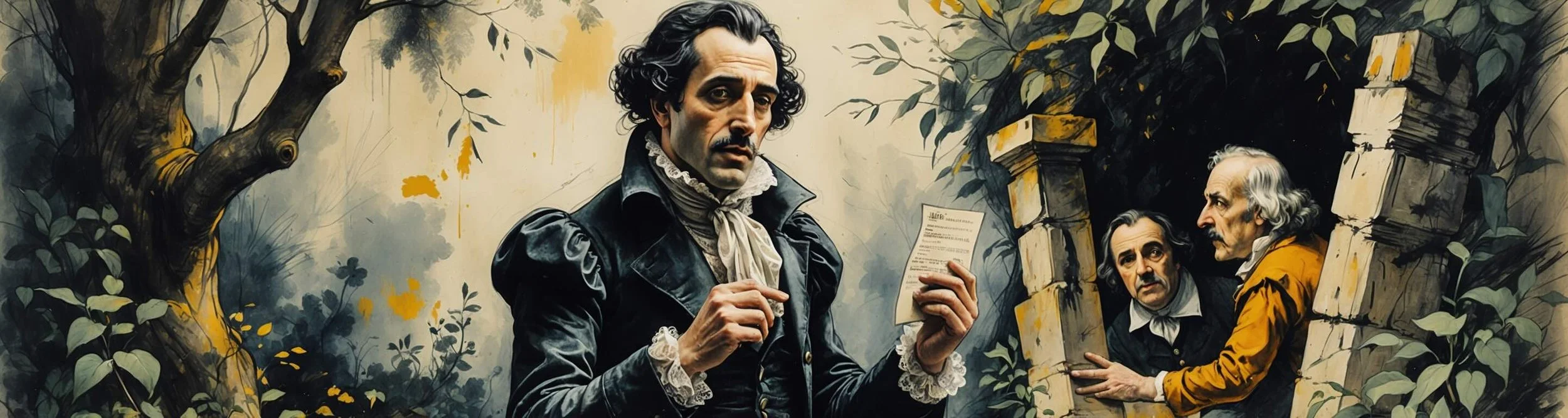
Scene Profile – At a Glance
- Location: The garden at Olivia's house, with a box-tree hedge to hide behind.
- What Happens: Maria plants a forged love-letter for Malvolio to find. Hidden behind the hedge, Sir Toby, Sir Andrew and Fabian watch as Malvolio convinces himself Olivia loves him and resolves to wear yellow stockings, cross-gartered.
- Key Characters: Malvolio, Maria, Sir Toby Belch, Sir Andrew Aguecheek and Fabian.
- Dramatic Function: The play's great comic trap. It turns the gulling of Malvolio into the engine of the sub-plot and sets up his humiliation before Olivia in the scenes to come.
- Famous Quote:
"Be not afraid of greatness: some are born great, some achieve greatness, and some have greatness thrust upon 'em."
(Malvolio, reading, Act 2, Scene 5) - Why It Matters: It is the comedy's most famous scene, exposing Malvolio's vanity and class ambition. His self-deception drives the cruel practical joke that gives the play much of its laughter and its later unease.
Scene Summary
In the garden, Sir Toby Belch, Sir Andrew Aguecheek and Fabian gather to enjoy a piece of sport at Malvolio's expense. Fabian is keen to see the steward shamed, since Malvolio once got him into trouble with Olivia. Maria arrives and tells the three men to hide behind the box-tree hedge. She drops a letter in Malvolio's path and slips away, promising it will make a fool of him.
Malvolio enters, already daydreaming aloud. He imagines that Maria once hinted Olivia favours him, and lets himself picture life as "Count Malvolio", married to his mistress and lording it over Sir Toby. The hidden watchers fume and itch to attack him, but Fabian keeps urging silence so the joke can play out.
Malvolio finds the letter and recognises what he takes to be Olivia's handwriting. He reads a teasing verse and a riddle – "M, O, A, I, doth sway my life" – and twists the letters until they seem to spell his own name. The prose that follows flatters him outright: he is told not to fear greatness, to be rude to Sir Toby, and to appear in yellow stockings, cross-gartered, smiling always.
Completely taken in, Malvolio vows to do everything the letter asks. He exits glowing with new pride. Maria returns to a hero's welcome from Sir Toby, who declares he could marry her for the jest, and she leads the delighted men off to watch Malvolio make his first appearance before Olivia.
"Here Comes the Trout"
The scene opens as a hunt. Maria has prepared the bait and posts her watchers like beaters at a covert, and her language treats Malvolio as a fish to be landed rather than a man to be tricked. The comedy is built on the gap between his dignity and the trap closing around him, and we are invited from the first line to enjoy his fall.
Original
for here comes the trout that must be caught with tickling.
(Maria, Act 2, Scene 5)
Shakespeare Retold (Modern Verse)
because here comes the fish we'll catch through mockery.
Maria's image of "tickling" a trout – stroking it gently until it can be grabbed by hand – is exactly her method. She does not force the letter on Malvolio; she lets his own vanity do the work. The cruelty of the joke is softened, for now, by how willingly the victim swims into the net.
Malvolio's Daydream
Before he even sees the letter, Malvolio is already lost in fantasy. He has half-convinced himself that Olivia favours him, and his imagination races ahead to marriage, a title and power over the household. This is the heart of the comedy: the letter does not deceive a sensible man, it confirms what an ambitious one already longs to believe.
Original
'Tis but fortune; all is fortune. Maria once told me she did affect me: and I have heard herself come thus near, that, should she fancy, it should be one of my complexion. Besides, she uses me with a more exalted respect than any one else that follows her.
(Malvolio, Act 2, Scene 5)
Shakespeare Retold (Modern Verse)
It is just luck, sheer luck. Maria told me that once she liked me; I have heard her say that if she fell in love, it would be with someone who looks like me. And she thinks of me with greater admiration than all others.
The speech is prose, not poetry, and that is part of the joke: Malvolio's grand ambitions come out in the plain, self-justifying voice of a careful steward. He builds a whole future on a half-remembered remark, reasoning step by step toward the conclusion he wants. Vanity here looks less like passion than like accountancy, and it is funnier for it.
"To Be Count Malvolio"
The fantasy then turns openly to status. Malvolio rehearses a scene in which he is master of the house, summoning his servants and putting Sir Toby firmly in his place. The hidden Toby, listening to himself being patronised, can barely keep quiet – which only sharpens the comedy of class turned upside down.
Original
To be Count Malvolio!
(Malvolio, Act 2, Scene 5)
Shakespeare Retold (Modern Verse)
Imagine this: I'm Count Malvolio.
Four words carry the whole of Malvolio's ambition. He does not dream of loving Olivia so much as of becoming a count through her, of the title and the authority it would bring. The watchers' outrage is partly snobbery of their own – a steward should know his place – but Shakespeare lets us feel both the absurdity of the dream and the rigid social order that makes it absurd.
The Riddle and the Letter
When Malvolio finally reads the letter, the trap springs. A verse riddle dares him to decode it, and he labours over the letters "M, O, A, I" until he can bend them to fit his own name. The harder the puzzle resists, the more determined he is to solve it in his own favour.
Original
I may command where I adore;
But silence, like a Lucrece knife,
With bloodless stroke my heart doth gore:
M, O, A, I, doth sway my life.
(Malvolio, reading, Act 2, Scene 5)
Shakespeare Retold (Modern Verse)
I may command who I adore
But must stay silent, like a knife
that's murdered one like me before;
M.O.A.I. doth sway my life.
The riddle is deliberately nonsense – Fabian calls it "a fustian riddle" – yet Malvolio treats it as a code written for him alone. The letters do not spell his name, and he knows it, but he forces them to "bow" to him because every one is somewhere in "Malvolio". It is a perfect picture of self-deception: the evidence does not fit, so he reshapes the evidence.
Language and Technique
- Hunting and fishing imagery: Maria's "trout", the "woodcock near the gin" and the "staniel" turn Malvolio into prey, so we watch the joke as a hunt closing in.
- Prose for the steward: Malvolio thinks in careful, self-justifying prose, not verse – the plain rhythm of a man reasoning himself into folly.
- Dramatic irony: We and the hidden watchers know the letter is forged; Malvolio does not. Every line he believes is funnier because we see the trap.
- Aside and interruption: Sir Toby, Sir Andrew and Fabian comment from the hedge, puncturing Malvolio's grand speeches with insults the audience shares.
- The riddle: The "M, O, A, I" puzzle is nonsense dressed as meaning, showing how easily a vain man reads himself into any sign.
- Clothing as folly: Yellow stockings and cross-gartering – styles Olivia hates – become the costume of Malvolio's self-delusion.
Key Quotes from Act 2, Scene 5
Quote 1be not afraid of greatness: some are born great, some achieve greatness, and some have greatness thrust upon 'em.
(Malvolio, reading, Act 2, Scene 5)
Shakespeare Retold (Modern Verse)
do not fear greatness. Some are born great, some achieve greatness, and some have greatness thrust upon them.
To be Count Malvolio!
(Malvolio, Act 2, Scene 5)
Shakespeare Retold (Modern Verse)
Imagine this: I'm Count Malvolio.
I may command where I adore;
But silence, like a Lucrece knife,
With bloodless stroke my heart doth gore:
M, O, A, I, doth sway my life.
(Malvolio, reading, Act 2, Scene 5)
Shakespeare Retold (Modern Verse)
I may command who I adore
But must stay silent, like a knife
that's murdered one like me before;
M.O.A.I. doth sway my life.
this is open. I will be proud, I will read politic authors,
I will baffle Sir Toby, I will wash off gross acquaintance,
I will be point-devise the very man.
(Malvolio, Act 2, Scene 5)
Shakespeare Retold (Modern Verse)
This is so clear. I will be proud; well read;
I'll mystify Sir Toby; dump poor friends;
and I will be the perfect gentleman.
I could marry this wench for this device.
(Sir Toby Belch, Act 2, Scene 5)
Shakespeare Retold (Modern Verse)
I'd wed the woman who devised this plan.
Key Takeaways
- The great comic trap: Maria's forged letter is the play's central practical joke, and this scene is where it works.
- Self-deception: The letter does not fool a wise man – it confirms what a vain, ambitious one already wants to believe.
- Class and ambition: Malvolio dreams of becoming "Count Malvolio", and the household's outrage shows how fixed the social order is.
- Dramatic irony: We and the hidden watchers know the truth, so every line Malvolio believes is funnier.
- Maria's wit: Maria is the clever author of the scheme, and Sir Toby's praise sets up their later marriage.
Study Questions and Analysis
Why is the gulling of Malvolio so funny on stage?
The scene is built for laughter because it puts three layers of awareness on the stage at once. The audience knows the letter is a forgery; the hidden watchers know it too and keep up a running commentary; and Malvolio knows nothing, taking every flattering word as gospel. This dramatic irony means almost every line lands twice – once as Malvolio's earnest hope, once as the watchers' mockery.
The staging adds to the comedy. Sir Toby, Sir Andrew and Fabian crouch behind the box-tree, popping up to insult Malvolio and being shushed by Fabian so the joke can continue. Malvolio's slow, self-satisfied reasoning – twisting "M, O, A, I" until it suits him – gives the actor room to be pompous, delighted and utterly blind all at once. C. L. Barber, in his 1959 Shakespeare's Festive Comedy, sees the play's holiday spirit in exactly this kind of release, where the killjoy is exposed and the household's appetite for fun is let loose at his expense.
What does the scene reveal about Malvolio's character?
It exposes Malvolio as a man eaten by vanity and ambition. Even before he finds the letter he is daydreaming of being "Count Malvolio", married to Olivia and giving orders to his betters. His self-love is so complete that the forgery barely has to work; he supplies most of the flattery himself, reasoning his way toward the conclusion he already craves.
The deeper interest is in his desire to rise. Malvolio is a steward, a senior servant, and his dream of marrying his mistress crosses a hard social line. Some readers find his punishment richly deserved, the comeuppance of a self-important killjoy. Others, following critics such as C. L. Barber, note that the very thing being mocked – the wish to better oneself – can look less like a crime than a misfortune, especially once the joke turns dark in the later scenes. The scene is funniest if we feel both the absurdity of his vanity and the rigidity of the world that makes his hope ridiculous.
How does Maria's letter manipulate Malvolio so successfully?
Maria's forgery is a small masterpiece of psychology. She does not simply declare love; she creates a puzzle that flatters Malvolio into doing the work himself. The riddle "M, O, A, I, doth sway my life" invites him to find his own name in it, so that the discovery feels like his own clever insight rather than a planted suggestion. People believe most firmly what they think they have worked out for themselves.
The letter then mixes general truth with personal bait. The line about greatness – "some are born great, some achieve greatness, and some have greatness thrust upon 'em" – sounds like genuine wisdom, which makes the flattery that surrounds it feel trustworthy. Maria also knows her target's tastes and vanities, instructing him to wear yellow stockings and cross-gartering precisely because they suit his self-image, even though Olivia detests them. The trap works because it is tailored to one man's weaknesses.
What is the significance of the "M, O, A, I" riddle?
The riddle is the hinge of the whole deception. On the surface it pretends to be the coded confession of a secret admirer; in fact it is a piece of cheerful nonsense designed to keep Malvolio guessing. Fabian dismisses it as "a fustian riddle", and the letters plainly do not spell Malvolio's name. The comedy comes from watching him refuse to accept that.
Malvolio admits there is "no consonancy in the sequel" – the letters do not line up – and then talks himself round anyway, because "every one of these letters are in my name". This is the scene's central insight into self-deception: faced with evidence that does not fit, he simply lowers his standard of proof until it does. The riddle works not because it is clever but because Malvolio is desperate to be its answer, and that desperation is what Maria has counted on all along.
Why does Malvolio agree to wear yellow stockings and cross-gartering?
The letter instructs him to remember that Olivia "commended thy yellow stockings" and "wished to see thee ever cross-gartered", and Malvolio takes this as proof of her secret love. He resolves to appear in this outfit at once, certain it will please her. The dramatic irony is sharp: Maria tells the watchers that yellow is "a colour she abhors" and cross-gartering "a fashion she detests".
His eagerness shows how far the flattery has carried him. He is willing to dress in a way he would normally think beneath his dignity, simply because he believes it is what his mistress wants. The costume becomes the visible sign of his self-delusion, and it guarantees that his coming appearance before Olivia will be a disaster. By making him choose the very things she hates, Maria ensures that Malvolio will humiliate himself in front of the one person he is trying to impress.
How does this scene set up the rest of the play?
The box-tree scene launches the sub-plot that runs to the end of the comedy. Everything that follows for Malvolio – his absurd appearance before Olivia, his imprisonment as a madman, his final furious exit – flows directly from the trap sprung here. It also cements the alliance of Sir Toby, Sir Andrew, Fabian and Maria as the play's company of mischief-makers.
It deepens the play's interest in self-deception and disguise, themes that run through the main plot as well. Where Viola's disguise is a survival strategy that leads toward love, Malvolio's transformation is a delusion that leads toward disgrace. The scene also quietly seeds the Maria and Sir Toby match, since Toby's delight in her wit here ripens into marriage by the close. As pure entertainment and as a study of vanity, it is the comic centre around which much of the later action turns.